

Managing legal exposure and safeguarding investment value across complex infrastructure and construction projects in Dubai and the UAE.
Dubai’s infrastructure expansion is no longer limited to isolated real estate developments or individual transport projects. It is part of a broader transformation of the emirate’s urban, financial, logistics, residential, and climate-resilience infrastructure. For foreign developers, contractors, institutional investors, family offices, and project sponsors, this creates significant opportunity. It also creates legal complexity.
Large-scale infrastructure and construction projects are not driven only by design, capital, and delivery. They depend on legal architecture. The contracts, approvals, governance structures, payment mechanisms, insurance arrangements, dispute clauses, and liability frameworks behind a project often determine whether that project can withstand delay, cost escalation, contractor failure, regulatory friction, financing pressure, and post-completion defects.
This is especially relevant in Dubai, where infrastructure growth is connected to long-term population expansion, foreign direct investment, financial sector growth, tourism, logistics, real estate demand, and climate adaptation. Projects such as the Dubai Metro Blue Line, the Tasreef rainwater drainage system, and major financial district expansion plans show that infrastructure is becoming a central pillar of Dubai’s next stage of development.
For international market participants, the key question is not simply whether Dubai offers attractive infrastructure opportunities. It does. The more important question is how those opportunities should be legally structured before capital, contractors, consultants, lenders, and public authority obligations become locked into the project.
In major infrastructure and construction projects, legal risk should not be treated as a problem to address only when a dispute emerges. It should be managed from the earliest stage of the transaction.
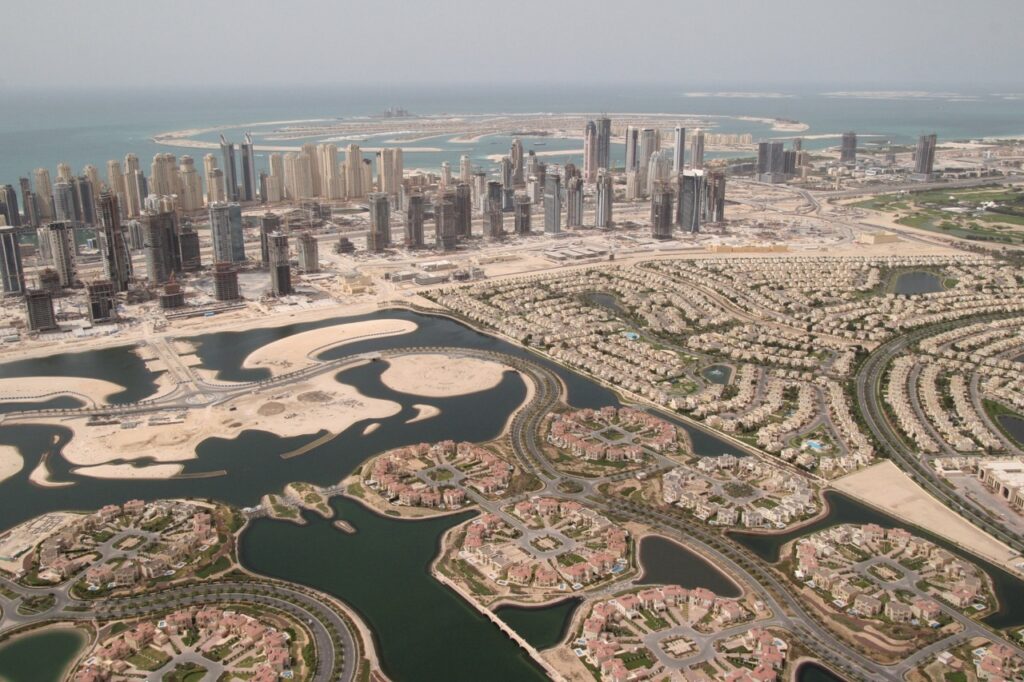
Why Dubai Infrastructure Is Attracting Foreign Capital
Dubai continues to attract foreign developers, contractors, and institutional investors because its infrastructure growth is linked to a wider economic strategy. The emirate is expanding transport networks, commercial districts, residential communities, logistics corridors, drainage systems, aviation capacity, financial infrastructure, and mixed-use developments designed to support long-term business and population growth.
This matters because infrastructure investment is not only about construction. It is about future economic capacity. Transport projects improve mobility and access to new districts. Drainage projects strengthen climate resilience. Financial district expansion supports corporate relocation, asset management, private capital, and professional services. Logistics and aviation infrastructure reinforce Dubai’s role as a regional and international trade hub.
For foreign investors, this makes Dubai attractive because infrastructure assets and related developments sit at the intersection of multiple long-term demand drivers. Real estate demand, corporate relocation, tourism, financial services, logistics, and government-backed urban planning all reinforce the market.
However, the same factors that make Dubai attractive also make projects more legally complex. An infrastructure project may involve public authorities, private developers, lenders, main contractors, subcontractors, consultants, designers, insurers, off-takers, buyers, tenants, operators, and foreign shareholders. Each participant has a different risk profile. Each contract must fit into the broader project structure.
This is why legal risk management is fundamental. A project can be commercially attractive and still legally fragile if its contracts, approvals, financing, liability allocation, and dispute mechanisms are poorly designed.
Infrastructure Projects Are Not Ordinary Real Estate Transactions
One of the common mistakes foreign participants make is treating infrastructure and major construction projects as if they were ordinary real estate transactions.
A standard property acquisition may focus heavily on title, price, due diligence, transfer, financing, and completion. Infrastructure projects require a much wider legal and commercial analysis. They often involve staged delivery, complex contractor obligations, regulatory approvals, public utility interfaces, engineering risk, environmental considerations, long-term maintenance issues, performance security, payment mechanisms, delay exposure, variation claims, and post-completion liability.
The difference is not only scale. It is complexity.
In an infrastructure project, risk moves through the entire lifecycle. It begins with land rights, planning approvals, licensing, procurement strategy, and tender documentation. It then moves into contract negotiation, design responsibility, construction performance, financing, insurance, delay management, handover, defects, operation, and potential disputes.
If the early legal structure is weak, later problems become harder to control. A vague scope of work can become a variation dispute. A poorly drafted delay clause can become a damages claim. A weak payment mechanism can damage contractor cash flow. A badly structured arbitration clause can create enforcement difficulties. Unclear design responsibility can become a major defects issue after completion.
For this reason, foreign developers, contractors, and institutional investors should treat legal structuring as part of project design, not as a secondary administrative step.
Contract Structuring: Where Most Project Risk Begins
In major Dubai infrastructure and construction projects, the contract is not an administrative document. It is the operating system of the project.
The contract determines who carries design risk, who is responsible for delays, how variations are approved, when payments become due, what happens if approvals are delayed, how defects are handled, when termination is permitted, how bonds may be called, and where disputes will be resolved.
Many UAE construction projects use FIDIC-based contracts, modified FIDIC forms, or bespoke agreements influenced by international construction practice. While these structures can provide a useful framework, the commercial outcome depends heavily on how the contract is adapted to the project, the parties, the site conditions, the financing model, and the regulatory environment.
Foreign contractors and developers should avoid assuming that a familiar international contract form automatically protects them. Standard forms are often amended. Risk may be shifted through special conditions, technical schedules, payment provisions, performance security requirements, notice clauses, and dispute resolution mechanisms.
Key issues often arise around scope definition. If the employer’s requirements are unclear, the contractor may later argue that additional works constitute variations. If the contractor’s obligations are too broad, it may absorb risks it did not price properly. If design responsibility is split between multiple parties, defects and delay claims may become difficult to allocate.
Payment structures also require careful attention. Infrastructure and construction projects are cash-flow sensitive. Milestone payments, certification procedures, retention, advance payment guarantees, performance bonds, and suspension rights must be clearly understood. A contractor that cannot secure timely payment may struggle to maintain progress. A developer that cannot enforce performance obligations may face delivery failure or financing pressure.
Variation mechanisms are another common source of disputes. In fast-moving projects, changes are often inevitable. The legal question is whether the contract provides a clear process for instructing, pricing, approving, and recording those changes. If the process is weak, commercial disagreement can quickly become formal claims.
Delay provisions must also be carefully drafted. Extension-of-time claims, liquidated damages, concurrent delay, employer-caused delay, authority-related delay, and supply chain disruption should not be left to vague wording. The contract should establish notice requirements, evidentiary standards, claim timelines, and consequences for failure to comply.
For foreign parties entering Dubai infrastructure projects, contract structuring is often the first and most important layer of legal risk management.
Developer Risk: Approvals, Financing, Delivery, and Liability
Developers operating in Dubai face a distinct risk profile. Their exposure is not limited to acquiring land, appointing contractors, and delivering a finished asset. They must manage the legal relationship between financing, approvals, design, construction, contractors, consultants, buyers, tenants, regulators, and long-term asset performance.
One of the first risks is regulatory alignment. Developers must ensure that the project’s legal structure matches the required approvals, land use, licensing, planning requirements, environmental obligations, and authority interfaces. A delay in approvals can affect financing, contractor timelines, buyer commitments, and delivery obligations.
Tender documentation is another critical area. If the tender package is incomplete or unclear, the developer may receive contractor pricing that does not fully reflect the real scope of the project. That can lead to variation claims, disputes over design responsibility, and cost escalation during delivery.
Contractor selection is also a legal risk issue, not only a commercial one. Developers must evaluate contractor capacity, licensing, financial strength, past performance, insurance, subcontracting strategy, and ability to comply with project documentation requirements. A contractor’s failure can expose the developer to delay, replacement costs, disputes with buyers or tenants, and financing stress.
Financing adds another layer of risk. Lenders and institutional partners may require completion milestones, reporting obligations, security packages, step-in rights, insurance protections, and project governance controls. These requirements must be aligned with construction contracts and development timelines. If the financing structure and construction contracts do not speak to each other, the project may become exposed during delay or default scenarios.
Developers must also consider post-completion liability. Defects, structural issues, consultant errors, incomplete handover documentation, and maintenance responsibilities can create long-tail exposure. In the UAE, decennial liability is especially important because contractors and supervising professionals may face statutory liability for certain structural defects or collapse for a ten-year period.
For developers, legal risk management should therefore begin before construction starts. It should shape procurement, contracting, financing, governance, delivery, handover, and post-completion obligations.
Contractor Risk: Payment, Variations, Delay, and Claims
Contractors entering Dubai infrastructure and construction projects face a different set of risks. Their main exposure often sits around payment, variations, delay, documentation, supply chain performance, bonds, and claims management.
Cash flow is one of the most important practical risks. Contractors may face high upfront mobilization costs, procurement commitments, labour costs, subcontractor payments, equipment costs, and material price exposure. If payment milestones, certification procedures, or employer approval processes are unclear, the contractor’s financial position can deteriorate quickly.
Variation claims are another major area of exposure. Infrastructure projects often evolve during delivery due to site conditions, authority requirements, design changes, employer instructions, or coordination issues with other contractors. Contractors must ensure that variation procedures are followed precisely. Informal instructions, undocumented changes, or late notices can weaken legitimate claims.
Delay risk is equally important. Contractors may face delay caused by late site access, late approvals, design changes, supply chain disruption, subcontractor failure, employer instructions, adverse conditions, or force majeure events. The contract should clearly define notice obligations, extension-of-time procedures, delay damages, and evidentiary requirements.
Documentation discipline is often the difference between a recoverable claim and an unsupported complaint. Contractors should maintain detailed records of instructions, site conditions, correspondence, progress reports, manpower, materials, procurement delays, inspection records, and cost impact. In construction disputes, records often decide outcomes.
Performance bonds and advance payment guarantees also require careful review. Contractors should understand when bonds may be called, whether calls can be challenged, what events constitute default, and how termination provisions interact with security instruments.
Subcontracting creates another layer of risk. Back-to-back clauses may not always operate as contractors expect, especially if the main contract and subcontract are not carefully aligned. A contractor may face claims from subcontractors even when recovery from the employer is delayed or disputed.
For contractors, the legal priority is not only to sign a commercially acceptable contract. It is to create a claims-resilient operating framework that protects payment, records variations, manages delay, and preserves rights throughout delivery.
Institutional Investor Risk: Due Diligence Before Capital Deployment
Institutional investors and family offices entering Dubai infrastructure, real estate development, or project-backed investment opportunities should approach legal risk differently from developers and contractors.
Their primary exposure is capital risk. They need to know whether the project is legally sound, commercially deliverable, properly approved, adequately financed, and protected against foreseeable disputes.
Due diligence should begin with the legal status of the project. Investors should examine land rights, ownership structure, development rights, title restrictions, regulatory approvals, licensing, planning status, authority correspondence, and any conditions attached to project approvals.
The developer’s track record is also important, but it should not be assessed only through marketing materials. Investors should review prior delivery history, disputes, financing arrangements, contractor relationships, governance standards, insurance, and ability to manage complex projects.
Construction contract review is essential. Investors should understand who carries design risk, who is responsible for delay, what remedies exist for non-performance, whether liquidated damages are enforceable and commercially meaningful, whether performance security is adequate, and how disputes will be handled.
Project finance documents should also be aligned with construction risk. If funding depends on milestones, presales, leasing, government approvals, or refinancing, investors need to understand how delays may affect the investment structure.
Insurance and liability coverage require close attention. Investors should review construction all-risk insurance, professional indemnity coverage, decennial liability exposure, third-party liability, delay-related coverage, and any exclusions that may affect recovery.
Exit rights and governance should also be addressed before capital is deployed. Investors should understand how they can exit, what consent rights they hold, what reporting obligations exist, what happens if cost overruns occur, and how disputes between shareholders or project sponsors will be resolved.
For institutional investors, legal due diligence is not a box-checking process. It is a way to test whether the project can survive real-world pressure.
| Stakeholder | Key Risks |
| Developer | Approvals, financing, liability |
| Contractor | Payment, delays, variations |
| Investor | Due diligence, governance |
| Consultant | Design responsibility |
| Lender | Project completion |
Decennial Liability and Defects Risk in UAE Construction
Decennial liability is one of the most important legal concepts in UAE construction and infrastructure projects.
Under UAE law, contractors and supervising architects or engineers may be jointly liable for a period of ten years for certain serious defects, including total or partial collapse and structural defects affecting the stability or safety of the building. This liability is statutory and cannot be treated as a normal contractual warranty that parties can simply ignore.
For developers, decennial liability is important because it affects long-term asset protection, buyer confidence, investor expectations, insurance planning, and post-completion risk. A project may be delivered and handed over, but liability issues may still arise years later if structural defects emerge.
For contractors and consultants, decennial liability requires careful attention to design responsibility, supervision obligations, technical documentation, insurance coverage, subcontractor management, and handover records. The risk is not only financial. It can affect reputation, future tenders, and dispute exposure.
For investors, decennial liability should be part of legal due diligence. They should understand who designed the project, who supervised the works, who constructed the asset, what insurance exists, whether warranties are transferable, and how defects claims would be pursued.
Defects risk should not be addressed only at handover. It should be considered during contract negotiation, design review, consultant appointment, construction monitoring, insurance procurement, and completion documentation. In high-value infrastructure and real estate assets, the post-completion phase is not legally passive. It is part of the risk lifecycle.
Force Majeure, Climate, and Supply Chain Risk
Recent years have made clear that construction projects must be structured for disruption. Extreme weather, supply chain delays, geopolitical instability, material price volatility, labour constraints, shipping disruption, and regulatory changes can all affect project timelines and costs.
Dubai’s major investment in rainwater drainage capacity following severe rainfall events shows that climate resilience is becoming part of infrastructure planning. For contractors, developers, and investors, this should also influence contract drafting and risk allocation.
Force majeure clauses should be carefully reviewed. Parties should understand what events are covered, what notice requirements apply, what relief is available, whether time extensions are granted, whether cost recovery is permitted, and what happens if disruption continues for an extended period.
Change-in-law clauses are also important, particularly for infrastructure, environmental, transport, energy, and regulated projects. If new laws, authority requirements, or regulatory approvals affect project scope or cost, the contract should explain how that risk is allocated.
Supply chain risk should be addressed through procurement planning, price adjustment mechanisms, alternative supplier rights, long-lead item management, and clear responsibility for import delays or material shortages.
The purpose is not to eliminate all risk. That is impossible. The purpose is to identify foreseeable categories of disruption and allocate them clearly before they become disputes.
Dispute Resolution and Arbitration Strategy
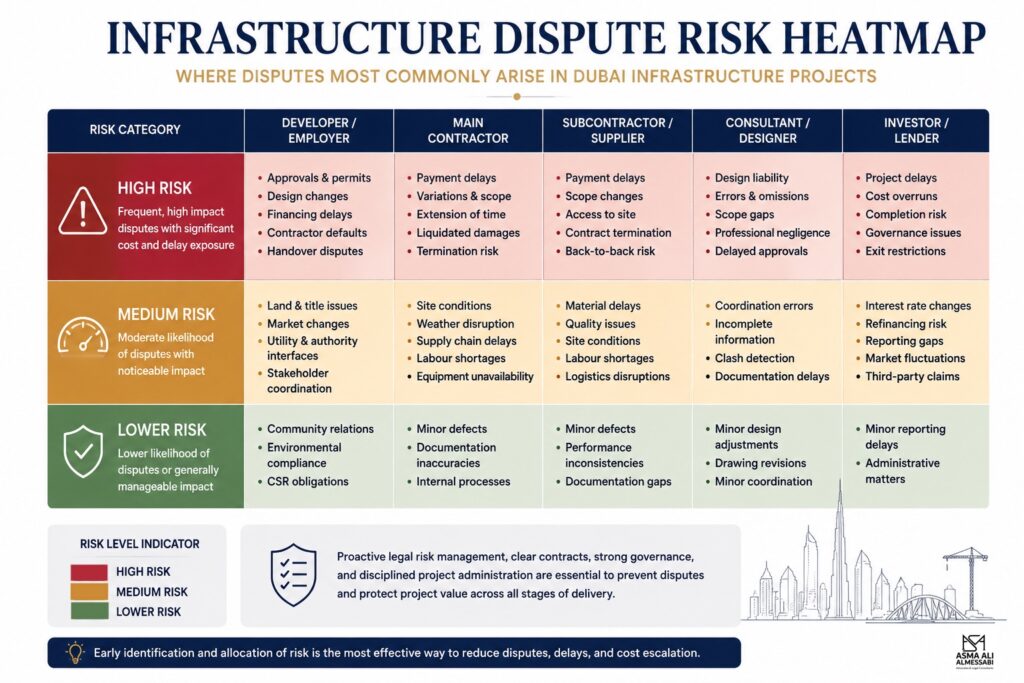
Construction and infrastructure disputes rarely arise from a single event. More often, they develop through a combination of delayed approvals, payment disagreements, variation claims, defective works, termination issues, bond calls, design responsibility disputes, or conflicting interpretations of contractual obligations. In large-scale projects, several of these issues may emerge simultaneously, creating complex disputes involving developers, contractors, consultants, lenders, insurers, and subcontractors.
For this reason, dispute resolution should not be viewed as a reactive measure. It should form part of the project’s legal framework from the earliest stages of planning and contract negotiation.
Before contracts are executed, project stakeholders should carefully evaluate:
- Governing law and jurisdiction provisions
• Arbitration seat and applicable arbitration rules
• Multi-party dispute management mechanisms
• Expert determination and technical review procedures
• Claims notification and dispute escalation processes
• Interim relief and enforcement options
• Documentation and evidence preservation requirements
• Consistency of dispute clauses across related project agreements
Arbitration remains a preferred dispute resolution mechanism for many major UAE construction and infrastructure projects due to its confidentiality, procedural flexibility, access to specialist tribunals, and ability to facilitate cross-border enforcement. However, even the strongest arbitration framework cannot compensate for weak project administration.
In practice, successful claims often depend on the quality of project records. Site reports, meeting minutes, variation instructions, payment applications, progress updates, delay notices, technical correspondence, and expert assessments frequently become the decisive evidence in construction proceedings.
Particular care should also be taken in projects involving multiple contractual layers. Developers, contractors, consultants, subcontractors, financiers, and insurers may all be connected to the same underlying dispute while being bound by different agreements. Where dispute resolution provisions are inconsistent, related claims may become fragmented across multiple forums, increasing both cost and complexity.
The most effective dispute strategy is therefore not one that begins when a conflict arises. It is one that is embedded into the project from day one, creating a clear framework for managing disagreements before they escalate into formal proceedings.
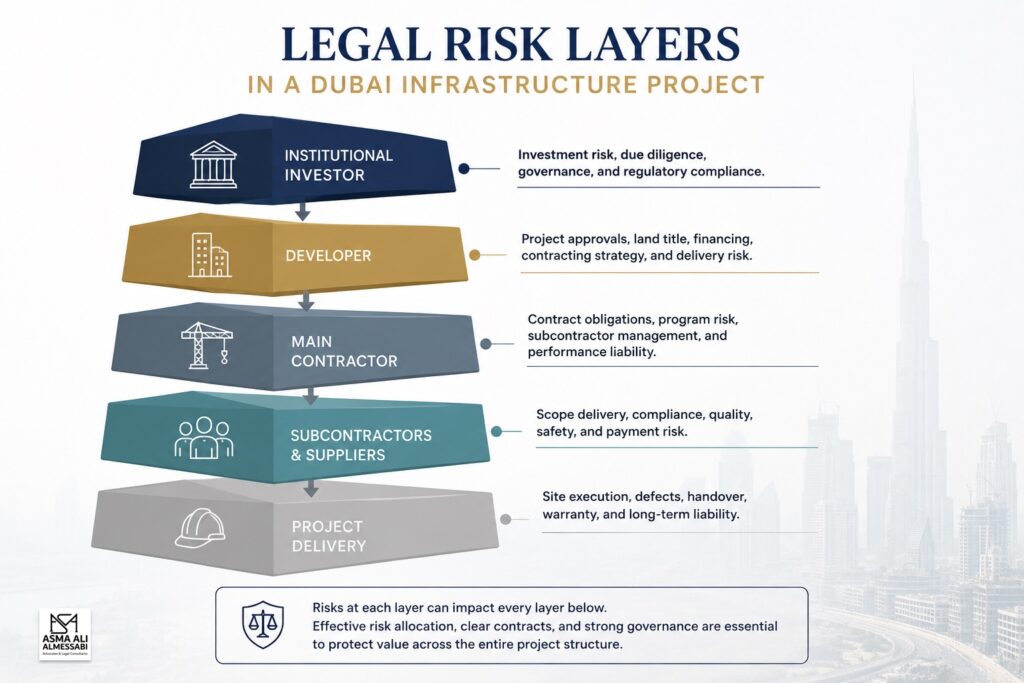
Legal Risk Layers in a Dubai Infrastructure Project
A major infrastructure project in Dubai usually contains several legal risk layers operating at the same time.
At the investment level, parties must assess ownership, capital structure, financing, shareholder rights, investor protections, exit mechanisms, and project governance.
At the regulatory level, they must evaluate licensing, permits, authority approvals, land use, environmental obligations, public infrastructure interfaces, and compliance requirements.
At the contract level, the main concerns are scope, design responsibility, payment, variations, delay, termination, bonds, insurance, liability caps, defects, and dispute resolution.
At the delivery level, parties must manage site access, subcontractors, procurement, supply chain, labour, inspections, progress reporting, and claim notices.
At the post-completion level, they must consider handover, defects, warranties, decennial liability, maintenance obligations, operations, and potential enforcement of claims.
These layers cannot be managed separately. If investment documents, construction contracts, regulatory approvals, financing terms, and dispute clauses are not aligned, the project may carry hidden risk even if each individual document appears acceptable in isolation.
This is why legal coordination is essential. Infrastructure risk is cumulative. Small weaknesses at different levels can combine into major exposure during delay, default, cost escalation, or dispute.
Strategic Legal Considerations Before Entering a Dubai Infrastructure Project
Before entering a Dubai infrastructure or major construction project, foreign developers, contractors, and institutional investors should conduct a legal review that focuses on the project’s full lifecycle.
The review should examine the project structure, land and title position, required approvals, licensing status, procurement model, contract form, risk allocation, payment security, performance bonds, insurance coverage, decennial liability exposure, dispute forum, financing alignment, governance framework, subcontracting strategy, and exit options.
It should also test whether the legal documents reflect the commercial reality of the project. A contract may look sophisticated but still fail if it does not match the project’s actual financing, delivery model, authority interface, or operational dependencies.
For developers, the priority is to create a legally resilient delivery framework. For contractors, the priority is to protect payment, claims, time extensions, and risk allocation. For investors, the priority is to ensure that capital is not deployed into a project whose legal structure cannot withstand delay, dispute, or delivery failure. The earlier these questions are addressed, the more stable the project becomes.
Why Legal Planning Matters in Dubai’s Infrastructure Expansion
Dubai’s infrastructure boom creates a significant opportunity for international market participants. But major infrastructure and construction projects are exposed to risks that cannot be solved by commercial optimism alone.
Large projects require legal discipline. They require contracts that allocate risk clearly, governance structures that support decision-making, approvals that match the project’s intended use, financing that aligns with delivery, insurance that responds to real exposure, and dispute clauses that can function under pressure.
Dubai remains one of the region’s most attractive infrastructure and development markets. But the quality of the legal structure will often determine whether a project becomes a successful long-term asset or a source of costly disputes.
For foreign developers, contractors, and institutional investors, the most important legal question is not simply how to enter the Dubai market. It is how to enter with a structure that protects capital, supports delivery, manages liability, and remains resilient throughout the project lifecycle.
ASMA Ali Al Messabi Advocates & Legal Consultants advises developers, contractors, investors, entrepreneurs, and cross-border businesses on UAE real estate, construction, infrastructure, commercial contracts, corporate structuring, dispute resolution, and project risk strategy. For clients entering Dubai infrastructure or major development projects, early legal planning can help transform opportunity into a more secure and scalable investment platform.
Frequently Asked Questions About Legal Risk in Dubai Infrastructure Projects
What legal risks should foreign developers consider before entering Dubai infrastructure projects?
Foreign developers should evaluate regulatory approvals, land rights, licensing requirements, project financing, contractor capacity, construction contracts, design responsibility, insurance, decennial liability, and dispute resolution mechanisms before entering Dubai infrastructure projects.
The main risk is not usually one single issue. It is the combination of several weaknesses across the project structure. A developer may have a strong commercial opportunity but still face problems if the land rights are unclear, the contractor is underqualified, the approval timeline is unrealistic, the contract does not manage delay properly, or the financing terms are not aligned with construction milestones.
Developers should also assess their exposure to buyers, tenants, lenders, public authorities, consultants, and contractors. Infrastructure and major real estate projects often involve long delivery timelines and multiple stakeholders, which means legal risk should be managed before commitments become difficult to reverse.
Are FIDIC contracts commonly used in UAE construction projects?
FIDIC-based contracts are commonly used in UAE construction and infrastructure projects, especially where international contractors, consultants, and employers are involved. However, parties should not assume that a FIDIC contract automatically creates balanced risk allocation.
In practice, FIDIC forms are often amended through special conditions. These amendments may shift significant risk to the contractor, alter payment rights, narrow extension-of-time protection, modify dispute mechanisms, or expand employer remedies.
Foreign contractors should review the full contract package, not only the headline form. Developers and investors should also ensure that the contract reflects the actual project structure, financing model, approval requirements, and delivery obligations. The value of a FIDIC-based contract depends on how carefully it is adapted to the project.
What is decennial liability in UAE construction law?
Decennial liability refers to a ten-year statutory liability regime under UAE law that may apply to contractors and supervising architects or engineers for serious structural defects, including total or partial collapse or defects affecting the stability or safety of a building.
This concept is important because it extends beyond ordinary contractual warranties. It can create long-term exposure after handover and completion.
Developers should consider decennial liability when appointing contractors, consultants, and designers. Contractors and engineers should ensure that their responsibilities, insurance coverage, documentation, and supervision obligations are properly managed. Investors should review decennial liability exposure as part of project due diligence, especially when acquiring completed or partially completed assets.
How can contractors protect themselves from delay and variation disputes?
Contractors can reduce delay and variation risk by ensuring that the contract includes clear procedures for notices, instructions, approvals, pricing, time extensions, and supporting evidence.
During delivery, contractors should document instructions, site conditions, design changes, employer delays, authority-related issues, labour constraints, material delays, and cost impacts. Informal communication is rarely enough in a serious construction dispute. Written records are essential.
Contractors should also review liquidated damages, suspension rights, payment certification, bond call provisions, termination clauses, and subcontractor obligations before signing. Many claims are lost not because the contractor had no commercial basis, but because notices were late, evidence was weak, or contractual procedures were not followed.
Why is legal due diligence important before investing in a Dubai infrastructure project?
Legal due diligence helps investors understand whether a project is legally sound, commercially deliverable, and properly protected against foreseeable risk.
An investor should review land rights, project approvals, developer track record, construction contracts, financing terms, insurance coverage, contractor capacity, existing claims, regulatory status, shareholder rights, exit mechanisms, and dispute history.
This is particularly important for institutional investors, family offices, and foreign investment groups that may not control day-to-day project delivery. Their risk is often tied to the quality of the structure created by the developer, contractor, and project company. Strong due diligence does not eliminate risk, but it helps investors identify whether risk is properly priced, allocated, insured, or unacceptable.
What dispute resolution mechanisms are commonly used in UAE construction contracts?
UAE construction contracts may use local court jurisdiction, arbitration, expert determination, dispute boards, or staged escalation mechanisms. In large infrastructure and cross-border construction projects, arbitration is commonly used because of confidentiality, technical flexibility, and potential enforceability across jurisdictions.
However, the dispute clause must be drafted carefully. It should clearly define the governing law, arbitration seat, institution, rules, language, number of arbitrators, interim relief options, and enforcement strategy.
Multi-party projects require additional care because developers, contractors, consultants, subcontractors, and insurers may be bound by different contracts. If dispute mechanisms are inconsistent, related claims may be fragmented across different forums.
Can foreign investors participate in Dubai infrastructure and real estate development projects?
Foreign investors can participate in Dubai infrastructure and real estate-related projects through different legal and commercial structures, depending on the asset, location, regulatory framework, ownership rules, project type, and investment model.
The appropriate structure may involve a UAE company, joint venture, project company, fund structure, holding vehicle, contractual investment arrangement, or participation in a development platform.
The key issue is not only whether investment is legally possible. Investors must understand ownership rights, governance protections, approval requirements, exit rights, financing exposure, tax considerations, dispute mechanisms, and project-level liabilities before committing capital.
What should be included in construction contracts for major UAE projects?
Major UAE construction contracts should clearly address scope, design responsibility, employer requirements, payment milestones, certification procedures, variations, extension of time, delay damages, force majeure, change in law, performance bonds, advance payment guarantees, insurance, defects liability, termination, dispute resolution, and governing law.
The contract should also define documentation requirements, reporting obligations, authority approval responsibilities, subcontracting rules, handover procedures, and post-completion obligations.
A construction contract should be drafted as a project-management and risk-allocation tool, not simply as a formal agreement. If it does not reflect how the project will actually be delivered, it may fail when pressure arises.
How can institutional investors reduce project delivery risk in Dubai?
Institutional investors can reduce project delivery risk by conducting legal, technical, financial, and commercial due diligence before deploying capital.
From a legal perspective, investors should examine the project company structure, land rights, development approvals, construction contracts, contractor capacity, insurance coverage, financing arrangements, governance rights, reporting obligations, exit mechanisms, and dispute resolution provisions.
They should also ensure that cost overruns, delay events, contractor default, regulatory issues, and defects exposure are properly addressed in the investment documents. Passive reliance on developer projections is not enough.
The strongest investment structures usually combine capital discipline with legal control rights, reporting transparency, project monitoring, and clear remedies if delivery fails.
Why should legal advice be obtained early in Dubai infrastructure projects?
Legal advice should be obtained early because many project risks are created before construction begins. Jurisdiction choice, land rights, procurement strategy, contract form, risk allocation, financing terms, insurance, governance, and dispute clauses are all typically determined at the beginning.
Once contracts are signed, works begin, funds are deployed, and approvals are in motion, it becomes harder and more expensive to correct structural weaknesses.
Early legal advice helps developers, contractors, and investors align commercial objectives with enforceable legal protections. In major Dubai infrastructure projects, this early planning can materially affect project stability, claim protection, financing confidence, and dispute readiness.