

International companies are no longer treating the UAE only as a market-entry destination. Increasingly, they are using it as a regional headquarters platform, a holding jurisdiction, a capital coordination hub, and a legal base for expansion across the Middle East, Africa, South Asia, and wider global markets.
This shift is not accidental. It reflects a broader restructuring of international business. Companies are rethinking where they place management teams, investment vehicles, corporate control functions, commercial operations, and regional decision-making authority. The old model, where global headquarters controlled every major region from Europe, the United States, or parts of Asia, is becoming less efficient in a fragmented economic environment.
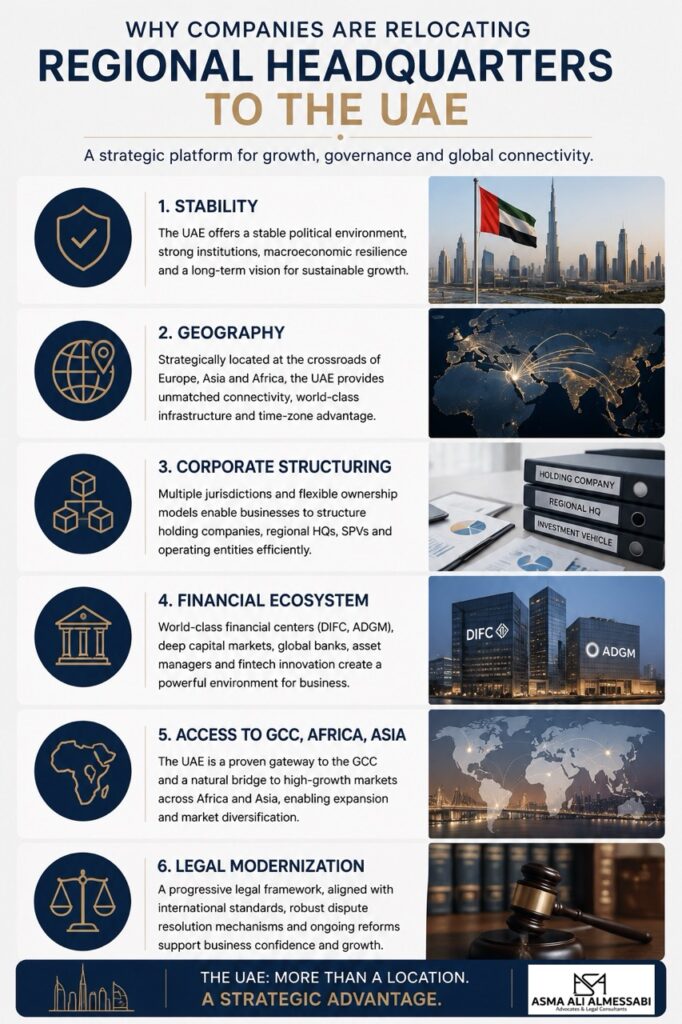
The UAE is benefiting from this transformation because it offers a combination that few jurisdictions can match: geographic connectivity, political stability, advanced infrastructure, sophisticated financial centres, access to high-growth markets, and a legal environment that has progressively adapted to international business needs. The UAE Ministry of Economy describes the country as hosting the largest number of regional headquarters in the Middle East and highlights its infrastructure, communications, and government support as reasons global corporations manage regional activities from the UAE.
For corporate groups, private investors, family businesses, technology companies, financial institutions, and multinational enterprises, the question is no longer simply whether they should “open a company in Dubai.” That question is too narrow. The more serious question is: what kind of UAE structure should support the company’s regional strategy, governance model, commercial contracts, tax position, investment activity, and risk exposure? That is where legal structuring becomes decisive.
A regional headquarters is not just an address. It is a control point. It determines how a company manages contracts, employees, subsidiaries, shareholders, investors, regulatory obligations, disputes, intellectual property, banking relationships, and future acquisitions. Poor structuring may allow a company to enter the UAE quickly, but it can also create legal friction later when the business begins to scale, raise capital, acquire assets, enter joint ventures, or operate across multiple jurisdictions.
In 2026, the UAE’s role as a regional headquarters hub is being reinforced by strong financial centre growth. DIFC reported strong client growth in the first quarter of 2026, including a 21 percent increase in financial services authorisations compared with the same period the previous year, positioning DIFC as a preferred base for regional headquarters serving the MEASA region. ADGM has also continued to attract major global asset managers, with reported assets under management rising by 36 percent in 2025 and more than 12,000 active licences in its ecosystem.
These are not soft branding signals. They show that international capital, regulated businesses, asset managers, investment firms, founders, and corporate groups are increasingly treating the UAE as a serious operating base.
For law firms, this creates a major opportunity. Many online articles still discuss UAE relocation in generic terms: tax advantages, lifestyle, company formation, speed of setup, and business-friendly regulation. Those points matter, but they are not enough for sophisticated companies. International businesses need deeper answers. They need to understand jurisdiction choice, legal governance, shareholder control, licensing, banking, corporate substance, dispute protection, acquisition readiness, and long-term scalability.
This is where the UAE’s corporate relocation story becomes a legal strategy question, not only a business setup question.
The Global Corporate Relocation Wave Behind the UAE’s Growth
International companies are relocating regional headquarters because the global business environment has become more complex. Economic uncertainty, geopolitical fragmentation, supply chain disruption, tax changes, inflationary pressure, and shifting trade corridors have made corporate location strategy more important than it was a decade ago.
For many companies, the regional headquarters decision is now connected to resilience. Businesses want to reduce overdependence on one market, one banking system, one tax environment, one supply chain route, or one legal jurisdiction. The UAE offers an attractive base because it sits between Europe, Asia, Africa, and the wider Middle East, while maintaining strong global connectivity.
The UAE is also increasingly relevant to private capital flows. Major financial institutions are expanding in the Gulf to serve wealthy clients and cross-border investors. Standard Chartered, for example, has been expanding its Gulf wealth operation and adding teams in Dubai and potentially Abu Dhabi, with the Gulf positioned as part of a broader wealth management growth strategy.
This matters for corporate relocation because company headquarters often follow capital. Where investors, family offices, private banks, fund managers, founders, and regional dealmakers gather, corporate structures tend to become more sophisticated. Companies do not only relocate for tax reasons. They relocate because decision-making, capital access, commercial opportunity, and strategic partnerships become easier to coordinate from a jurisdiction that is already attracting financial and investment activity.
The Middle East is also becoming a more active link between Asia and global capital flows. Recent moves by Gulf banks to expand in Hong Kong reflect deeper financial connectivity between the Middle East and Greater China. This reinforces the broader picture: the UAE and the wider Gulf are not peripheral business locations. They are increasingly part of the global capital map.
For international companies, the UAE can therefore serve several roles at once:
- It can be a regional management centre.
- It can be a commercial contracting base.
- It can be a holding company jurisdiction.
- It can be a platform for GCC expansion.
- It can be a gateway into Africa, South Asia, and the wider Middle East.
- It can be a base for regulated financial, fintech, digital asset, logistics, construction, infrastructure, and professional services businesses.
- It can also become a neutral jurisdiction for cross-border governance and shareholder coordination.
This layered role is what makes the UAE more powerful than a simple business setup destination.
Why the UAE Is Becoming a Regional Headquarters Hub
The UAE’s attractiveness is built on several reinforcing factors. None of them should be viewed in isolation.
First, the UAE has geographic leverage. From Dubai and Abu Dhabi, companies can manage operations across the GCC, Levant, Africa, South Asia, and parts of Europe within practical travel and time-zone ranges. For companies with regional management teams, this is not a minor advantage. It affects board meetings, client travel, logistics, investor relations, and operational oversight.
Second, the UAE offers strong infrastructure. Airports, ports, financial districts, digital connectivity, logistics platforms, hospitality infrastructure, and professional services ecosystems make the country operationally attractive for companies that need to manage multiple markets.
Third, the UAE has developed multiple legal and regulatory environments for different business needs. A company may operate through Mainland UAE, a free zone, DIFC, ADGM, or a combination of structures. This flexibility allows businesses to choose a model that reflects their commercial, regulatory, ownership, and governance requirements.
Fourth, the UAE has become more relevant to international finance. DIFC and ADGM are not merely local business districts. They are international financial centres that attract banks, asset managers, fintech companies, insurers, private wealth structures, and investment vehicles. DIFC’s reported 2026 client growth and ADGM’s growth in assets under management demonstrate that global financial actors are increasing their UAE presence.
Fifth, the UAE’s appeal is increasingly strategic rather than purely tax-driven. It is reductive and risky to frame the UAE only as a “low-tax” jurisdiction. Sophisticated companies evaluate the UAE because of corporate structuring options, regional access, investor confidence, legal modernization, quality of life for executives, ease of international recruitment, and the possibility of building a long-term base in a high-growth region.
This distinction matters. Companies that relocate only for perceived tax advantages often make poor structural decisions. Companies that relocate as part of a serious regional strategy tend to evaluate legal, governance, regulatory, and operational questions more carefully.
Regional Headquarters Are Not the Same as Simple Company Formation
One of the biggest mistakes in the market is treating company formation and corporate relocation as if they were the same thing.
Company formation answers a relatively narrow question: how can a legal entity be established?
Regional headquarters planning addresses a far more complex issue: how should a business structure its operations, governance, ownership, contracts, risk exposure, and future growth from the UAE?
For a small founder-led company, a basic setup may be sufficient in the early stages. For an international business, that is rarely enough.
A regional headquarters structure may need to coordinate:
- Commercial contracts across multiple jurisdictions
• Executive and employee relocation
• Intercompany agreements
• Shareholder rights and governance structures
• Regional distribution arrangements
• Intellectual property ownership and licensing
• Banking and treasury functions
• Compliance and reporting obligations
• Dispute resolution mechanisms
• Acquisition and investment structures
• Joint ventures and strategic partnerships
• Regulatory approvals
• Economic substance and tax considerations
This is why the legal foundation matters.
A company can often be incorporated quickly, but speed alone should never be considered the primary measure of success. A poorly designed structure may create significant complications later when the business requires financing, regulatory approvals, investor participation, acquisitions, partner exits, asset protection, or dispute management. For international companies, the initial structure should be built with long-term operational pressure in mind.
The question is not simply: “Can we establish the company?”
The question is: “Will this structure still support the business three to five years from now?”
DIFC, ADGM, Mainland UAE, or Free Zone: Choosing the Right Structure
The UAE is attractive partly because it offers multiple structural pathways. However, that flexibility also creates complexity. The right jurisdiction depends on the company’s activities, counterparties, governance requirements, regulatory profile, banking expectations, tax analysis, and expansion strategy.
Below is a simplified comparison:
| Structure | Best suited for | Key characteristics | Strategic use |
| Mainland UAE | Companies trading directly in the UAE market | Broad commercial presence, local operational flexibility, sector-specific licensing | Operating businesses, UAE commercial activity, local contracts |
| DIFC | Financial services, professional services, holding structures, private wealth, regional HQs | Common law framework, established financial ecosystem, international credibility | Regulated financial activity, corporate governance, regional management |
| ADGM | Asset management, SPVs, investment platforms, fintech, family offices | Common law framework, strong Abu Dhabi financial ecosystem, flexible structuring | Holding vehicles, investment structures, private capital, asset management |
| Other UAE Free Zones | Sector-specific businesses, trading, logistics, media, technology, services | Activity-specific licensing, free zone benefits, cost flexibility | Market entry, operating entities, trading structures, startup operations |
This table should not be read as legal advice. It is a strategic starting point.
DIFC may be attractive for companies that need international credibility, financial sector proximity, common law familiarity, and access to a mature professional services ecosystem. ADGM may be particularly relevant for investment vehicles, SPVs, asset managers, family offices, and structures linked to Abu Dhabi’s capital ecosystem. Mainland UAE may be more suitable for companies that need direct UAE market access, local contracting capability, or wider operational flexibility.
The issue is not which jurisdiction is “best.” The issue is which jurisdiction fits the company’s commercial model.
A fintech company, a family-owned trading group, a construction business, a European consulting firm, a private equity-backed portfolio company, and a multinational regional management office may all need different UAE structures.
How UAE Holding Companies Support Regional Expansion
One of the strongest corporate use cases for the UAE is the holding company model.
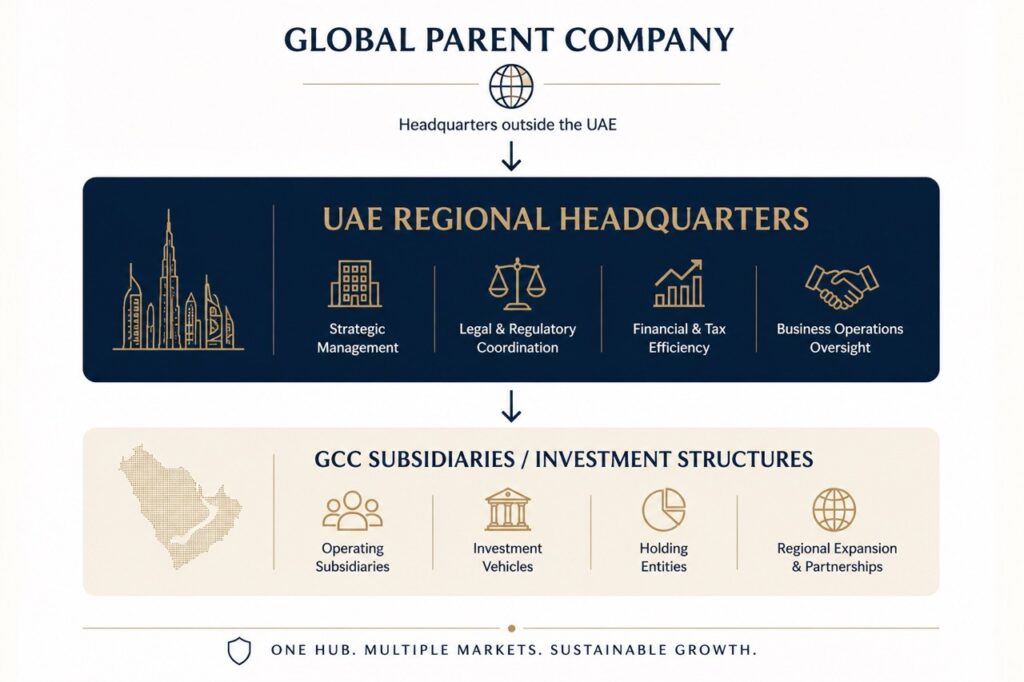
An international group may use a UAE entity to hold subsidiaries, manage regional contracts, coordinate acquisitions, receive investment, or centralize governance across GCC and wider regional operations.
A UAE holding company can support:
- Regional ownership of subsidiaries.
- Investment into operating companies.
- Joint venture participation.
- Asset ownership.
- Cross-border corporate governance.
- Shareholder control.
- Succession and continuity planning for family-owned businesses.
- Acquisition readiness.
- Banking and treasury coordination.
- Management of regional commercial contracts.
However, a UAE holding company should not be created as a template structure. Its design must reflect the business model. The legal documents, ownership arrangements, shareholder agreements, governance mechanisms, tax analysis, licensing, and banking strategy must work together.
For example, a group entering the UAE to acquire regional distributors may need a different structure from a technology company using Dubai as a regional sales headquarters. A family business consolidating assets may need a different framework from a regulated investment company operating in ADGM. A holding company that looks clean on paper may still be weak if it does not properly address control rights, exit provisions, dispute mechanisms, succession, board authority, or compliance obligations.
This is where legal advisory becomes commercially relevant. The value is not in creating an entity. The value is in creating a structure that can survive growth, investment, shareholder changes, disputes, and regulatory scrutiny.
Corporate Governance Is the Hidden Issue in UAE Relocation
Many companies focus on licensing first and governance second. That is backwards.
Corporate governance should be part of the relocation strategy from the beginning. A regional headquarters may become the place where decisions are made, contracts are approved, subsidiaries are supervised, and regional risks are managed. If governance is weak, the structure becomes vulnerable.
Key governance questions include:
- Who controls the UAE entity?
- Who has signing authority?
- How are shareholder decisions made?
- What happens if partners disagree?
- Are board powers clearly defined?
- How are regional subsidiaries supervised?
- Are reserved matters properly documented?
- Are management agreements needed?
- Are intercompany arrangements clear?
- What dispute resolution mechanism applies?
- What law governs the key contracts?
- Are exit rights, drag-along rights, tag-along rights, deadlock mechanisms, and transfer restrictions properly drafted?
These questions are especially important for joint ventures, family-owned companies, private equity-backed businesses, founder-led companies, and international groups entering the GCC through local partners.
A regional headquarters with weak governance may function smoothly during the growth phase, but problems often emerge during financing, restructuring, acquisition, succession, or dispute scenarios.
This is why international companies should treat corporate governance as a risk-management tool, not as an administrative formality.
The UAE’s Role in Cross-Border Mergers and Acquisitions
The UAE’s growing appeal as a regional headquarters hub is closely tied to its increasing role in cross-border mergers and acquisitions.
As international companies expand across the GCC and wider Middle East, many are using the UAE as a platform for regional consolidation, acquisition activity, investor coordination, and corporate restructuring. UAE-based entities are increasingly being used to acquire or manage regional distributors, technology firms, logistics operators, infrastructure-linked businesses, regulated entities, and strategic real estate assets across multiple jurisdictions.
The country’s financial ecosystem continues to reinforce this positioning. Global asset managers, investment firms, and financial institutions are steadily expanding their presence within DIFC and ADGM, strengthening the UAE’s role as a regional centre for capital deployment and transaction activity. The entrance of major international players into ADGM, including Man Group’s commitment to establish a presence in Abu Dhabi, further reflects the growing institutional relevance of the UAE in the global investment landscape.
For many companies, the UAE is no longer viewed simply as a market-entry jurisdiction. It is increasingly being used as a neutral holding environment, a base for investor relations and transaction coordination, and a gateway for acquisitions throughout the GCC and broader Middle East. The concentration of legal, financial, and advisory expertise within the UAE also provides businesses with access to sophisticated professional support for complex regional transactions and dispute management.
However, cross-border M&A activity requires careful legal planning from the outset. Companies must evaluate due diligence exposure, beneficial ownership structures, regulatory approvals, foreign investment restrictions, sector-specific licensing requirements, employment liabilities, commercial contracts, tax implications, competition considerations, anti-money laundering obligations, and dispute protection mechanisms.
The earlier these elements are integrated into the corporate structure, the more resilient and scalable the regional platform becomes.

Banking, Substance, and Operational Reality
A serious UAE relocation strategy must also address banking expectations and operational substance.
One of the most common misconceptions among international companies is the assumption that incorporating a UAE entity automatically guarantees smooth banking access, international credibility, or operational acceptance. In reality, banks, counterparties, and regulators increasingly assess the underlying commercial logic and substance behind the structure itself.
Financial institutions now evaluate factors such as ownership transparency, governance standards, source of funds, business rationale, regulatory exposure, commercial activity, and overall risk profile far more carefully than in previous years. A UAE entity with limited operational justification or unclear governance may face additional scrutiny, while a company with a coherent regional headquarters model, documented governance, proper licensing, and credible ownership structures is generally positioned more favorably.
Operational substance is therefore becoming a central part of corporate structuring strategy. This may include maintaining a genuine office presence, employing local management or staff, documenting board-level decision-making processes, conducting real regional commercial activity, aligning banking activity with operational purpose, and maintaining disciplined accounting, reporting, and compliance procedures.
Substance should not be approached as a simple regulatory checkbox. It should reflect the genuine commercial reality of the business.
This is particularly important for international groups seeking to use the UAE as a long-term regional headquarters rather than merely as a passive holding jurisdiction or administrative shell structure.
Common Legal Mistakes Companies Make When Relocating to the UAE
International companies frequently make avoidable structural mistakes when relocating operations or establishing regional headquarters in the UAE.
One of the most common errors is selecting a jurisdiction primarily on setup cost rather than long-term operational suitability. A structure that appears inexpensive at the beginning may later become restrictive or inefficient as the business expands, raises capital, enters joint ventures, or pursues acquisitions.
Another recurring issue is treating free zone selection as a purely administrative decision. Different financial centres and free zones are designed for different regulatory environments, business activities, governance expectations, and commercial profiles. Choosing the wrong jurisdiction can affect banking, licensing flexibility, operational scope, and investor confidence.
Many businesses also underestimate the importance of shareholder documentation and governance planning. Weak agreements may create serious complications during founder disputes, investor negotiations, succession events, or partner exits. Similarly, companies often fail to align their licence with the actual nature of their operations, incorrectly assuming that a single licence structure automatically supports all forms of regional activity.
Misunderstanding the relationship between Mainland UAE and free zone structures is another common problem. Businesses intending to trade, hire staff, distribute products, or operate across multiple UAE markets must carefully evaluate how their structure interacts with local commercial requirements.
Banking due diligence is frequently underestimated as well. Financial institutions may examine ownership structures, commercial activity, client profiles, source of funds, governance procedures, and compliance exposure far beyond the initial incorporation documents.
Companies also often neglect dispute planning during the early stages of structuring. Governing law clauses, arbitration mechanisms, jurisdiction selection, enforcement rights, and interim remedies should be considered proactively rather than after a dispute emerges.
Finally, many international groups fail to integrate legal, tax, operational, financial, and HR planning into a unified relocation strategy. Corporate relocation is multidisciplinary by nature. A structure that works from a licensing perspective may still create operational, governance, banking, or investment complications if these areas are not aligned from the beginning.
Why the UAE Is Becoming a Long-Term Strategic Base
The UAE’s appeal is no longer driven solely by speed of incorporation or perceptions around taxation. Increasingly, companies are viewing the country as a long-term strategic platform for regional and international operations.
The continued growth of DIFC and ADGM, the expansion of global asset managers, rising regional banking activity, private wealth migration, and the UAE’s growing role within international capital flows all point toward the same broader trend: businesses are using the UAE as a durable operational and governance hub rather than as a temporary jurisdictional solution.
This distinction is important because serious companies rarely relocate regional headquarters for short-term convenience alone. They require legal predictability, institutional credibility, access to international talent, banking infrastructure, operational scalability, investor confidence, and long-term strategic flexibility.
The UAE may not be the ideal structure for every business model. However, for companies with GCC exposure, Middle East expansion objectives, cross-border investment activity, family office involvement, fintech ambitions, or acquisition strategies, the UAE is increasingly becoming central to the global corporate structuring conversation.
The discussion is therefore shifting away from whether the UAE is business-friendly.
The more important question is how international companies can structure their UAE presence correctly and sustainably.
Strategic Legal Considerations for Companies Entering the UAE Market
Before relocating a regional headquarters to the UAE, companies should carefully assess the legal strategy underlying the move itself.
A proper review should evaluate the intended role of the UAE entity within the wider corporate group, the most appropriate jurisdiction for the business model, the ownership and governance framework, licensing requirements, expected banking profile, and the relationship between the UAE structure and foreign parent or subsidiary entities.
Companies should also consider how commercial contracts, executive relocation, operational substance, tax positioning, dispute resolution mechanisms, future investment plans, compliance obligations, and potential restructuring scenarios will interact with the proposed structure over time.
These questions are most effectively addressed before the structure becomes operational, not after the company has already expanded across multiple jurisdictions or admitted investors into the business.
For international companies, the UAE offers substantial strategic opportunities. However, the quality of the legal structure will ultimately determine whether the UAE entity becomes a resilient regional platform or a source of future operational friction.
ASMA Ali Al Messabi Advocates & Legal Consultants advises corporate groups, investors, entrepreneurs, and cross-border businesses on UAE corporate structuring, governance, commercial transactions, dispute resolution, and regional market-entry strategy. For companies considering regional headquarters relocation or expansion into the UAE, early legal planning can significantly strengthen long-term operational stability and scalability.

Frequently Asked Questions About Relocating Regional Headquarters to the UAE
Q: Why are international companies relocating regional headquarters to the UAE?
A: International companies are relocating regional headquarters to the UAE because the country offers a combination of geographic access, political stability, advanced infrastructure, financial centre credibility, and strong regional connectivity. The UAE allows companies to manage operations across the GCC, Middle East, Africa, South Asia, and parts of Europe from a commercially practical base.
For many businesses, relocation is also connected to resilience. Companies want to reduce exposure to fragmented markets, regulatory uncertainty, supply chain disruption, and overdependence on traditional headquarters jurisdictions. The UAE gives international businesses a platform from which they can coordinate contracts, subsidiaries, investors, employees, and regional strategy.
However, relocation should not be treated as a simple incorporation exercise. The correct UAE structure depends on the company’s activity, ownership model, governance needs, licensing requirements, tax analysis, and long-term expansion plan.
Q: Is Dubai the best location for a regional headquarters in the UAE?
A: Dubai is often the first choice for regional headquarters because of its international connectivity, professional services ecosystem, DIFC, logistics infrastructure, hospitality infrastructure, and strong global brand. It is particularly attractive for companies that need regional management, client-facing operations, financial services proximity, or access to international talent.
However, Dubai is not automatically the best option for every company. Abu Dhabi, through ADGM and its wider investment ecosystem, may be more suitable for asset managers, holding structures, family offices, investment platforms, and businesses connected to Abu Dhabi’s institutional capital environment.
The best location depends on the company’s purpose. A trading business, a fintech company, a family office, a professional services firm, and a regional acquisition vehicle may each require a different jurisdictional analysis.
Q: What is the difference between DIFC, ADGM, and Mainland UAE?
A: DIFC and ADGM are financial free zones with common law frameworks and strong international recognition. They are often attractive for financial services, holding structures, investment vehicles, private wealth structures, fintech, and professional services companies.
Mainland UAE is generally more relevant for companies that need to operate directly across the UAE local market, enter commercial contracts with UAE-based clients, hire locally, or conduct activities that require mainland licensing.
The choice should not be made based only on prestige or setup speed. Companies should evaluate licensing, ownership, banking, tax, regulatory obligations, governance, commercial contracts, and future growth plans before selecting a structure.
Q: Can a foreign company fully own a UAE business?
A: In many cases, foreign ownership is possible in the UAE, particularly in free zones and in many mainland business activities following legal reforms. However, ownership rules depend on the activity, jurisdiction, licence type, sector, and applicable regulatory requirements.
Companies should avoid assuming that 100 percent ownership automatically means the structure is strategically correct. Ownership is only one part of the analysis. Control rights, shareholder agreements, board authority, regulatory approvals, banking expectations, and exit mechanisms may be equally important.
For international groups, the key question is not only whether foreign ownership is allowed, but whether the structure supports the company’s regional business model.
Q: Why do companies use UAE holding companies?
A: Companies use UAE holding companies to manage regional subsidiaries, investment interests, joint ventures, acquisitions, asset ownership, and shareholder governance from a central platform. A UAE holding company can be useful for international groups expanding into the GCC, family businesses consolidating assets, private investors structuring regional investments, or companies planning acquisitions.
However, a holding company must be designed carefully. Legal documents, ownership rights, governance mechanisms, tax analysis, licensing, banking, and compliance obligations should all be aligned. A weak holding structure may create problems when investors enter, partners exit, assets are sold, or disputes arise.
Q: What legal risks should companies consider before relocating to the UAE?
A: Companies should consider licensing risk, shareholder risk, governance risk, tax and substance risk, banking risk, employment risk, contract risk, regulatory risk, and dispute risk.
Common problems include choosing the wrong jurisdiction, using generic company documents, failing to define shareholder rights, misunderstanding the relationship between mainland and free zone activity, assuming banking will be automatic, and failing to plan for disputes or future M&A.
The legal structure should be designed before the company begins operating at scale. Fixing structural mistakes later can be more expensive and more disruptive than planning correctly at the beginning.
Q: Is the UAE becoming a hub for cross-border M&A?
A: Yes. The UAE is increasingly used as a base for regional acquisitions, investment vehicles, private capital, and cross-border corporate activity. The growth of DIFC and ADGM, the presence of global asset managers, and the UAE’s role as a gateway into GCC markets all support its relevance as an M&A platform.
For companies pursuing acquisitions, the UAE can provide a central legal and commercial base. However, M&A activity requires careful attention to due diligence, ownership, regulatory approvals, commercial contracts, employment matters, tax considerations, banking, dispute resolution, and post-acquisition governance.
Q: What role does corporate governance play in UAE relocation?
A: Corporate governance is central to a successful UAE relocation. It determines how decisions are made, who controls the company, how shareholders interact, how disputes are resolved, how subsidiaries are supervised, and how the regional headquarters operates.
Weak governance may not create problems immediately, but it often becomes dangerous when the company grows, admits investors, enters joint ventures, acquires assets, or faces disputes. Proper governance documents should address board authority, reserved matters, shareholder rights, transfer restrictions, deadlock mechanisms, exit rights, signing authority, and dispute resolution.
Local laws serve as a reliable adjunct to the benefits system for relocation purposes: Although the clarity of the laws governing company incorporation, mergers, and corporate acquisition regulations, together with the introduction of legislation relating to family businesses, has constituted a significant factor in attracting foreign companies to relocate to the UAE, this is undoubtedly further reinforced by the country’s adoption of internationally recognized commercial laws, conventions, and legal frameworks, as reflected in the legal systems and regulatory environments of the Dubai International Financial Centre (“DIFC”) and the Abu Dhabi Global Market (“ADGM”), in addition to the Country’s embrace of modern commercial concepts and evolving international business practices.
Q: Should companies use a business setup consultant or a law firm for UAE relocation?
A: Business setup consultants can assist with administrative incorporation and licensing procedures. However, international companies relocating regional headquarters usually require legal analysis beyond basic company formation.
A law firm can advise on corporate structuring, shareholder agreements, commercial contracts, governance, regulatory exposure, dispute resolution, M&A readiness, and cross-border legal risk. For simple setups, administrative assistance may be enough. For regional headquarters, holding structures, joint ventures, investor-backed companies, or regulated businesses, legal structuring is essential.
Q: When should a company seek legal advice before relocating to the UAE?
A: A company should seek legal advice before choosing the jurisdiction, applying for a licence, signing shareholder documents, opening banking relationships, hiring regional executives, entering commercial contracts, or transferring assets into the UAE structure.
Early advice is important because the first structural decisions often shape future flexibility. Once a company is incorporated, contracts are signed, employees are hired, and bank accounts are opened, changing the structure may become more complex.
The best time to plan the legal structure is before the relocation process begins.