

Dubai and the wider UAE have become one of the most attractive jurisdictions for founders building Web3, blockchain, crypto, fintech, tokenization, and digital asset businesses. The appeal is clear: international connectivity, strong investor interest, advanced financial centres, progressive regulatory development, and a market that is actively positioning itself as a global hub for digital innovation, but this opportunity also creates a common mistake.
Many founders treat Web3 legal planning as something to address after the product is built, after the token model is designed, or after investors are already interested. In a regulated market, that sequence can become expensive.
Launching a Web3 business in Dubai or the UAE is not only a company formation exercise. Depending on the business model, founders may need to consider virtual asset regulation, licensing, anti-money laundering obligations, governance, token classification, investor documentation, commercial contracts, data protection, smart contract enforceability, intellectual property ownership, and cross-border regulatory exposure.
The UAE offers real opportunities for Web3 startups, but it is not a regulatory shortcut. Founders need to understand where their business sits before going to market.
A blockchain infrastructure company is not the same as a crypto exchange. A software developer is not the same as a custodian. A tokenization platform is not the same as a pure technology provider. A decentralized application may still create legal responsibilities if there is an identifiable team, operator, issuer, promoter, treasury, governance structure, or user-facing service.
The strongest Web3 companies entering the UAE are not those that move fastest without structure. They are the companies that understand their regulatory position early and build with legal scalability in mind.

Mistake 1: Assuming Every Blockchain Business Is the Same
One of the first mistakes Web3 founders make is assuming that all blockchain businesses are treated similarly. They are not.
A company developing blockchain infrastructure may have a very different legal profile from a company operating a crypto exchange, offering custody services, facilitating token transfers, issuing tokens, managing wallets, providing investment access, operating a marketplace, or building a DeFi protocol.
This distinction matters because regulatory obligations depend heavily on activity. In Dubai, virtual asset activities may fall under the supervision of the Virtual Assets Regulatory Authority. In Abu Dhabi Global Market, virtual asset activity may fall under the Financial Services Regulatory Authority. In DIFC, crypto-token activity is governed through the Dubai Financial Services Authority framework. Other UAE structures may involve different licensing, regulatory, or commercial considerations depending on the business model. For founders, the central question is not simply: “Are we a Web3 company?”. The better question is: “What regulated activity, if any, are we actually performing?”
A startup that only develops software tools for third-party clients may be treated differently from a platform that holds client assets, matches buyers and sellers, provides exchange functionality, operates a wallet, markets an investment token, or facilitates financial transactions involving virtual assets.
The term VASP, or Virtual Asset Service Provider, is especially important. If a business conducts virtual asset activities that require authorization, it may need to satisfy regulatory requirements before operating. This may include licensing, governance controls, compliance policies, risk management procedures, technology standards, customer onboarding, AML controls, and ongoing supervision.
The risk for founders is misclassification, if a business incorrectly assumes that it is only a technology company, but its actual activity resembles regulated virtual asset services, the company may face regulatory exposure, investor concern, banking friction, or disruption before launch.
This is why the legal analysis must begin with the business model. Before choosing a jurisdiction, drafting documents, launching a token, building a marketplace, or onboarding users, founders should map exactly what the platform does.
- Does the company hold assets?
- Does it facilitate transactions?
- Does it exchange virtual assets?
- Does it offer custody?
- Does it issue or promote tokens?
- Does it control user funds?
- Does it provide investment-like access?
- Does it operate infrastructure only?
- Does it interact with fiat currency?
- Does it serve users inside or outside the UAE?
These questions are not theoretical. They determine whether the company is building a software product, a regulated virtual asset business, a fintech platform, an investment structure, or a hybrid model requiring more careful regulatory treatment. For a Web3 business in Dubai, legal planning should begin with activity classification. Without that step, everything else may be built on the wrong foundation.
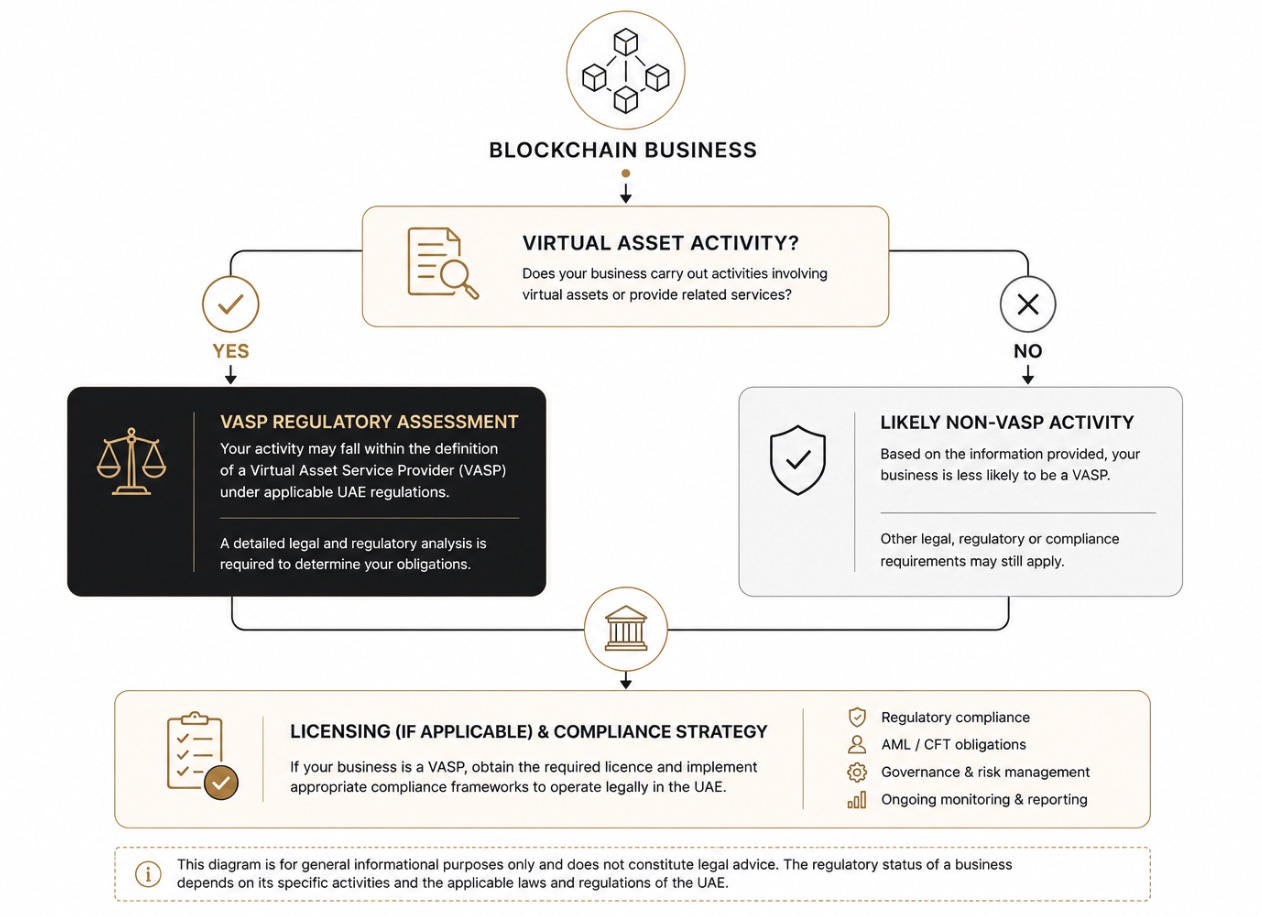
Web3 Regulatory Assessment Framework
Mistake 2: Choosing the Wrong UAE Jurisdiction
The second common mistake is choosing a UAE jurisdiction based only on setup cost, speed, or what another founder did, that is not serious structuring.Dubai and the UAE offer multiple legal and regulatory environments, including Mainland UAE, DIFC, ADGM, VARA-supervised Dubai structures, and other free zones. Each may serve a different purpose depending on the business model, investor expectations, regulatory profile, operational plan, and target market. A founder launching a crypto exchange, a tokenization platform, a DeFi interface, a blockchain analytics provider, a fintech software company, or a Web3 advisory business may not need the same structure.
The wrong jurisdiction can create friction later. It may affect licensing, banking, investor due diligence, operational scope, commercial credibility, tax planning, hiring, contract enforceability, and future expansion. DIFC may be relevant for certain financial services and regulated fintech activity under the DFSA framework. ADGM may be attractive for digital asset businesses, investment structures, asset managers, and regulated virtual asset activity under the FSRA. Dubai structures involving virtual assets may require analysis under VARA’s regime. Mainland or other free zone structures may be suitable for businesses whose activity is commercial, technological, advisory, or operational rather than regulated virtual asset service activity. The point is not that one jurisdiction is better than another, the point is that the jurisdiction must match the business model. For example, a blockchain development studio that builds enterprise software may need a different structure from a company operating a custodial wallet. A token issuer raising capital from international investors may need a different analysis from an NFT creative platform. A fintech company serving regulated institutions may need a different structure from a DAO tooling provider.
Investors also care about jurisdictional quality. A Web3 startup may be able to incorporate quickly, but if the structure does not support future licensing, token issuance, banking, governance, or fundraising, it may become a problem during due diligence. Founders should also avoid assuming that the UAE structure is only about incorporation. In serious Web3 projects, the entity structure may need to support shareholder rights, intellectual property ownership, technology development, treasury management, token economics, licensing pathways, investor participation, cross-border operations, and dispute resolution. The wrong structure can become difficult to unwind once users, investors, employees, developers, token holders, and counterparties are involved.
For this reason, jurisdiction selection should not be treated as an administrative decision. It should be part of the startup’s legal and commercial strategy.
| Consideration | Mainland UAE | DIFC | ADGM | Other UAE Free Zones |
| Primary Purpose | Commercial operations across the UAE | International financial centre | International financial centre | Commercial and technology businesses |
| Typical Web3 Use Cases | Technology companies, software, commercial activities (depending on the business model) | Regulated financial services and eligible crypto-related activities | Digital asset businesses, fintech and regulated financial services | Blockchain development, technology, innovation and support services (subject to activity) |
| Regulatory Environment | Depends on the activity and applicable authorities | Financial regulatory framework | Financial regulatory framework | Varies by free zone and activity |
| Investor Appeal | High, depending on structure | High among international financial institutions | High among institutional investors | Depends on the free zone and business model |
| Banking Considerations | Depends on business profile and compliance | Generally strong institutional ecosystem | Strong institutional ecosystem | Depends on jurisdiction, activity and risk profile |
| Suitable for Regulated Virtual Asset Activities | Activity-specific assessment required | Subject to applicable DFSA requirements | Subject to applicable FSRA requirements | Activity and jurisdiction specific |
| Scalability for International Operations | High with appropriate structuring | High | High | Varies depending on the jurisdiction |
| Key Consideration | Operational flexibility | Financial services ecosystem | Digital asset regulatory ecosystem | Cost, business activity and long-term objectives |
Mistake 3: Waiting Too Long to Think About Compliance
Many Web3 startups follow the same flawed sequence: Build first, launch fast and add compliance later. That approach may work for some low-risk software products. It does not work well for businesses that may touch virtual assets, payments, custody, exchange activity, token issuance, investor funds, or regulated financial services.
In the UAE, compliance is not only a defensive function. It is part of market credibility. Banks, investors, regulators, counterparties, institutional clients, and strategic partners may all evaluate whether a Web3 company has a credible compliance framework. For virtual asset businesses, compliance may involve AML policies, KYC procedures, sanctions screening, transaction monitoring, governance controls, internal reporting, risk assessments, customer due diligence, record keeping, technology security, and incident management. Founders often underestimate the operational weight of these obligations. A compliance framework is not simply a document downloaded from the internet. It must reflect the real business model.
A platform handling retail users has different risk from a B2B infrastructure provider. A custodial wallet has different risk from a non-custodial interface. A token launch has different risk from a blockchain analytics product. A cross-border exchange model has different risk from a closed enterprise blockchain solution.
The most dangerous version of this mistake is assuming that compliance begins only after licensing. In reality, compliance planning should influence product design, onboarding flows, user terms, custody arrangements, transaction monitoring, governance, treasury controls, and commercial agreements before launch.
For example, if a platform intends to onboard users globally, it must consider how it will verify customers, manage restricted jurisdictions, handle sanctions exposure, monitor suspicious activity, and respond to regulatory requests. If it plans to work with institutions, it may need stronger governance, reporting, and security controls. If it plans to issue tokens, it must consider disclosure, marketing, investor expectations, token utility, secondary-market activity, and potential regulatory classification.
This is also important for fundraising. Serious investors increasingly look at compliance readiness before investing in Web3 companies. A weak compliance structure can raise concerns about future licensing, regulatory enforcement, banking access, and exit potential. A startup may be technologically impressive and legally fragile at the same time; that is the problem.
For Web3 founders in Dubai and the UAE, compliance should not be treated as a late-stage burden. It should be built into the operating model from the start.

Mistake 4: Thinking Smart Contracts Replace Legal Contracts
Smart contracts are powerful tools. They can automate execution, reduce manual intervention, and create transparent transaction logic. But they do not replace legal contracts. This is one of the most common misunderstandings in Web3.
A smart contract may execute code. It does not automatically answer every legal question connected to the business relationship:
- It may not define governing law.
- It may not explain liability.
- It may not allocate intellectual property rights.
- It may not handle fraud, error, force majeure, sanctions, regulatory intervention, defective code, user disputes, investor rights, confidentiality, data protection, termination, or dispute resolution.
- It may not explain who is responsible if the code behaves differently from the commercial intention.
In many Web3 projects, the technical architecture and legal architecture must work together. The smart contract can automate certain functions, while legal agreements define the rights, responsibilities, limitations, remedies, and dispute mechanisms surrounding those functions. This is especially important for token launches, staking arrangements, NFT marketplaces, DeFi interfaces, DAO governance tools, custody models, developer agreements, and platform terms.
Founders often focus heavily on the code and too little on the legal relationship created around the code. That can become dangerous when a transaction fails, a vulnerability is exploited, a user suffers loss, a contributor disputes ownership, an investor challenges disclosure, or a regulator questions the platform’s activity.
Legal contracts remain important because they create clarity around matters that code alone may not resolve:
- Who owns the intellectual property?
- Who controls the platform?
- Who is responsible for defects?
- What happens if a smart contract is exploited?
- Can users claim damages?
- Which law applies?
- Where are disputes resolved?
- Are token holders investors, users, members, or something else?
- What rights do contributors have?
- What disclosures were made before launch?
- What obligations does the company owe after launch?
Smart contracts may reduce operational friction, but they do not eliminate legal risk. For UAE Web3 startups, this distinction matters because many projects are cross-border by nature. Users, developers, founders, investors, tokens, servers, wallets, and counterparties may all be located in different jurisdictions. Without clear legal documentation, disputes can become complex very quickly.
A strong Web3 legal structure should connect the technical system with enforceable contractual rights. Code may execute the transaction. Legal documents explain the relationship.
Mistake 5: Building Today Without Planning for Investment Tomorrow
Many Web3 founders build for launch, but not for investment, scaling, licensing, acquisition, or exit. This is a major strategic mistake.
A startup’s first structure may look acceptable when the company has only founders, developers, and an early product. But the same structure may become weak when the company raises capital, issues tokens, enters a regulated activity, hires across borders, attracts institutional partners, or considers acquisition.
Investors will usually examine the legal structure. They may review corporate ownership, founder rights, vesting, intellectual property assignment, token allocation, regulatory exposure, licensing status, commercial contracts, employment documents, data protection, treasury controls, and litigation risk. If those elements are unclear, the investment process becomes harder.
A common issue is intellectual property ownership. Web3 startups often rely on external developers, contributors, agencies, open-source code, community input, or decentralized teams. If IP ownership is not properly assigned, the company may not fully own the technology it is trying to commercialize.
Another common issue is token structure. If token rights, utility, governance, distribution, vesting, treasury allocation, investor participation, and disclosures are not clearly documented, the company may face problems later with investors, users, exchanges, regulators, or counterparties.
Founder arrangements also matter. Without proper shareholder agreements, vesting terms, decision-making rules, transfer restrictions, deadlock mechanisms, and exit provisions, disputes between founders can destabilize the company before it scales.
Regulatory planning is equally important. A company that begins as a software platform may later move toward custody, exchange, brokerage, investment access, staking, payments, or token issuance. If the original structure does not support that direction, the company may need restructuring before it can continue.
Banking and payment access can also become a challenge. Web3 companies often face more scrutiny from banks and service providers. A credible legal structure, clear business model, compliance framework, and transparent ownership can materially improve the company’s position.
The strongest founders do not only ask: “Can we launch?”, They ask: “Can this structure support the company when investors, regulators, banks, users, and acquirers examine it?” That is the difference between a fast launch and a scalable Web3 business.
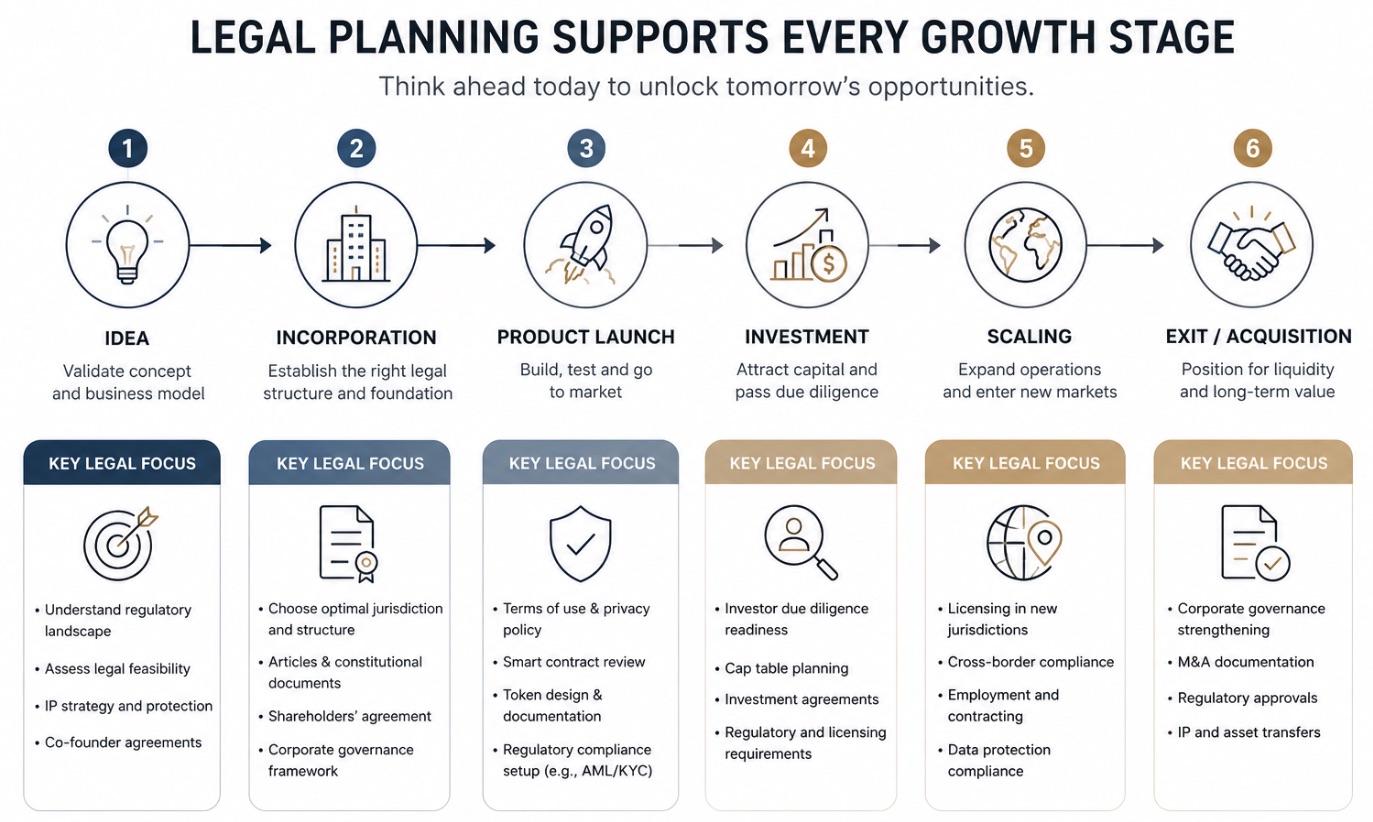
Legal Considerations Before Launching a Web3 Business in Dubai
Before launching a Web3 business in Dubai or the UAE, founders should conduct a legal review that starts with the business model and moves outward.
The review should identify what the platform actually does, whether virtual asset regulation may apply, which UAE jurisdiction is most suitable, what licence may be required, how the company should be structured, who owns the technology, how tokens are issued or managed, what compliance obligations apply, and how the platform’s commercial relationships should be documented.
Founders should also evaluate investor expectations, banking requirements, governance, cybersecurity risk, customer terms, data protection, AML exposure, sanctions controls, dispute resolution, and cross-border operations.
This review should happen before launch, not after user onboarding begins.
The UAE offers one of the most serious digital asset environments in the region. But serious environments reward serious structuring. Founders who approach the UAE only as a fast incorporation destination may miss the larger opportunity.
For Web3 companies, Dubai and the UAE can provide a powerful base for growth. But the legal framework must be designed carefully enough to support the business beyond the first launch.
ASMA Ali Al Messabi Advocates & Legal Consultants advises founders, investors, fintech companies, virtual asset businesses, and cross-border ventures on UAE corporate structuring, commercial contracts, fintech regulation, virtual asset advisory, smart contract and DAO-related legal considerations, AML and compliance, dispute resolution, and market-entry strategy.
For Web3 startups planning to launch in Dubai or the UAE, early legal planning can help reduce regulatory uncertainty, strengthen investor confidence, and create a more resilient foundation for growth.

Frequently Asked Questions About Launching a Web3 Business in Dubai and the UAE
What qualifies as a VASP in the UAE?
A VASP, or Virtual Asset Service Provider, is generally a business authorized to conduct regulated virtual asset activities. The exact analysis depends on the jurisdiction, regulator, and activity involved.
In Dubai, VARA supervises virtual asset activities in the emirate, except within the DIFC. In ADGM, virtual asset activity falls under the FSRA framework. In DIFC, crypto-token activity is regulated through the DFSA framework.
Founders should not assume that using blockchain automatically makes them a VASP. The analysis depends on what the business actually does. Custody, exchange, transfer, brokerage, token issuance, investment activity, or platform operation may create different regulatory implications from pure software development.
Does every blockchain company in Dubai need a licence?
No. Not every blockchain company requires the same type of licence or regulatory approval.
A company developing blockchain software, offering technical consulting, building enterprise tools, or providing non-regulated infrastructure may have a different legal position from a company conducting virtual asset exchange, custody, transfer, investment, token issuance, or other regulated activity.
However, founders should not make this assessment casually. The difference between a technology company and a regulated virtual asset business can depend on operational details, user flows, custody arrangements, transaction control, revenue model, and marketing.
A legal review should be conducted before launch.
Can foreign founders launch a Web3 business in Dubai?
Foreign founders can establish Web3, fintech, blockchain, and virtual asset-related businesses in Dubai and the wider UAE, subject to the correct corporate, licensing, and regulatory structure.
The appropriate structure depends on the activity. Some businesses may require virtual asset licensing or financial services approval. Others may be structured as technology, advisory, software, or commercial businesses.
Founders should consider ownership, jurisdiction, licensing, banking, visas, investor expectations, compliance, tax, IP ownership, and cross-border operations before choosing a setup.
What is the difference between VARA, DIFC, and ADGM for Web3 businesses?
VARA regulates virtual asset activity in Dubai, excluding the DIFC. DIFC has its own financial services regulator, the DFSA, which regulates crypto-token activity within its framework. ADGM, in Abu Dhabi, has its own regulator, the FSRA, and has developed a digital asset and virtual asset framework.
The choice between these environments depends on the business model, target clients, regulatory activity, investor profile, operational needs, and long-term strategy.
A company should not choose based only on brand recognition or setup cost. It should choose based on legal and commercial fit.
Are NFTs regulated in the UAE?
NFTs may or may not raise regulatory issues depending on how they are structured, marketed, sold, and used.
A simple digital collectible may be treated differently from an NFT linked to investment returns, fractional ownership, financial rights, real-world assets, revenue sharing, or speculative trading activity. The legal analysis depends on substance, not only terminology.
Founders should be careful when describing NFTs as utility assets, membership rights, investment products, or ownership instruments. The legal position may change depending on the rights attached to the token.
Do smart contracts replace legal contracts?
No. Smart contracts do not replace legal contracts.
Smart contracts can automate execution, but legal contracts define rights, obligations, liability, ownership, governing law, dispute resolution, confidentiality, termination, and remedies. In serious Web3 projects, the smart contract and the legal contract should be aligned.
This is particularly important for token issuance, DeFi platforms, staking arrangements, custody, NFT marketplaces, DAO governance, and developer relationships.
Can a DAO operate legally in the UAE?
A DAO may raise legal issues depending on its structure, governance, activity, treasury, participants, and decision-making process.
The term DAO does not automatically remove liability or regulatory responsibility. If there are identifiable founders, administrators, treasury managers, developers, promoters, or commercial operators, legal obligations may still arise.
A DAO-related project should be reviewed carefully before launch, especially if it involves tokens, funds, voting rights, investment activity, user assets, or cross-border participation.
What AML obligations apply to crypto businesses in the UAE?
Crypto and virtual asset businesses may be subject to AML, KYC, sanctions screening, transaction monitoring, reporting, governance, and record-keeping obligations depending on their activity and regulatory status.
AML compliance is not limited to checking a customer’s identity. It may involve ongoing monitoring, risk classification, source-of-funds assessment, suspicious activity reporting, sanctions screening, internal policies, staff training, and governance controls.
Founders should design AML and compliance processes before onboarding users.
Can a token project launch before licensing?
This depends on the token, the activity, the jurisdiction, the target market, and how the token is issued, marketed, sold, or used.
Launching before legal analysis can create serious risk. A token may have regulatory implications if it resembles an investment product, provides financial rights, is marketed for speculative gain, grants governance or revenue rights, or is connected to virtual asset services.
Before launching a token, founders should review token classification, disclosures, marketing restrictions, purchaser rights, exchange plans, treasury allocation, vesting, utility, and regulatory exposure.
When should Web3 founders seek legal advice in Dubai?
Founders should seek legal advice before choosing a jurisdiction, incorporating, issuing tokens, onboarding users, raising funds, signing developer agreements, launching smart contracts, applying for licences, or marketing virtual asset services.
Early legal advice is more effective than fixing structural mistakes later. Once the platform is live, users are onboarded, tokens are issued, investors are involved, or contracts are signed, legal restructuring becomes more complicated.
The best time to structure a Web3 business is before launch.