

The UAE’s New Role in Global Wealth Planning
Over the past decade, the United Arab Emirates has transformed from a regional commercial centre into one of the world’s leading destinations for international wealth. Entrepreneurs, multinational business owners, family offices, investors, and high-net-worth families are no longer choosing Dubai or Abu Dhabi solely because of their strategic location or business-friendly environment. Increasingly, they are relocating long-term wealth, governance structures, investment vehicles, and succession planning to the UAE. This evolution reflects a broader shift in how global families think about wealth.
Building wealth has become increasingly international. A business may be incorporated in Dubai, own intellectual property in Europe, hold investment portfolios managed from Switzerland, invest in US private equity, and own real estate across several jurisdictions. Family members may live in different countries, hold different citizenships, marry under different legal systems, and become subject to different inheritance and tax regimes. As wealth becomes more international, its ownership often becomes more fragmented.
The legal challenges faced by successful families are therefore changing. Rather than asking how to create wealth, many are asking how to preserve it, govern it, and transfer it responsibly to future generations without creating uncertainty or conflict.
The UAE has responded to these changing priorities by developing sophisticated legal and financial ecosystems designed not only for business formation but also for long-term private wealth planning. Through the Dubai International Financial Centre (DIFC) and Abu Dhabi Global Market (ADGM), families now have access to internationally recognised legal frameworks supporting foundations, trusts, family offices, holding structures, investment vehicles, and governance arrangements that were once associated primarily with jurisdictions such as Jersey, Guernsey, Singapore, or Liechtenstein.
The market is expanding rapidly. DIFC reported the registration of 158 new foundations during the first quarter of 2026, representing year-on-year growth of more than 100 per cent, while its Family Wealth Centre continues to attract family businesses, founders, and ultra-high-net-worth individuals seeking structured approaches to succession, governance, and long-term wealth preservation. This reflects a wider regional trend as the Middle East prepares for one of the largest intergenerational transfers of private wealth in its history.
For many internationally mobile families, the conversation has therefore changed, the question is no longer simply where to invest, it is increasingly how wealth should be owned, governed, and transferred over several generations.

Wealth Is Becoming Global, but Ownership Often Remains Fragmented
Many successful families never deliberately design their ownership structure, instead, it evolves naturally over time. A founder establishes an operating company. Years later, investment properties are acquired in different countries. A holding company is incorporated for tax or commercial reasons. Investment portfolios are opened with international banks. Children join the business while other family members pursue careers elsewhere. Additional companies are created to support expansion, acquisitions, intellectual property, or new ventures.
Each decision makes sense individually. Collectively, however, these decisions often produce an ownership structure that was never intentionally designed. The result may include personally owned shares, multiple holding companies, overseas real estate, private investment vehicles, joint ownership arrangements, several wills prepared in different jurisdictions, and a growing number of family members with varying expectations regarding control and inheritance.
This complexity often remains invisible during the founder’s lifetime, the business continues to operate successfully, assets appreciate in value, and relationships remain stable. The real test comes later, a sudden illness, retirement, sale of the business, divorce, shareholder dispute, regulatory investigation, or unexpected death can expose weaknesses that have accumulated over many years. Questions that were never formally answered suddenly become urgent:
- Who should control the operating companies?
- Should every child receive identical voting rights?
- How should income be distributed between active and passive family members?
- Can one beneficiary sell their interest without the consent of others?
- What happens if family members live under different inheritance laws?
- Who resolves disagreements between different generations?
- How should international assets be coordinated across multiple legal systems?
These questions are rarely answered by a single document: A will may determine how certain assets pass after death. A company can own subsidiaries or investments. A shareholders’ agreement can regulate corporate decision-making. A trust may separate legal and beneficial ownership. Each of these instruments has an important role but none of them, however, automatically creates a coherent framework for governing an international family’s wealth over several decades. This distinction is becoming increasingly important. Sophisticated wealth planning is no longer concerned solely with transferring assets after death. It is concerned with creating a governance system capable of supporting the family while it continues to grow.
The Hidden Risk Is Rarely Investment Performance
Families often spend decades building successful businesses, acquiring valuable assets, and diversifying internationally. Far less time is devoted to designing how those assets will be managed once the founder is no longer making every important decision. Ironically, this governance risk frequently poses a greater long-term threat than market volatility.
Businesses survive recessions, investment portfolios recover from temporary downturns, real estate markets fluctuate. Families, however, may struggle to recover from uncertainty over ownership, succession, or control. International experience repeatedly demonstrates that significant private wealth is rarely lost because the original business was unsuccessful.
More often, it becomes diluted through fragmented ownership, conflicting expectations, unclear governance, succession disputes, or decision-making structures that were never designed to survive beyond the founding generation. This is particularly relevant for family-owned businesses. The founder may possess decades of commercial experience and maintain personal relationships with clients, regulators, financial institutions, and strategic partners.
Future generations may inherit ownership without inheriting the same experience, treating ownership and management as identical concepts can therefore create unnecessary risk.
- Not every beneficiary wishes to participate in the business.
- Not every family member possesses the same commercial expertise.
- Not every shareholder should necessarily exercise equal operational authority.
Separating economic ownership from day-to-day management has consequently become one of the defining characteristics of modern family governance. Rather than asking whether every beneficiary should become an owner in exactly the same way, many families now ask a more strategic question: How can ownership remain stable while allowing professional management, structured succession, and long-term continuity?
Why Traditional Estate Planning Is No Longer Enough
Traditional estate planning remains essential. Every internationally mobile family should consider appropriate wills, powers of attorney, shareholder agreements, and succession planning relevant to the jurisdictions in which they hold assets.
However, modern international wealth often extends far beyond what traditional estate planning was originally designed to address. A family may simultaneously own operating companies, investment vehicles, intellectual property, digital assets, commercial real estate, residential property, international bank accounts, venture capital investments, and philanthropic initiatives spread across multiple legal systems. Each asset class may be governed by different rules concerning ownership, succession, taxation, regulation, and reporting.
Coordinating these assets through individual ownership alone can become increasingly inefficient as both the family’s wealth and the number of beneficiaries expand. This is one reason why sophisticated international families increasingly separate three concepts that were once treated as identical:
- Ownership – Who legally owns the assets?
- Control – Who makes strategic decisions?
- Benefit – Who ultimately receives economic value?
Keeping these concepts separate allows governance arrangements to be designed according to the family’s long-term objectives rather than simply following legal ownership. This is precisely where foundations have become increasingly significant. Rather than acting as a substitute for wills, companies, or trusts, a properly structured foundation may provide the legal framework through which these different components operate together.
Instead of allowing ownership to become progressively fragmented across future generations, the foundation can provide continuity while clearly defining governance, decision-making authority, succession mechanisms, and beneficiary rights. It is this combination of legal personality, structured governance, and long-term continuity that has positioned UAE foundations as one of the most sophisticated private wealth planning tools now available to internationally mobile families.
Why UAE Foundations Have Become a Strategic Planning Tool
A foundation is often described as a legal entity established to hold and administer assets for defined purposes. While technically correct, that definition explains very little about why foundations have become increasingly important for international families. The real value of a foundation lies not in its legal form but in the role it plays within a family’s broader governance strategy.
Rather than allowing ownership to become progressively divided among multiple individuals over successive generations, a foundation can become the long-term owner of selected assets while the family’s constitutional documents determine how those assets should be managed, controlled, and ultimately enjoyed.
In many traditional ownership structures, legal ownership, voting rights, management authority, and economic benefit are concentrated in the same individuals. As the family expands, those rights naturally become fragmented. Future generations may inherit equal ownership despite having very different levels of experience, commitment, or involvement in the family business.
A foundation allows those elements to be separated:
- Ownership may remain stable.
- Management can be delegated.
- Economic benefits can be distributed according to agreed principles.
- Governance can continue independently of changes within the family.
For internationally mobile families, this continuity often becomes considerably more valuable than the structure itself.
Understanding the Foundation Structure
Unlike a conventional company, a foundation does not have shareholders who own transferable shares in the traditional corporate sense, instead, assets transferred into the foundation become assets of the foundation itself.
Those assets are then administered according to the foundation’s constitutional documents, applicable legislation, and its stated purposes. Because the foundation has its own legal personality, it may generally own property, hold investments, establish bank accounts, enter into contracts, own shares in companies, and participate in legal proceedings in its own name, subject to the applicable legal framework.
This characteristic distinguishes foundations from many traditional trust structures while providing families with an institutional ownership vehicle capable of continuing independently of individual family members. Rather than asking who personally owns each asset, the more useful question becomes:
Who governs the foundation, and how have those governance powers been designed?
This shift from personal ownership to institutional governance is one of the principal reasons foundations have become increasingly popular among family businesses, entrepreneurs, and internationally mobile investors.
A Foundation Is Not the Business
One of the most common misunderstandings is that a foundation should replace the operating business itself, in practice, this is rarely its primary purpose. Instead, the foundation usually sits above the family’s commercial activities, becoming the long-term owner of the structures through which those activities are carried out.
A simplified ownership structure may resemble the following.
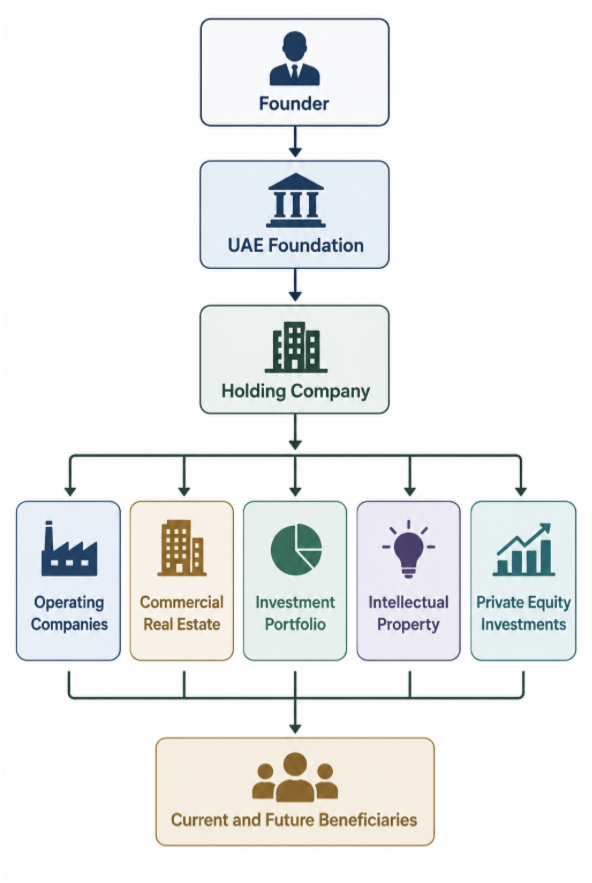
This arrangement allows the family’s principal assets to remain under a single governance framework while individual businesses continue operating through appropriate corporate entities. The objective is not to make day-to-day business decisions more complicated, it is to simplify ownership. If one subsidiary is sold, another acquired, or a new investment added, the overall ownership architecture remains stable because the foundation continues to sit at the top of the structure.
Foundation, Trust, Holding Company or Will?
Families frequently ask which structure is “best.” In reality, the question is usually incorrect as these structures perform different functions and often complement rather than replace one another.
| Feature | Foundation | Holding Company | Trust | Will |
| Separate legal personality | ✓ | ✓ | No | No |
| Long-term governance | Excellent | Limited | Good | None |
| Succession planning | Excellent | Limited | Excellent | Good |
| Ownership of companies | Excellent | Excellent | Good | None |
| Beneficiary framework | Excellent | None | Excellent | None |
| Multi-generational planning | Excellent | Limited | Excellent | Limited |
| Operates during founder’s lifetime | Yes | Yes | Yes | No |
- A will determines how certain assets pass following death.
- A holding company consolidates ownership of corporate assets.
- A trust separates legal ownership from beneficial enjoyment.
- A foundation provides an institutional framework capable of coordinating ownership, governance, succession, and long-term administration.
Sophisticated families frequently employ several of these structures simultaneously because each addresses different legal and commercial objectives.
The Four Pillars of Every Successful Foundation
Although every family’s circumstances differ, most successful foundation structures are built around four essential components.
The Founder
The founder establishes the foundation, contributes the initial assets where appropriate, and defines its long-term objectives. This stage requires considerably more thought than simply completing incorporation documents.
The founder should determine questions such as:
- Why is the foundation being established?
- Which assets should ultimately be transferred?
- How should future generations benefit?
- Which decisions should remain within the family?
- Which decisions should become independent?
- What should happen if the founder becomes incapacitated?
Many planning difficulties originate because these questions were postponed rather than answered. A carefully drafted foundation should therefore reflect not only the family’s current circumstances but also how those circumstances are likely to evolve over the coming decades.
The Foundation Council
The council performs a role broadly comparable to the board of directors of a company, its responsibility extends beyond simple administration.
The council safeguards the foundation’s assets, implements its stated purposes, supervises investments where appropriate, authorises distributions, and ensures compliance with the constitutional documents.
The composition of the council deserves careful consideration. Some families initially assume that every council member should be a close relative and experience often suggests otherwise. Many successful family wealth structures combine family representatives with independent professionals who contribute legal, financial, commercial, or governance expertise.
This combination offers several advantages, independent members may provide objective judgment during family disagreements, reduce conflicts of interest, improve institutional credibility, and help ensure continuity as future generations assume greater responsibility. Professional governance rarely diminishes family control, more often, it protects it.
Beneficiaries
Beneficiaries are the people the foundation is created to support, and their roles, interests, and needs will rarely be the same.
This is especially true in entrepreneurial families. One child may run the family business, another may build a career elsewhere, while a third may have no commercial involvement at all but still remain an integral part of the family.
Treating everyone exactly the same does not always lead to a fair outcome. For that reason, many families separate governance, economic benefits, and management responsibilities. This creates a structure where each generation can contribute based on its skills, interests, and commitment, rather than receiving identical rights by default.
The Guardian
Depending on the jurisdiction and legal structure, a foundation may appoint a guardian to provide independent oversight.
The guardian is not responsible for the foundation’s day-to-day administration. Instead, the role is to oversee the council, ensuring its decisions remain aligned with the foundation’s purpose and governing documents.
For many family foundations, the guardian also provides long-term continuity, helping preserve the founder’s vision while reducing the risk of governance drifting over successive generations.
Governance Is Usually More Important Than Tax
Families frequently begin succession planning by asking tax questions, while taxation is naturally important, it is rarely the issue that ultimately determines whether wealth survives across several generations. International experience consistently demonstrates that governance failures destroy substantially more family wealth than tax inefficiencies.
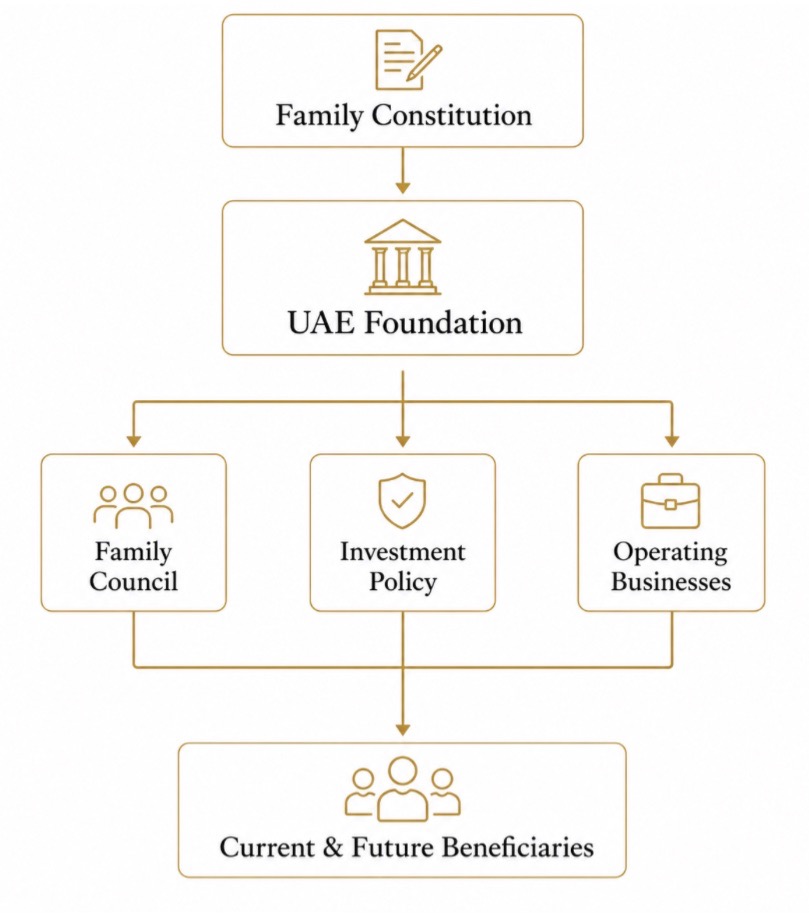
Businesses are divided because decision-making authority was never defined, properties become difficult to manage because ownership fragmented among numerous beneficiaries and family members pursue litigation because expectations were never documented.
Strategic decisions become impossible because unanimous approval is required from individuals living across different jurisdictions with different priorities. These problems are rarely solved by selecting a different tax structure, they are solved through governance.
A well-designed foundation therefore focuses first on creating clear decision-making mechanisms. Questions that should be answered include:
- Who appoints future council members?
- Can family members remove council members?
- Which decisions require unanimous approval?
- How should disagreements be resolved?
- Should independent advisers participate?
- What happens if a beneficiary becomes incapable?
- How are future generations introduced into governance?
- Can the constitutional documents be amended?
These issues may appear administrative, in reality, they determine whether the structure remains effective twenty or thirty years later.
Practical Example: Planning Beyond the Founder
Consider a founder who owns a successful manufacturing business in Dubai together with commercial property in London and investment portfolios managed in Switzerland:
- The founder has three adult children.
- Only one works within the business.
Without long-term planning, ownership of these assets may eventually become divided equally among all three beneficiaries, regardless of their different levels of experience or involvement. This may create uncertainty over management, voting rights, distributions, and future investment decisions.
By contrast, a properly structured foundation may hold the ownership interests centrally while establishing governance rules that distinguish between business management, strategic oversight, and economic benefit.
The child managing the company may continue participating in operational leadership while other beneficiaries may continue receiving economic benefits without becoming directly involved in management decisions.
-Ownership remains consolidated.
-Governance remains predictable.
-The family’s objectives remain clearly documented.
Rather than simply determining who receives assets, the structure determines how those assets continue functioning for the benefit of future generations.
Asset Protection: What a UAE Foundation Can and Cannot Do
Few expressions in private wealth planning are used more frequently—or misunderstood more often—than asset protection.
Marketing material often suggests that establishing a foundation automatically places assets beyond the reach of creditors, family disputes, taxation, or legal proceedings. Such claims oversimplify a complex legal area and create unrealistic expectations.
A properly established UAE foundation can become an important component of a long-term asset protection strategy. It can separate ownership, improve governance, and provide continuity across generations.
It is not, however, a legal mechanism for concealing assets, defeating legitimate creditors, avoiding regulatory obligations, or insulating wealth from every future claim.
Understanding this distinction is essential, the strength of a foundation lies in lawful planning undertaken before risks materialise—not in attempting to solve problems after they have already arisen.
What Asset Protection Actually Means
In professional private wealth planning, asset protection is better understood as risk management rather than immunity.
The objective is to organise ownership so that family wealth is managed responsibly, governed effectively, and less vulnerable to foreseeable risks such as:
- Fragmented ownership across multiple heirs
- Succession disputes
- Poor governance
- Business continuity issues
- Unplanned incapacity
- Forced sales of family assets
- Commercial uncertainty following the founder’s retirement or death
These risks destroy substantially more family wealth than dramatic court cases.
A carefully structured foundation helps address these governance challenges by establishing clear rules before uncertainty emerges.
What a Foundation Cannot Do
Equally important is understanding what a foundation should never be expected to achieve.
A foundation cannot lawfully be used to:
- Defeat existing creditor claims
- Conceal beneficial ownership
- Circumvent anti-money laundering regulations
- Avoid legitimate tax obligations
- Frustrate court judgments
- Transfer assets after liabilities have already arisen
- Shield criminal proceeds
- Create artificial ownership arrangements lacking genuine substance
Courts across many jurisdictions retain powers to examine transactions that appear intended to prejudice creditors, evade lawful obligations, or undermine public policy. If assets are transferred into a foundation only after litigation has commenced—or when insolvency is foreseeable—the transfer itself may become vulnerable to legal challenge depending upon the applicable laws. For this reason, sophisticated advisers view foundations as preventive planning tools, not emergency solutions.
Timing Matters
One of the most significant differences between effective planning and ineffective planning is timing.
Consider two entrepreneurs: The first establishes a comprehensive family governance structure while the business is expanding successfully. Ownership is consolidated, governance procedures are documented, succession planning is implemented, and independent oversight is introduced. Years later, an unexpected commercial dispute arises.
Although the dispute must still be resolved through the appropriate legal process, the family’s ownership structure continues operating as intended because it was created long before any claim existed.
Now consider a second entrepreneur who attempts to transfer substantial assets into a newly established foundation immediately after receiving notice of litigation. Although the documentation may appear similar, the legal context is fundamentally different.
The timing itself may become one of the most important issues examined by advisers, regulators, counterparties, or courts, asset protection therefore begins years before protection appears necessary.
Governance Is the Strongest Form of Protection
Many people assume that legal structures protect wealth but in reality, governance often provides significantly greater protection than legal documentation alone. Consider a successful family business worth hundreds of millions of dollars and the greatest threat to its continuity may not be taxation or litigation. Instead, it may be disagreement among siblings regarding strategic direction
One beneficiary wishes to sell while another wants expansion. Then a third has no commercial experience but equal voting rights. Without governance, these disagreements can paralyse decision-making regardless of how successful the underlying business remains.
A foundation allows these issues to be addressed before conflict emerges, rather than leaving future generations to negotiate fundamental questions during periods of emotional pressure, governance arrangements can define:
- Appointment procedures
- Voting thresholds
- Distribution policies
- Family representation
- Independent oversight
- Succession of leadership
- Dispute resolution mechanisms
- Long-term investment objectives
Good governance protects wealth because it protects decision-making.
Separating Ownership from Management
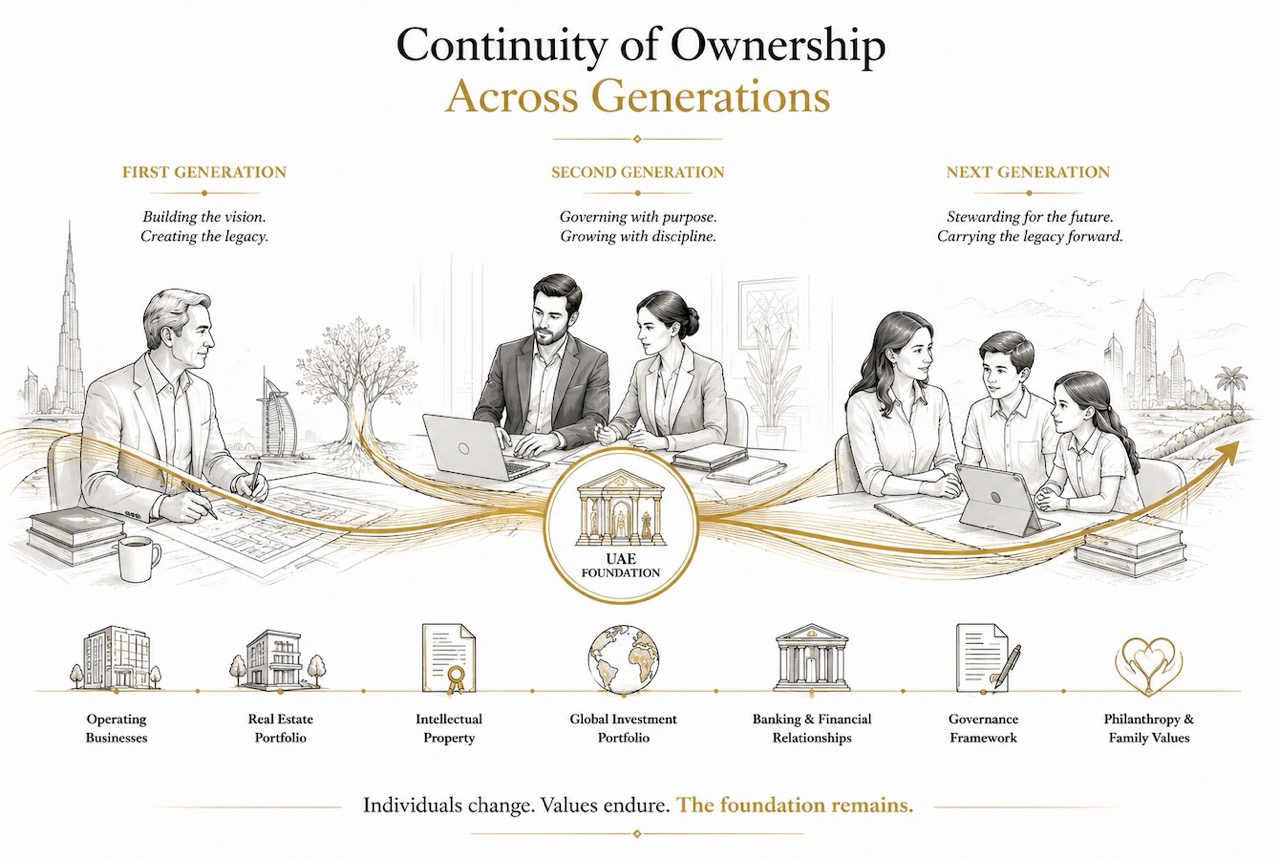
One of the greatest advantages of a foundation is that it separates ownership from day-to-day management.
During the founder’s lifetime, these two roles are often combined. The founder owns the business, manages its operations, makes strategic decisions, and oversees investments. As families grow and wealth passes to future generations, however, this model rarely remains practical.
Children or other beneficiaries may inherit an interest in the family’s wealth without having the experience, qualifications, or desire to manage the underlying businesses. Some may become lawyers, doctors, academics, artists, or entrepreneurs pursuing entirely different careers. Requiring every beneficiary to participate in management can lead to disagreements, inconsistent decision-making, and unnecessary disruption.
A foundation provides a different approach. It can retain ownership of the family’s assets while appointing directors or professional managers to oversee the operating companies. Beneficiaries continue to benefit from the wealth according to the foundation’s governing documents, without needing to manage the businesses themselves.
By separating ownership from management, the family can preserve professional governance, maintain business continuity, and reduce the risk of internal conflicts as new generations become involved.
Cross-Border Wealth Requires Cross-Border Planning
International families rarely hold all their wealth within one jurisdiction, a typical entrepreneurial family relocating to the UAE might own:
- Operating companies incorporated in Dubai
- Residential property in London
- Holiday homes in Europe
- Investment portfolios managed in Switzerland
- Intellectual property licensed internationally
- Private equity interests in Asia
- Bank accounts across several financial centres
Each asset remains subject to its own legal system, creating a UAE foundation does not automatically replace the legal requirements applicable in those jurisdictions.
Instead, the foundation becomes part of a wider international planning exercise, before transferring significant assets, advisers should evaluate matters including:
- Recognition of foundations under foreign law
- Local registration requirements
- Restrictions on foreign ownership
- Tax implications of transfers
- Corporate governance obligations
- Matrimonial property regimes
- Existing succession laws
- Reporting obligations
- Banking documentation
- Regulatory approvals where applicable
The objective is not merely to establish a UAE structure, it is to integrate that structure into the family’s global legal architecture.
DIFC, ADGM or RAK ICC: Choosing the Appropriate UAE Structure for International Family Wealth
Families frequently approach advisers with a seemingly straightforward question:
“Which is better: DIFC, ADGM or RAK ICC?”
The more accurate answer is that there is no universally superior jurisdiction. Each offers distinct legal and commercial advantages, and the appropriate choice depends on the family’s ownership structure, governance objectives, asset profile, operational footprint, and long-term succession strategy rather than headline comparisons or incorporation costs alone.
DIFC has developed one of the region’s most comprehensive private wealth ecosystems, combining foundations with family offices, investment management, banking, arbitration, and a mature network of professional advisers through the DIFC Family Wealth Centre. For internationally active entrepreneurs and family businesses with a significant presence in Dubai, this integrated environment can provide considerable practical advantages.
ADGM has similarly established itself as a leading jurisdiction for foundations, family offices, investment management, and institutional governance within Abu Dhabi’s expanding financial centre. Its common law framework and growing international reputation continue to attract families seeking sophisticated cross-border wealth planning and long-term governance solutions.
RAK International Corporate Centre (RAK ICC) provides a different proposition. While it is not a financial free zone like DIFC or ADGM, it has become a well-established jurisdiction for foundations, holding companies, private wealth structures, and family office ownership arrangements. Many internationally mobile families and entrepreneurs consider RAK ICC where enhanced confidentiality, flexible holding structures, and long-term asset ownership are priorities within a compliant regulatory framework.
The decision therefore extends well beyond incorporation formalities. It requires an assessment of how the chosen jurisdiction will support governance, succession, international asset ownership, banking relationships, regulatory compliance, and the family’s broader commercial objectives over the coming decades.
Unlike DIFC and ADGM, which operate as international financial free zones, RAK ICC functions as an international corporate registry. This distinction does not diminish its relevance for private wealth planning. On the contrary, many families and advisers consider RAK ICC particularly well suited for foundations, holding companies, and long-term ownership structures where governance, flexibility, and confidentiality are key considerations.
Among the factors commonly evaluated are:
| Consideration | DIFC | ADGM | RAK ICC |
| Legal Environment | Dubai International Financial Centre | Abu Dhabi Global Market | UAE International Corporate Registry |
| Separate Legal Personality | ✓ | ✓ | ✓ |
| Foundation Regime | ✓ | ✓ | ✓ |
| Holding Company Structures | ✓ | ✓ | ✓ |
| Family Office Ownership | ✓ | ✓ | ✓ |
| Cross-Border Asset Holding | ✓ | ✓ | ✓ |
| Private Wealth & Succession Planning | ✓ | ✓ | ✓ |
| Typical Users | International entrepreneurs, family businesses, UHNW families | Family offices, institutional investors, international families | Entrepreneurs, private investors, family offices, holding structures |
| Primary Strength | Integrated financial ecosystem and professional services | Common law governance and institutional wealth planning | Flexible holding structures, private wealth and family governance |
| Confidentiality | Limited public disclosure within a regulated framework | Limited public disclosure within a regulated framework | Enhanced confidentiality with limited public disclosure, subject to applicable laws |
| Banking & Advisory Ecosystem | Extensive | Extensive | Supported through UAE banking and professional advisers |
| Often Selected For | Dubai-centred international operations | Abu Dhabi-centred investment and governance structures | Foundations, holding companies, family wealth and succession planning |
No single jurisdiction should be regarded as universally superior. DIFC, ADGM and RAK ICC each serve different commercial and private wealth objectives, and in many cases they can complement rather than replace one another within a broader ownership structure. The appropriate choice depends on the family’s existing assets, operational footprint, governance requirements, succession objectives, banking relationships, confidentiality considerations, and wider international strategy. Selecting the right jurisdiction is therefore less about choosing the “best” option and more about identifying the structure that best supports the family’s long-term legal, commercial, and generational goals.
Tax Planning Requires Individual Analysis
Tax considerations frequently motivate international restructuring projects, however, private wealth planning should never begin with tax alone.
Instead, taxation should be evaluated within the broader context of governance, succession, commercial objectives, regulatory compliance, and long-term family strategy. The UAE has introduced a comprehensive corporate tax framework, and specific provisions exist regarding qualifying family foundations. Whether a particular foundation satisfies those requirements depends upon its legal structure, activities, beneficiaries, constitutional documents, and compliance with applicable legislation.
International taxation introduces additional complexity as families may simultaneously become subject to:
- Residence-based taxation
- Source-based taxation
- Controlled foreign company rules
- Transfer pricing considerations
- Reporting obligations
- Double taxation treaties
- Exit taxes
- Inheritance taxes
- Capital gains taxation
Accordingly, tax planning should never be isolated from legal planning. The most resilient structures are those that achieve commercial, governance, succession, and tax objectives simultaneously.
Trust, Governance and International Credibility
As families become more international, their ownership structures inevitably receive greater scrutiny.
Whether opening private banking relationships, acquiring overseas investments, establishing family offices, or expanding businesses across multiple jurisdictions, families are increasingly expected to demonstrate that their ownership structures are transparent, well governed, and supported by appropriate legal documentation.
This is where a professionally established foundation can provide significant practical value.
Rather than simply acting as a legal vehicle to hold assets, a foundation creates a clear governance framework that explains who is responsible for decision-making, how assets are managed, and how future beneficiaries are intended to benefit from the family’s wealth.
For banks, financial institutions, investors, and professional counterparties, this level of organisation often provides greater confidence than fragmented personal ownership spread across multiple individuals and jurisdictions.
A well-designed structure also facilitates ongoing regulatory compliance. Depending on the jurisdictions involved, families may need to satisfy requirements relating to beneficial ownership, source of wealth, source of funds, tax reporting, and anti-money laundering regulations. Addressing these matters from the outset generally makes the structure easier to operate over the long term and reduces administrative complexity as the family’s assets continue to grow.
Ultimately, modern private wealth planning is no longer measured by how little information a family discloses. It is measured by how effectively its ownership structure supports governance, regulatory compliance, institutional confidence, and long-term continuity.
A UAE foundation is therefore not simply a vehicle for holding wealth—it is a framework that helps internationally mobile families demonstrate that their wealth is organised, professionally governed, and prepared for future generations.
Common Planning Mistakes Families Make When Establishing a UAE Foundation
Most unsuccessful foundation structures do not fail because the legislation is inadequate.
They fail because the family attempted to solve a legal problem without first defining its long-term objectives.
A foundation should never be viewed as an off-the-shelf incorporation product. It is a governance framework that may remain in place for decades, supporting multiple generations, different asset classes, changing family dynamics, and evolving regulatory requirements.
The following planning issues are among the most common areas requiring careful legal consideration.
Establishing the Structure Before Defining the Strategy
One of the most common mistakes is treating the foundation as the starting point rather than the outcome of the planning process.
Before any incorporation documents are prepared, families should first determine what they are trying to achieve.
Is the priority preserving ownership of a family business? Preparing for succession? Consolidating international assets? Supporting future generations? Protecting long-term governance? Managing philanthropic activities?
Different objectives frequently require different governance arrangements.
The legal structure should reflect the family’s strategy—not the other way around.
Focusing Exclusively on Tax
Tax efficiency is naturally an important consideration for internationally mobile families.
However, tax should rarely become the primary driver of a wealth structure.
History demonstrates that far more family wealth is lost through poor governance, succession disputes, fragmented ownership, or poorly documented decision-making than through inefficient tax planning.
The most resilient structures are those that achieve governance, succession, commercial continuity, regulatory compliance, and tax efficiency simultaneously.
Retaining Excessive Founder Control
Founders often struggle with one difficult question:
How much control should I retain?
Maintaining complete authority may appear reassuring in the short term. In the longer term, however, excessive reserved powers can undermine the very continuity the foundation was intended to create.
If every significant decision continues to depend upon one individual, the structure may struggle to operate effectively following retirement, incapacity, or death.
The objective is therefore not to maximise or minimise founder control, it is to design an appropriate balance between leadership, independence, and continuity.
Treating Every Beneficiary Identically
Family businesses often involve individuals with different roles, levels of experience, and long-term aspirations. While one family member may actively lead the operating business, others may pursue careers outside the family enterprise or have little interest in participating in its management.
Applying identical governance rights to every beneficiary, regardless of their involvement or expertise, can create unnecessary challenges for both the business and the family. Decision-making may become slower, disagreements more frequent, and the ability to respond quickly to commercial opportunities may be reduced.
A carefully designed foundation allows governance to reflect these practical realities. Management responsibilities can be allocated to those best equipped to oversee the family’s businesses and investments, while economic interests remain protected for all beneficiaries in accordance with the family’s long-term objectives.
This distinction enables families to preserve both operational efficiency and intergenerational fairness without assuming that every beneficiary must play the same role in managing the family’s wealth.
Assuming the Foundation Never Needs Review
The circumstances that exist when a foundation is established rarely remain unchanged over the following decades. Families grow, businesses expand into new markets, investment portfolios evolve, and beneficiaries assume different roles and responsibilities. Regulatory developments, tax legislation, and cross-border reporting obligations may also change across the jurisdictions in which the family owns assets or resides.
Periodic legal and governance reviews help ensure that the foundation continues to reflect the family’s objectives while remaining appropriate for its commercial and regulatory environment. These reviews may consider whether the governance framework remains effective, whether the foundation’s constitutional documents continue to reflect the family’s intentions, and whether changes in ownership, investments, or international activities require adjustments to the overall structure.
For many internationally active families, the most successful foundations are those that evolve alongside the family itself. Private wealth planning is therefore best understood as an ongoing governance process rather than a single legal transaction completed at the moment of establishment.
A Strategic Framework for International Family Wealth
The strongest private wealth structures rarely begin with legal documents as they begin with strategic questions. Before selecting a jurisdiction or legal vehicle, internationally mobile families should undertake a comprehensive review of their existing ownership arrangements and future objectives.
That review commonly includes:
- The family’s long-term vision for ownership and succession
- Existing corporate structures
- International asset locations
- Residence and citizenship of family members
- Existing wills and estate planning
- Family business governance
- Shareholder arrangements
- Philanthropic objectives
- Future generations’ anticipated involvement
- Cross-border tax considerations
- Banking relationships
- Regulatory reporting obligations
- Potential dispute scenarios
- Long-term governance requirements
Only after these issues have been analysed can advisers properly evaluate whether a UAE foundation represents the appropriate solution—or whether a combination of companies, trusts, wills, shareholder agreements, and governance documents would better serve the family’s objectives.
This integrated approach reflects the way sophisticated private wealth planning is increasingly undertaken throughout the world’s leading financial centres.
How ASMA ALI ALMESSABI Advocates & Legal Consultants Advises International Families
Every family has a unique ownership structure, commercial history, and long-term vision, accordingly, no two foundation structures should be identical. At ASMA Ali Al Messabi Advocates & Legal Consultants, private wealth planning begins with understanding the family’s broader objectives rather than recommending a predetermined legal vehicle.
Our work may include:
- Assessing whether a foundation is appropriate for the family’s circumstances
- Advising on DIFC, ADGM and RAK ICC foundation, holding company and private wealth structures.
- Designing governance frameworks for family businesses
- Coordinating foundations with holding companies, shareholder agreements, and operating businesses
- Advising on succession planning for internationally mobile families
- Supporting family offices, entrepreneurs, founders, and private investors
- Coordinating with international legal and tax advisers where multiple jurisdictions are involved
- Reviewing existing ownership structures before significant restructuring
- Advising on family constitutions and governance documentation
- Providing ongoing legal support as family structures evolve over time
Our objective is not simply to establish legal entities. It is to help families create ownership structures capable of supporting continuity, responsible governance, and long-term stewardship across generations.

Building wealth is an extraordinary achievement. Preserving it across multiple generations is a different challenge altogether. As families become more international, ownership structures inevitably become more complex. Businesses expand into new markets, investments diversify across jurisdictions, and future generations develop different roles, aspirations, and responsibilities.
Without careful planning, that complexity can gradually undermine the very wealth it was intended to protect.Successful private wealth planning is therefore no longer defined solely by tax efficiency or succession documents. It is increasingly measured by the quality of governance.
The most resilient family structures separate ownership from management, establish clear decision-making processes, anticipate future change, and provide continuity that extends beyond the founder’s lifetime.
Within this evolving landscape, UAE foundations have emerged as one of the region’s most sophisticated legal tools for internationally mobile families. When properly integrated with broader corporate, estate, tax, and governance planning, they can provide a stable framework for preserving family businesses, coordinating international assets, and supporting future generations with clarity and confidence.
However, a foundation should never be viewed as a standalone product. Its effectiveness depends entirely on how well it reflects the family’s objectives, commercial reality, governance requirements, and cross-border legal considerations. For families seeking to preserve not only their wealth but also the continuity of their legacy, careful planning today may determine how successfully that legacy is carried forward tomorrow.
Frequently Asked Questions
What is the primary purpose of a UAE foundation?
A UAE foundation is generally used to support long-term wealth planning by providing a legal framework for owning assets, managing succession, establishing governance, and preserving continuity across generations. Depending on the family’s objectives, it may hold shares in businesses, investment portfolios, real estate structures, intellectual property, or other eligible assets.
Is a UAE foundation suitable only for ultra-high-net-worth families?
Not necessarily.While foundations are frequently associated with substantial private wealth, they may also be appropriate for successful entrepreneurs, family businesses, founders, and internationally mobile investors whose ownership structures have become increasingly complex.
The decision should depend on governance and succession needs rather than wealth alone.
Can a UAE foundation own international assets?
In many cases, yes. However, every asset remains subject to the laws of the jurisdiction in which it is located. Local legal, tax, regulatory, and registration requirements should therefore be reviewed before transferring significant international assets into a foundation.
Does establishing a foundation avoid inheritance laws?
A foundation should never be established with the expectation of circumventing applicable inheritance legislation. Succession planning must always be considered within the legal framework governing the relevant assets, jurisdictions, and family circumstances. Appropriate legal advice should be obtained before implementing any ownership structure.
Can beneficiaries manage the family business?
They may, but they do not have to. One of the principal advantages of a foundation is its ability to distinguish between ownership, governance, and operational management.
This allows professionally qualified family members—or external executives—to continue managing the business while beneficiaries receive economic benefits according to the family’s governance arrangements.
How often should a family foundation be reviewed?
A legal review should be considered whenever significant changes occur, including business sales, acquisitions, international relocation, births, deaths, marriages, divorces, major investments, or changes in tax or regulatory legislation.
Many families also benefit from periodic governance reviews even where no major events have occurred.
Is a foundation better than a trust?
Neither structure is universally superior, both can play important roles within international private wealth planning. The appropriate solution depends upon the family’s objectives, jurisdictional connections, governance preferences, tax considerations, and the nature of the assets involved.
Professional legal advice is essential before selecting any long-term ownership structure.
Can RAK ICC be a suitable jurisdiction for family offices and holding companies?
Yes, depending on the family’s objectives and the overall ownership structure. RAK ICC is frequently used for foundations, holding companies, and private wealth structures, making it an attractive option for families seeking long-term asset ownership, succession planning, and governance within a compliant legal framework. It may be particularly suitable where enhanced confidentiality, cross-border asset holding, and flexible ownership arrangements are priorities. However, the choice between RAK ICC, DIFC, and ADGM should always be based on the family’s assets, business activities, banking relationships, regulatory requirements, and long-term succession goals rather than on any single feature of a jurisdiction.