

Acquiring an established business in the United Arab Emirates can provide an international investor with immediate access to operating licences, employees, customer relationships, intellectual property, physical assets and an existing position in the market. A share acquisition, however, also places the buyer behind the history of the company it acquires. Rights and commercial relationships may pass with the business, but so may contractual exposure, regulatory deficiencies, tax liabilities, disputes and obligations created before the buyer assumed control.
Legal due diligence is the process through which that distinction is examined before the acquisition becomes irreversible.
Its purpose extends considerably beyond confirming that corporate documents have been uploaded to a data room. The investigation should establish what the buyer is actually acquiring, whether the target owns or controls the assets attributed to it, whether it is properly authorised to conduct its business, what liabilities remain within the company and whether the assumptions supporting the agreed valuation withstand legal scrutiny.
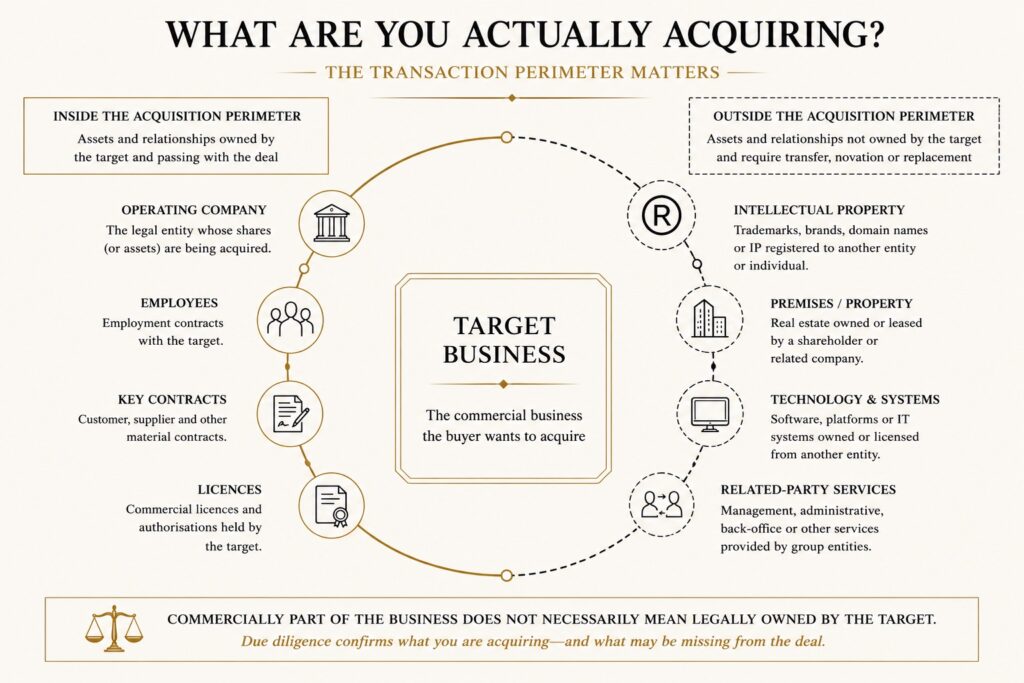
This analysis has particular importance in the UAE. A target may operate onshore, through one or more free-zone entities, within a regulated sector or as part of a wider group whose assets and operations are divided among several companies. The commercial presentation of a business does not necessarily correspond with the legal perimeter of the company whose shares are being sold.
A property used exclusively by the target may belong to its founder. A commercially important brand may be registered to another group company. Employees may support several related businesses. Revenue may depend on contracts containing change-of-control provisions. Financing arrangements may restrict a sale. A licence may not extend to every activity represented as part of the target’s business. Historic tax, employment, regulatory or compliance exposure may remain within the company after ownership changes.
None of these findings necessarily prevents an acquisition. Their significance lies in the effect they have on the transaction.
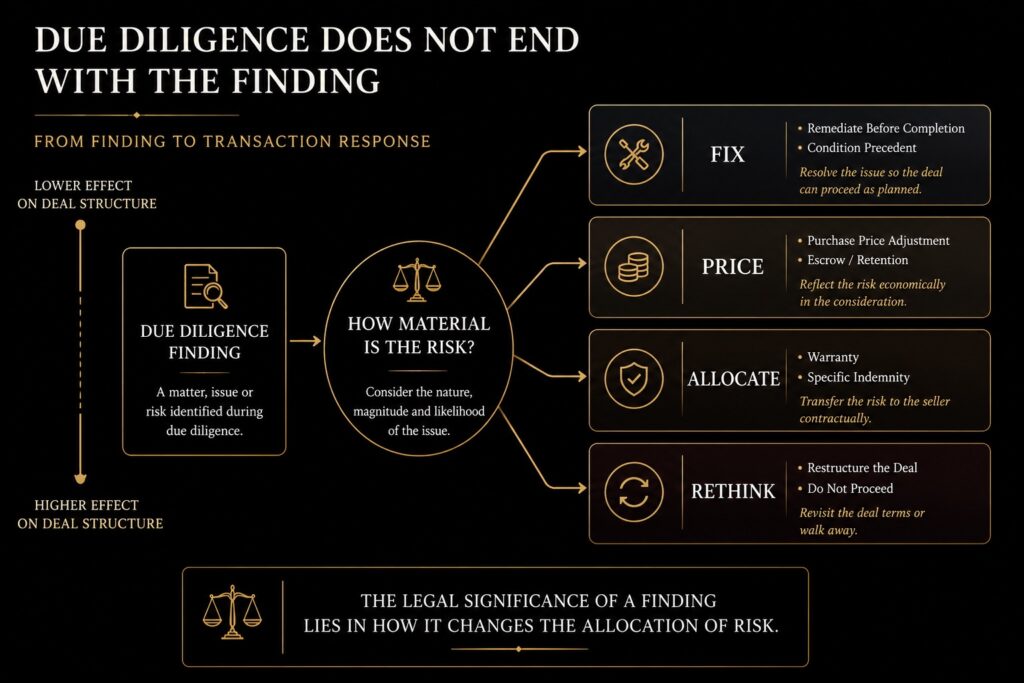
A risk identified through due diligence may require remediation before completion, regulatory or third-party consent, a change to the purchase price, a specific indemnity, additional warranty protection, escrow or retention arrangements, restructuring of the acquisition perimeter or a different allocation of responsibility between buyer and seller. A sufficiently fundamental finding may alter the investment decision itself.
The quality of legal due diligence should therefore be measured by its effect on the transaction rather than by the volume of documents reviewed. Its function is to determine whether the business the buyer believes it is purchasing corresponds with the legal position it will actually inherit and, where it does not, how the resulting risk should affect the terms on which the buyer is prepared to proceed.
Establishing the Transaction Perimeter
Before examining individual areas of legal risk, the buyer needs to establish precisely what constitutes the business being acquired.
This is more complex than identifying the name of the target company.
An operating business may comprise several legal entities, licences, contractual relationships and assets. Some may fall within the proposed acquisition and others may remain with the seller or its wider group. The transaction perimeter determines which of those elements will pass to the buyer and which will require separate transfer, replacement or continuing contractual arrangements.
The distinction between a share acquisition and an asset acquisition is fundamental.
In a share acquisition, the buyer acquires an ownership interest in the existing company. The legal entity continues to exist with its assets, contracts, employees, liabilities and historical exposure. The change occurs at shareholder level rather than through the creation of a new operating company.
That continuity is commercially convenient, but it also explains why historical liabilities matter. The buyer does not acquire only the future earnings of the target. It acquires an interest in the entity within which past obligations may already have arisen.
An asset acquisition presents a different risk profile. The parties define the assets, rights and, where agreed and legally transferable, liabilities that form part of the transaction. This can permit greater selectivity, but it introduces questions concerning title, assignment, employee arrangements, licences, third-party consents and the legal mechanics required to transfer the operating business.
Neither structure is inherently preferable. The appropriate approach depends on the target, commercial objectives, regulatory environment, tax position and risks identified during the transaction.
What matters at the outset is that the legal perimeter corresponds with the commercial proposition. If a buyer values a business because of its premises, intellectual property, contracts, personnel and licences, due diligence must establish whether those elements actually sit within the transaction being negotiated.
Corporate Structure, Ownership and Authority
Corporate due diligence establishes the legal foundation upon which the acquisition rests. The review ordinarily begins with the target’s incorporation, legal form, constitutional documents, ownership and corporate records. Its more important purpose is to establish whether the seller holds the interest it proposes to sell, whether the target has been validly organised and maintained, and whether restrictions exist that could affect the proposed transfer.
Historic ownership can be as important as the current position. Earlier transfers, reorganisations or changes in shareholding may reveal deficiencies in the chain of title. An irregularity in a prior transaction may ultimately affect the seller’s ability to demonstrate valid ownership of the interest now being offered to the buyer.
Existing shareholder arrangements require similar attention. Pre-emption rights, reserved matters, consent requirements, transfer restrictions, options and other contractual rights may affect whether the transaction can proceed in the manner contemplated.
Where the target forms part of a wider group, the corporate review should also identify subsidiaries, affiliates and material related-party relationships. The legal boundary between those entities is central to determining what the buyer will own following completion.
A target may operate commercially as part of an integrated group while owning relatively few of the resources upon which its business depends. Another group company may own the trademark, employ senior management, provide technology or hold property used by the target. Shareholders may have provided financing or guarantees personally. Common ownership may have allowed those arrangements to operate informally without creating immediate commercial difficulty.
A sale changes that environment, in fact once the target leaves the seller’s group, arrangements previously sustained by common ownership may need to be replaced by assignments, licences, leases, transitional services agreements or other contractual arrangements. Identifying those dependencies is therefore part of determining whether the target can operate independently after completion.
Foreign Ownership, Strategic-Impact Activities and Regulatory Status
The liberalisation of foreign investment has materially expanded the ability of international investors to own UAE businesses. It should not, however, be interpreted as establishing an unrestricted ownership regime for every activity.
The UAE Commercial Companies framework preserves special treatment for activities having a strategic impact. Depending on the activity concerned, foreign ownership may remain subject to regulatory conditions, approval requirements or national participation requirements determined within the applicable framework.
For an international buyer, the issue must be addressed at transaction level. The relevant question is not whether foreign investors can generally own UAE companies, but whether this particular investor can acquire the proposed interest in this particular business under the rules applicable to its activities.
Licensing analysis is equally important. A licence confirms more than the existence of the company. It defines the activities the business is authorised to conduct within the relevant licensing framework. Due diligence should therefore compare the target’s licensed activities with the business it actually conducts and the revenue streams on which its valuation is based.
Growing businesses can evolve more quickly than their formal licensing structure. New products may have been introduced, services expanded, activities carried out in additional jurisdictions or functions performed through affiliates. A valid commercial licence does not resolve the analysis if the target’s material operations extend beyond the activities it authorises.
Regulated sectors require a deeper review. Financial services, insurance, virtual assets, healthcare, education, telecommunications and other regulated activities can involve sector-specific approvals and supervisory requirements in addition to ordinary commercial licensing.
The acquisition itself may also constitute a regulated event. A change in ownership or control can trigger notification, consent or prior approval requirements even where the target’s existing operating licence remains valid.
That distinction has direct consequences for transaction documentation. If regulatory approval is required before control can lawfully change, the matter belongs within the conditions to completion and transaction timetable rather than on a post-closing compliance list.
| Risk Area | Principal Question | Potential Transaction Consequence |
| Corporate ownership | Does the seller hold valid title to the interest being sold? | Restructuring, title remediation, condition precedent |
| Licensing | Does the target have authority for its actual activities? | Licence amendment, approval, transaction restructuring |
| Foreign ownership | Is the proposed ownership structure permitted? | Regulatory approval or ownership restructuring |
| Competition | Does the acquisition require merger-control analysis or clearance? | Filing, condition precedent, delayed completion |
| Material contracts | Does change of control trigger consent or termination rights? | Third-party consent, valuation impact |
| Financing | Does the transaction trigger repayment or release requirements? | Refinancing, debt repayment, security release |
| Related parties | Does the target depend on assets/services outside the deal? | TSA, lease, assignment, price adjustment |
| Tax | Are historic and ongoing tax assumptions sustainable? | Indemnity, price adjustment, restructuring |
| Disputes | Are there material existing or contingent liabilities? | Indemnity, escrow, retention |
| IP / technology | Does the target actually own or control the key rights? | Assignment, licence, remediation |
Beneficial Ownership and the Integrity of Title
Legal ownership and beneficial control should be capable of reconciliation. The buyer needs to understand the persons who ultimately own or control the target, both to verify the ownership structure being acquired and to assess related regulatory, anti-money-laundering, sanctions and compliance issues.
Discrepancies between corporate records, beneficial ownership information and the seller’s description of the structure require explanation. Their significance depends on their cause.
Some arise from outdated filings or incomplete reorganisations. Others may reflect nominee arrangements, historic transfers or holding structures that require additional documentation. More serious discrepancies can indicate uncertainty over control or the existence of interests not apparent from the target’s formal records.
Historic title remains relevant here as well. The buyer needs confidence not only that the seller appears as the present shareholder but that the ownership interest has reached the seller through a legally defensible chain.
This is particularly important where the transaction involves founders, family groups or companies that have undergone several restructurings. Informality that caused little difficulty while ownership remained within the same commercial group can become significant when title must be transferred to an independent third-party buyer.
Ownership due diligence ultimately tests whether the seller can deliver what the acquisition agreement will require it to transfer.
Competition and Economic Concentration
Competition analysis should form part of the preliminary transaction assessment rather than being left until the acquisition agreement is substantially negotiated.
Federal Decree-Law No. 36 of 2023 Regulating Competition governs economic concentrations in the UAE, with the current notification thresholds established under Cabinet Decision No. 3 of 2025. The regime can apply to acquisitions and other transactions that result in direct or indirect control.
Under the current thresholds, notification may be required where the total annual sales of the concerned establishments in the relevant UAE market exceeded AED 300 million during the preceding fiscal year, or where their combined market share exceeded 40 per cent of transactions in the relevant UAE market.
Whether a transaction meets those thresholds requires more than looking at the purchase price or the target’s total global revenue. The relevant market, the activities of the parties and the economic effect of the transaction must be considered within the competition framework.
For acquisitions capable of meeting the notification criteria, merger-control analysis can become part of the critical path to completion. The issue affects transaction timing, conditions precedent and potentially the parties’ obligations between signing and closing.
The point is particularly important for international acquirers that may initially view the UAE component of a wider transaction as relatively small. Competition analysis should consider the parties’ relevant UAE activities rather than assume that a global transaction falls outside the domestic regime because the target is headquartered elsewhere.
Regulatory and competition clearance should therefore be assessed before the parties commit to a timetable that assumes completion can occur without prior governmental approval.
Material Contracts and Change-of-Control Risk
For many businesses, contractual relationships represent a substantial part of enterprise value.Revenue may depend on a small number of customers. Operations may rely upon exclusive distribution arrangements, long-term supply contracts, technology licences, franchise rights, financing facilities or strategic commercial partnerships. Legal due diligence must establish not merely that these contracts exist, but whether their value survives the acquisition.
Change-of-control provisions are especially important in a share transaction. Although the target remains the same legal entity after its shares are transferred, a material contract may give the counterparty consent, termination or other rights when ownership or control changes. An acquisition can therefore complete successfully at corporate level while simultaneously weakening one of the commercial relationships on which the purchase price was based.
Asset acquisitions present a related but different issue. If a material contract is to pass to the buyer, the agreement must be examined to determine whether it can be assigned or transferred and whether counterparty consent is required.
The substantive allocation of risk within material contracts also deserves attention. Exclusivity, minimum purchase commitments, unusual termination rights, uncapped liability, indemnities, guarantees, restrictive covenants, pricing commitments and renewal provisions can all affect the economics of the acquired business.
The review should be proportionate to commercial importance. Treating every agreement in a data room as equally significant can obscure the contracts that actually support revenue, supply, financing, technology or market access.
Where a material contract is vulnerable to termination or requires consent, the issue should flow directly into the acquisition process. Consent may become a condition precedent. A particular exposure may require an indemnity. A contract nearing expiry may affect valuation. A material discrepancy between the contractual position and the seller’s commercial presentation may require the buyer to reconsider the assumptions underlying the transaction.
Employment, Management and Key-Person Dependence
An acquisition transfers control of an operating organisation, not merely ownership of a corporate vehicle.
Employment due diligence should establish the workforce structure, material contractual terms, accrued entitlements, incentive arrangements, disputes and compliance with the employment regime applicable to the target.
The jurisdiction in which personnel are employed matters. Businesses operating within different UAE jurisdictions, including financial free zones with their own employment frameworks, cannot necessarily be reviewed against a single set of assumptions.
In many acquisitions, however, the more significant issue is concentration of commercial value in a small number of individuals.
Founder-led businesses, professional-services firms and specialist companies may depend heavily on personal relationships, technical expertise or management knowledge. If those individuals can leave shortly after completion, the buyer may acquire the legal entity without retaining part of the capability upon which the valuation was based.
Senior-management contracts, notice periods, incentive arrangements, restrictive covenants and retention measures therefore have a direct transactional dimension.
Informal remuneration arrangements also deserve scrutiny. Bonuses, commissions, shareholder benefits and other longstanding practices may create economic expectations or liabilities not apparent from standard employment contracts.
Where retention of key personnel forms part of the investment thesis, the issue belongs within the acquisition structure and negotiations rather than being deferred entirely to post-completion integration.
Real Estate, Leases and Operational Premises
The legal position of premises can be fundamental to businesses whose operations depend upon a particular location.
Due diligence should establish whether the target owns or leases the property it uses, the duration and terms of its occupancy rights, permitted use, renewal provisions and any restrictions or consent requirements that may be affected by the acquisition.
Related-party property arrangements require particular attention. A target may have occupied premises owned by its founder or another group company for many years without a formal long-term arrangement. While common ownership continues, the absence of contractual certainty may have little immediate commercial effect. Once the target is sold, the buyer may discover that an essential operational site falls outside the acquisition perimeter.
The same analysis applies to warehouses, manufacturing facilities, staff accommodation and other property necessary to operate the business.
Where the target depends on premises it does not own, continuity after completion must be secured through an appropriate legal arrangement. The issue is therefore not simply whether the company has somewhere to operate today, but whether the right to occupy that location will survive the transaction on acceptable terms.
Financing, Security and Existing Obligations
The target’s financing arrangements affect both enterprise value and completion mechanics. Material borrowing, shareholder loans, guarantees, security interests and other financing obligations should be identified together with the rights attached to them. The amount of debt is only part of the analysis.
Financing documents may contain change-of-control provisions, mandatory prepayment requirements, financial covenants or restrictions affecting distributions and asset transfers. Existing security can encumber assets that the buyer expects to control freely following completion.
Guarantees can create further separation issues. A target may have guaranteed liabilities of another group company, while its own facilities may benefit from guarantees or security provided elsewhere within the seller’s group. Completion can therefore require releases, replacement security or refinancing.
Related-party balances deserve equal attention. Shareholder loans may need to be repaid, capitalised, waived or incorporated into the agreed transaction economics. Undocumented balances can create uncertainty over whether amounts recorded within the group are legally recoverable debts or represent another form of financial support.
These findings feed directly into the mechanics of the acquisition. Debt may be refinanced at closing, deducted from equity value or remain outstanding under agreed arrangements. Security releases may be completion deliverables. Shareholder balances may need to be settled before control changes.
A profitable target can otherwise emerge from completion subject to financial restrictions and liabilities that were not reflected adequately in the buyer’s valuation.
Due Diligence and Purchase-Price Mechanics
Legal due diligence and purchase-price analysis are often treated as separate workstreams. In a well-structured acquisition, they continually inform one another.
The headline enterprise value agreed for a business is not necessarily the amount ultimately paid to the seller for its shares. Debt, cash, working capital, shareholder balances and other agreed adjustments can affect the equity value delivered at completion.
Legal diligence helps establish what sits behind those numbers. An item presented as ordinary working capital may represent a disputed receivable. A shareholder balance may be legally repayable debt. A financing arrangement may contain an early repayment obligation triggered by the acquisition. An undisclosed commitment may need to be reflected in the treatment of debt or liabilities. Material capital expenditure obligations may affect the buyer’s understanding of the target’s near-term cash requirements.
The parties must also determine how changes in the business between the valuation date and completion are treated. Transactions using completion accounts typically provide for post-completion determination or adjustment of specified financial measures. A locked-box structure instead fixes the equity price by reference to an earlier balance sheet and ordinarily relies on contractual protections against value being extracted from the target between the locked-box date and completion.
In the latter context, diligence into related-party payments, distributions and other potential leakage assumes particular significance. The buyer is relying upon the economic value represented at the agreed locked-box date remaining within the business, subject to specifically permitted items.
The appropriate mechanism depends on the transaction. The legal point is that due-diligence findings should be tested against the purchase-price methodology rather than confined to warranties and indemnities.
A risk that changes the target’s actual economic position may belong in the price mechanics, not merely in the liability provisions of the acquisition agreement.

Litigation, Arbitration and Contingent Liabilities
Pending litigation is an obvious due-diligence issue. Potential disputes are often more difficult to identify and can be equally significant.
The review should extend beyond filed court proceedings and arbitrations to threatened claims, material demand letters, regulatory investigations, contractual defaults and disputes reasonably capable of developing into financial or operational exposure.
The absence of formal proceedings does not establish the absence of litigation risk. Dissatisfied customers, terminated distributors, unpaid suppliers, employee grievances and regulatory correspondence can reveal contingent exposure before a claim has been formally commenced.
Materiality should be assessed by consequence rather than claim value alone. A relatively modest dispute may have substantial importance if it threatens a licence, intellectual property right or commercially critical contract. A larger monetary claim may have a different risk profile where adequate insurance or another form of protection exists.
Existing judgments and arbitral awards require separate examination, including whether the target is creditor or debtor and whether enforcement remains outstanding.
Where material exposure is identified, the acquisition agreement can allocate the economic risk through a specific indemnity, retention, escrow, price adjustment or other negotiated protection. Responsibility for conducting ongoing proceedings after completion may also need to be addressed.
The purpose of disputes due diligence is therefore not simply to catalogue litigation. It is to establish how unresolved claims affect the value and risk profile of the company whose ownership is changing.
Intellectual Property, Technology and Data
In technology, consumer, professional-services and brand-driven acquisitions, intellectual property can represent a substantial proportion of enterprise value.
Commercial use does not establish legal ownership. A target may rely on trademarks, software, domain names, databases, designs, copyrighted material and proprietary processes without owning all of those rights directly. Intellectual property may remain registered in the name of a founder or related company. Software may have been developed by contractors without sufficiently clear assignment arrangements. Rights may be registered in some markets but inadequately protected in others.
The review should establish which rights are material, who owns them, whether the target’s rights of use are sufficiently robust and whether the acquisition affects any relevant licences.
Technology dependencies extend the inquiry beyond proprietary rights. Businesses may rely extensively on third-party software, cloud infrastructure, APIs and digital platforms. Restrictions on transfer, termination rights or significant pricing changes can affect the target even where its core intellectual property is properly owned.
Data adds a separate legal dimension. Depending on the nature of the business and jurisdictions involved, privacy compliance, cybersecurity governance, processing arrangements, cross-border data flows, material incidents and contractual obligations concerning data may all require investigation.
These matters are not merely technical considerations. If the target does not securely own or control the technology, intellectual property or data rights on which its business model depends, the legal asset base may not support the valuation attributed to it.
Tax Due Diligence in the UAE’s Corporate Tax Environment
Corporate tax has become an established component of UAE acquisition due diligence.
The investigation should address the target’s registrations, filings, material tax positions and historical exposure, together with VAT and other tax matters relevant to its activities. The proposed acquisition structure should also be examined for its own tax consequences.
Free-zone targets require particular care. Incorporation in a UAE free zone does not, by itself, establish entitlement to a 0 per cent corporate tax rate. The Qualifying Free Zone Person regime depends upon statutory conditions, including matters concerning adequate substance, qualifying income, transfer pricing compliance and the nature of the activities and income concerned.
An acquirer should therefore distinguish the target’s corporate status from its tax status. A business marketed as a “free-zone company” may not necessarily enjoy the tax treatment that a buyer unfamiliar with the regime assumes from that description.
Historic related-party transactions can also warrant examination, particularly where they affect transfer pricing, the target’s tax position or arrangements that will cease following separation from the seller’s group.
Tax diligence and transaction structuring should be coordinated. Share and asset acquisitions can produce different tax consequences, while restructuring undertaken before completion may itself require analysis.
The objective is not simply to establish whether returns have been filed. It is to determine whether the tax assumptions incorporated into the valuation and transaction structure remain defensible after the target’s actual position has been reviewed.
AML, Sanctions, Regulatory Compliance and Reputational Exposure
An acquisition can expose the buyer to the target’s compliance history as well as its future earnings. The appropriate depth of investigation depends on the business. A regulated financial institution or virtual-asset business requires a different level of review from a conventional commercial enterprise. Companies operating internationally, dealing with higher-risk counterparties or relying on intermediaries may also justify enhanced scrutiny.
Relevant areas can include anti-money-laundering controls, sanctions compliance, beneficial ownership, customer and counterparty screening, regulatory correspondence, internal policies and the effectiveness of the target’s compliance framework.
International buyers must also consider the regulatory environment applicable to their own group. An activity or relationship permissible in the UAE may still create compliance implications under sanctions, anti-bribery or other rules applicable to the buyer, its financing sources or its parent organisation.
Reputational risk can be commercially material even where immediate legal liability is uncertain. Undisclosed ownership interests, questionable intermediaries, weak compliance systems or historic relationships with higher-risk counterparties may affect banking relationships, regulatory approvals and the ability to integrate the target into an international corporate group.
Compliance diligence is most effective when calibrated to the target’s actual risk profile rather than conducted as a generic questionnaire exercise.
Environmental and Sector-Specific Exposure
Environmental due diligence will not be equally relevant to every acquisition. For businesses involving manufacturing, industrial facilities, energy, waste, chemicals, construction, logistics or land-intensive operations, however, it can form a material part of the liability analysis.
The review may need to consider permits, environmental approvals, historic operations, waste-management obligations, contamination risk and contractual allocation of environmental responsibility.
The significance can extend beyond regulatory compliance. Environmental exposure may affect the value of land, require remediation expenditure, interfere with future development or create liabilities that remain within the target following a share acquisition.
Sector-specific regulation can raise comparable issues in other industries. The legal diligence scope should therefore be built around the target’s actual activities rather than assume that a standard corporate checklist captures every material regulatory exposure.
This risk-based approach is one of the principal distinctions between comprehensive due diligence and indiscriminate due diligence. The former investigates what can materially affect the acquisition; the latter simply asks the same questions of every target.
Related-Party Transactions and the Business After Separation
Related-party arrangements can materially distort the apparent independence and profitability of a target.
A business may rely on its wider group for premises, employees, intellectual property, financing, procurement, technology, guarantees or management services. Some arrangements may be formally documented; others may exist largely because the parties have historically shared common ownership.
A sale tests whether those arrangements can survive separation. If the target occupies a shareholder’s property without a long-term lease, uses another company’s trademark without a formal licence or benefits from group services below market cost, its historic financial performance may not represent the cost of operating as an independent business.
The issue affects both operational continuity and valuation. The buyer needs to establish which related-party relationships will terminate at completion, which should continue and which must be replaced on arm’s-length terms. Transitional services agreements, new leases, IP assignments, employee arrangements, refinancing and other separation measures may be required.
Historic related-party dealings can also require examination for liabilities, balances and transactions that should be settled before completion.
The central question is prospective: can the target operate after the acquisition on the assumptions that supported the buyer’s valuation?
Due diligence into related parties is therefore not simply an exercise in identifying conflicts. It is a test of the target’s standalone business model.
A Due-Diligence Finding Is Only Useful If It Changes the Deal
Few operating businesses are free of legal imperfections. The purpose of due diligence is not to produce an exhaustive catalogue of them.
Materiality is what converts an observation into a transaction issue.
A licensing deficiency that can be corrected before completion requires a different response from a regulatory problem that threatens the target’s ability to conduct its principal business. A minor contractual irregularity is not equivalent to a change-of-control right held by the target’s largest customer. A historic employment issue differs from an unresolved tax exposure whose amount cannot yet be quantified.
The legal team must therefore move from identification to consequence. Some findings require remediation. Others affect valuation. Certain risks should remain economically with the seller. Others can be accepted by the buyer if adequately reflected in the price. Regulatory approvals and critical third-party consents may need to be obtained before completion. A defect affecting ownership of a core asset may require restructuring of the transaction perimeter.
In sufficiently serious cases, the finding may undermine the rationale for proceeding, this is where legal due diligence becomes transaction advice.
A red flag that appears in a report but is not reflected in the acquisition agreement, purchase-price mechanics, completion process or investment decision has not necessarily been resolved. The transaction documents should embody the parties’ agreed response to the risks the investigation has uncovered.
Warranties, Indemnities and Disclosure
The acquisition agreement converts much of the due-diligence analysis into contractual risk allocation. Warranties generally establish contractual statements concerning the target, its business and the circumstances in which the buyer is entering the transaction. Their precise legal effect depends on the governing law and drafting, but they can perform an important disclosure and risk-allocation function.
Indemnities serve a different purpose and are commonly negotiated for identified risks where the parties agree that the economic consequences of a specified liability should remain with the seller if it crystallises.
The distinction becomes important once diligence has revealed a known exposure. A specific historic tax issue, dispute or regulatory liability may require a different contractual response from the possibility that an unknown liability exists somewhere within the target’s history. Broad warranty protection should not automatically be assumed to provide the same economic allocation as a specifically negotiated indemnity.
Disclosure forms the other side of that process. The seller may disclose matters qualifying the warranties, while the buyer needs to understand how those disclosures affect the contractual protection it is receiving. The diligence exercise, disclosure process and acquisition agreement should therefore be read as parts of the same risk-allocation system.
Limitations on claims require equal attention. Time limits, financial thresholds, caps, exclusions, knowledge qualifications and conduct provisions can materially affect the practical value of warranty or indemnity protection.
The strength of an acquisition agreement cannot therefore be judged by the breadth of its warranties alone. The relevant question is how the entire contractual framework allocates the risks identified during diligence and those that remain unknown at completion.
Conditions Precedent and the Road to Completion
Some risks should be resolved before ownership changes rather than compensated for afterwards. Regulatory approvals, competition clearance where required, third-party consents, financing releases, corporate restructuring, licence amendments and other matters essential to the legality or commercial integrity of the transaction may therefore become conditions precedent.
The distinction between a condition precedent and a post-completion undertaking can be commercially significant. Once the buyer has completed and paid the consideration, its negotiating position changes. Where an unresolved matter affects regulatory approval, title to a core asset, continuity of a critical contract or the legal ability of the target to conduct its business, postponing resolution until after completion may expose the buyer to a risk that contractual damages cannot adequately address. Not every diligence finding belongs in the conditions precedent. Excessive conditionality can make a transaction unnecessarily difficult to close and increase execution risk.
Materiality should determine the approach. Completion mechanics should then specify what must occur when ownership changes: payment of consideration, transfer of shares or assets, delivery of corporate approvals, management changes, release or replacement of security, settlement of shareholder balances and delivery of the documents necessary to place the buyer in the agreed legal position.
Due diligence therefore continues to shape the transaction through signing, the period before closing and completion itself.
Post-Acquisition Risk Does Not End at Completion
Completion transfers ownership. It does not cure every deficiency identified in the target. Some matters will deliberately remain for post-acquisition remediation. Corporate records may require correction. Licences may need updating. Contract templates may need standardisation. Intellectual property protection may require strengthening. Compliance systems may need to be aligned with the buyer’s group standards.
Those matters should form part of a defined integration programme rather than disappear when the transaction team closes the acquisition.
International buyers may also need to bring the target within group frameworks governing delegated authority, contracting, financial controls, data protection, compliance, cybersecurity and corporate governance.
The distinction between accepted risk and remediable deficiency is important. Some liabilities form part of the economics on which the buyer agreed to proceed. Others represent weaknesses that should be corrected to protect the acquired business going forward.
Post-completion legal integration is therefore a continuation of the transaction rather than an unrelated administrative exercise. The acquisition gives the buyer control of the target; integration determines how effectively that control is converted into a stable operating business.
How International Buyers Should Approach UAE M&A Due Diligence
A disciplined diligence process begins with the investment thesis rather than the data room. Counsel should understand why the buyer wants the target, which assets and relationships support the valuation, where the principal regulatory exposure lies and what circumstances would materially undermine the commercial rationale for the transaction.
The scope can then be weighted accordingly. A regulated fintech acquisition may place licensing, technology, data, AML and change-of-control approval at the centre of the review. A property-intensive business may require deeper analysis of real estate, financing and environmental exposure. A professional-services acquisition may depend disproportionately on client relationships and key personnel. A technology transaction may turn principally on intellectual property ownership, software dependencies and data governance.
Comprehensive diligence does not require every legal issue to receive equal attention. Material findings should also be escalated while the transaction remains capable of being changed. A fundamental problem identified only in the final report may technically have been discovered through due diligence, but the process has failed if the buyer no longer has sufficient time to investigate, renegotiate or restructure the transaction effectively.
The strongest legal teams therefore treat diligence as an active transaction workstream. Findings move continuously into valuation discussions, regulatory analysis, transaction documents and completion planning. The final report records that analysis. It should not be the first time the buyer learns what matters.
How ASMA Supports UAE M&A Transactions and Due Diligence
ASMA Ali Al Messabi Advocates & Legal Consultants advises international businesses, investors, entrepreneurs and corporate groups on UAE acquisitions, strategic investments and related corporate transactions.
The firm’s work can extend from the initial structuring of an acquisition through legal due diligence, regulatory and corporate analysis, review of material contracts and liabilities, negotiation of transaction documents and completion.
Where a target operates across several UAE jurisdictions, conducts regulated activities or forms part of an international ownership structure, the transaction may require coordination across corporate, regulatory, contractual, employment, real estate, dispute and other legal workstreams.
Due-diligence findings are assessed in the context of the acquisition rather than as isolated observations. Depending on their significance, they may require restructuring, regulatory approval, conditions precedent, purchase-price adjustments, warranties, indemnities, disclosure, completion protections or post-acquisition remediation.
The objective is to establish the legal position of the business the client proposes to acquire and ensure that the transaction documents reflect the risks the buyer has agreed to assume.
Due Diligence Should Determine the Deal the Buyer Is Prepared to Make
Legal due diligence is commonly described as an investigation conducted before an acquisition. Its more important function is to determine whether the transaction the buyer initially contemplated remains the transaction it should complete after the target has been examined in detail.
A well-managed company may emerge from diligence with relatively limited issues requiring contractual protection. In other cases, the investigation may reveal that the commercial business and the legal entity being acquired do not align as closely as expected. Assets may sit outside the target, licences may require attention, important contracts may be vulnerable to a change of control, historical liabilities may remain unresolved or the business may depend upon related-party arrangements that will not survive completion.
Those findings do not necessarily prevent the acquisition. They alter its legal or economic terms. The purchase price may need adjustment. A known exposure may remain with the seller through an indemnity. Regulatory or competition approval may become a condition of completion. Consideration may be retained or placed in escrow. An asset may need to be transferred into the target before closing. Financing may need to be refinanced or security released. The buyer may require a critical counterparty’s consent before assuming control.
In more serious circumstances, due diligence may demonstrate that the assumptions supporting the acquisition cannot be reconciled with the target’s legal position. That is not a failure of the transaction process. Identifying that divergence before the buyer becomes committed is one of the principal purposes of due diligence.
For international buyers entering or expanding within the UAE, the quality of legal due diligence should therefore be measured neither by the number of documents reviewed nor by the length of the resulting report. Its value lies in establishing what the buyer is acquiring, what liabilities accompany it, which risks can be corrected, which must be allocated contractually and which materially alter the investment decision.
The objective is not to acquire a business without legal risk. No operating business can sensibly be assessed against that standard. It is to acquire the business with a defensible understanding of the risks that matter and on transaction terms that reflect them.

Frequently Asked Questions
What should a buyer investigate before acquiring a UAE company?
The scope depends on the target and transaction. Legal due diligence commonly examines corporate ownership and authority, licensing and regulatory status, beneficial ownership, competition issues, material contracts, employment, property, financing and security, disputes, intellectual property, technology and data, tax, compliance and related-party arrangements.
The review should ultimately establish whether the assets, rights, personnel and commercial relationships supporting the target’s value are legally contained within, or securely available to, the business the buyer will own after completion.
What is the difference between buying shares and buying the assets of a UAE business?
A share acquisition transfers ownership of the company itself. The company generally continues to hold its existing assets, contracts, employees, rights and liabilities after the ownership change. An asset acquisition involves the purchase of specified assets or components of the business. Contracts, licences, employees and other rights may require separate transfer analysis, consent or regulatory steps.
The appropriate structure depends on the commercial objective, liability profile, regulatory position, tax consequences and characteristics of the target.
Can foreign investors own 100 per cent of a UAE company?
Foreign ownership has been substantially liberalised in the UAE, but the position depends on the company’s activities and applicable regulatory framework. Activities designated as having a strategic impact may remain subject to particular ownership conditions, approvals or national participation requirements. Regulated industries can impose additional requirements.
An international buyer should therefore establish the ownership rules applicable to the specific target rather than rely on a general assumption that every UAE business is available for unrestricted foreign ownership.
Can a UAE acquisition require competition approval?
Yes, where the transaction constitutes an economic concentration falling within the UAE competition regime and the applicable thresholds and conditions are met. Under the current framework, the analysis can involve annual sales in the relevant UAE market and the parties’ combined market share. The relevant market and the nature of the control being acquired are therefore important.
Potential competition clearance should be considered early because a filing requirement can affect transaction documentation and the timetable to completion.
Why are change-of-control clauses important in an acquisition?
A share acquisition changes ownership or control of the target even though the target remains the same legal entity. Material contracts may give counterparties consent, termination or other rights when that occurs. A change-of-control provision in a major customer, financing, distribution or technology agreement can therefore affect the commercial value of the acquisition even where the share transfer itself is legally valid.
Does acquiring all the shares eliminate concerns about who owns the target’s assets?
No. Material assets associated commercially with the target may legally belong to shareholders, founders or related companies. Property, intellectual property, equipment or other resources used by the target should therefore be examined to determine whether they are owned by the company or available under arrangements that will remain effective following completion.
Are UAE free-zone companies subject to different due-diligence considerations?
Potentially. The relevant free-zone rules, licensing requirements and regulatory framework need to be considered alongside applicable federal law. DIFC and ADGM also maintain distinct legal and regulatory frameworks in several areas. Due diligence should therefore reflect the target’s actual jurisdiction and activities rather than treat all UAE entities identically.
Free-zone incorporation should likewise not be confused with automatic entitlement to preferential corporate tax treatment.
Does a buyer inherit the target company’s historical liabilities in a share acquisition?
A share acquisition changes ownership of the company rather than replacing the legal entity. Liabilities that remain obligations of the target can therefore continue after completion. This is one reason historical legal, financial and tax diligence is important and why acquisition agreements commonly use warranties, indemnities, price mechanisms and other contractual protections to allocate pre-completion risk.
How can due diligence affect the purchase price?
Due-diligence findings can affect valuation directly or influence the mechanics used to calculate the consideration. Debt, cash, working capital, shareholder balances, disputed receivables, financing obligations and other liabilities may affect equity value. Particular findings may also justify a price reduction, escrow, retention or another negotiated adjustment.
In locked-box transactions, diligence into leakage and related-party payments can be particularly important, while completion-account transactions may require careful analysis of the items included within the agreed adjustment mechanism.
What is the difference between a warranty and an indemnity in an M&A transaction?
Warranties generally comprise contractual statements concerning the target, business or transaction and can support disclosure and contractual remedies, subject to the governing law and agreed limitations. Indemnities are commonly used to allocate the economic consequences of specified identified risks.
A known tax exposure, dispute or regulatory issue may therefore require a different contractual response from the possibility of an unidentified liability existing within the target.
Should due diligence cover beneficial ownership, AML and sanctions?
Where relevant to the target and transaction, yes. Ownership and control can be important to corporate, regulatory, AML and sanctions analysis. The appropriate depth of review depends on the target’s activities, customers, counterparties, jurisdictions and regulatory profile.
International buyers may also need to consider compliance requirements applicable to their own corporate group or financing arrangements.
Why does related-party due diligence matter?
A target may depend on shareholders or related companies for property, personnel, intellectual property, financing, procurement, guarantees, technology or management services. Those arrangements may operate effectively under common ownership but cease or require replacement after the target is sold. They can also affect whether the target’s historic financial performance represents its true standalone cost base.
Should the buyer investigate disputes even if no court proceedings have been filed?
Yes. Filed litigation and arbitration represent only part of potential dispute exposure. Threatened claims, contractual defaults, demand letters, regulatory correspondence, employment disputes and deteriorating commercial relationships may indicate liabilities before formal proceedings begin.
Their importance should be assessed according to potential financial, regulatory and operational consequences.
Can regulatory approval be required even if the target already holds a valid UAE licence?
Yes. In regulated sectors, the acquisition or change in control itself may trigger notification or prior approval requirements independently from the target’s existing licence. This is why regulatory due diligence must consider both the target’s current authority to operate and the legal consequences of the proposed ownership change.
Does legal due diligence end when the acquisition agreement is signed?
No. Diligence findings may affect conditions precedent, regulatory and competition approvals, third-party consents, completion deliverables and actions required between signing and closing. Some deficiencies may also be intentionally deferred for post-completion remediation and should become part of the buyer’s integration programme.
How early should UAE legal counsel become involved in an acquisition?
Preferably before the transaction structure and principal commercial terms become difficult to change. Early legal involvement can help define the acquisition perimeter, identify ownership and regulatory constraints, determine whether competition or sector-specific approvals may be required and ensure that material legal findings can influence valuation, transaction structure and acquisition documentation while those matters remain negotiable.