

A favourable judgment or arbitral award may determine a dispute, but it does not necessarily resolve the commercial problem that gave rise to it. Where the unsuccessful party does not comply voluntarily, the successful claimant must still convert the decision into recovery. In a cross-border dispute, that process may involve a different jurisdiction, a different court and legal questions that were never at issue in the original proceedings.
This is particularly relevant to businesses and investors with interests in the United Arab Emirates. A dispute may be litigated in England, France, the United States or another jurisdiction while the judgment debtor owns property, shares or other assets in the UAE. An arbitration may be seated outside the country even though the respondent conducts substantial business in Dubai or Abu Dhabi. Success abroad may therefore depend ultimately on whether the resulting decision can be enforced in the UAE and whether assets are available to satisfy it.
The UAE provides several routes through which foreign judgments and arbitral awards may be enforced. The appropriate route depends on the nature of the decision, its country of origin, the existence of an applicable treaty or convention, the jurisdiction in which enforcement is sought and the procedural history of the underlying proceedings. A foreign court judgment and a foreign arbitral award may both establish a payment obligation, but they reach the enforcement stage through different legal frameworks.
Enforceability is only part of the analysis. A judgment may satisfy the legal requirements for enforcement but produce little recovery if the debtor has no identifiable assets capable of execution. Conversely, substantial assets in the UAE provide limited assistance if the creditor has not established an effective legal route through which the underlying judgment or award can be enforced against them.
For international businesses, the central question is consequently broader than whether a foreign judgment or arbitral award can be enforced in the UAE. The real issue is how the decision can be converted into an effective recovery against assets located within the country.
That question is best considered before the underlying proceedings have concluded. In significant international disputes, the location of assets can influence the choice of forum, applications for interim or protective measures, settlement strategy and the timing of enforcement action. At the transactional stage, enforceability may also influence the drafting of jurisdiction and arbitration clauses long before a dispute arises.
Cross-border enforcement should therefore be understood as part of the wider management of legal and commercial risk, rather than as an administrative exercise that begins only after judgment.
The UAE’s Role in Cross-Border Enforcement
The UAE’s position as a centre for international trade, investment, finance, real estate and corporate activity has increased its significance as an enforcement jurisdiction. UAE companies enter contracts governed by foreign laws; international investors hold interests through UAE entities; multinational groups maintain assets and operating businesses in the country; and commercial agreements frequently provide for litigation or arbitration outside the jurisdiction in which one party’s assets are ultimately located.
The resulting scenarios are varied. A creditor may hold an English court judgment against a company owning property in Dubai. An arbitral award rendered in Singapore may be directed against a business with receivables or bank accounts in the UAE. A dispute between international shareholders may have been determined abroad while the relevant investment or corporate interest remains within the country.
Proceedings having taken place elsewhere do not, in themselves, prevent the resulting decision from being enforced in the UAE. At the same time, a foreign judgment does not automatically acquire the same executable effect in the UAE that it enjoys in the jurisdiction in which it was issued.
For foreign court judgments pursued through the onshore UAE courts, the principal domestic framework is Federal Decree-Law No. 42 of 2022 Promulgating the Civil Procedure Code. Article 222 addresses the execution of judgments and orders issued in foreign countries and establishes a reciprocity principle together with conditions that must be verified before enforcement may be ordered.
International treaties can provide a different basis for enforcement. The UAE participates in regional and bilateral arrangements concerning judicial cooperation, and the Civil Procedure Code preserves the operation of applicable treaties. Whether such an instrument exists between the UAE and the country from which a judgment originates should accordingly be considered at an early stage.
Foreign arbitral awards occupy a different legal position. The UAE has been a contracting state to the 1958 Convention on the Recognition and Enforcement of Foreign Arbitral Awards, commonly known as the New York Convention, since 2006. The Convention provides an international framework through which qualifying arbitral awards may be recognised and enforced across contracting states, subject to defined grounds upon which recognition or enforcement may be refused.
There is consequently no single UAE procedure applicable to every overseas decision. The creditor must establish the nature of the instrument it holds and the legal framework governing its enforcement before determining how that right can be pursued against the debtor’s UAE assets.
From Judgment to Recovery
Cross-border enforcement is sometimes discussed as though obtaining recognition of a foreign decision and recovering the underlying debt were substantially the same objective. In practice, they present different legal and commercial problems.
The terminology requires care. Recognition, enforcement and execution have particular meanings within different legal systems and should not be treated as though every UAE matter follows an identical three-stage statutory sequence. They nevertheless provide a useful way of understanding the creditor’s position.
At one level lies the question of whether the foreign judgment or award can be given legal effect within the relevant UAE jurisdiction. At another lies the creditor’s ability to invoke the available enforcement machinery. Beyond both is the economic objective of identifying assets legally belonging to the debtor and converting enforcement rights into actual recovery.
The importance of that distinction becomes apparent where corporate groups are involved. A claimant may obtain a substantial judgment against a trading subsidiary whose wider group owns valuable businesses, property and investments in the UAE. Those commercial connections do not make every group asset available to satisfy the subsidiary’s debt. Assets owned by a parent company, sister company, shareholder or director do not ordinarily become executable merely because those persons are associated with the judgment debtor.
Apparently valuable assets may present their own complications. Property may be mortgaged. Shares may belong to another entity. Receivables may have been assigned or encumbered. Other creditors may have prior or competing rights. The existence of a financially substantial corporate group is therefore not equivalent to the existence of unencumbered assets legally available to satisfy a particular judgment.
For substantial claims, asset analysis should accompany the enforcement analysis from an early stage. Understanding the debtor’s financial and corporate position can inform applications for protective measures, settlement negotiations, decisions about parallel enforcement in different jurisdictions and the amount of further expenditure that can reasonably be committed to recovery.
An effective enforcement position ultimately requires both a sound legal route and a realistic path to assets capable of satisfying the debt.

Foreign Court Judgments and Arbitral Awards Require Different Analysis
A fundamental distinction in cross-border enforcement is that between a judgment issued by a foreign national court and an award rendered by an arbitral tribunal. A foreign court judgment derives its authority from the judicial system of another state. Where enforcement is sought through the onshore UAE courts and no applicable treaty establishes a different regime, Article 222 of the Civil Procedure Code provides the principal domestic framework.
An arbitral award has a different juridical foundation. Arbitration derives from the parties’ agreement to submit disputes to a tribunal, while international enforcement is significantly supported by the New York Convention. The Convention establishes a multilateral framework for recognition and enforcement among contracting states and confines refusal to specified grounds.
This international enforcement architecture is one reason arbitration is frequently selected for substantial cross-border transactions. It does not guarantee enforcement of every award, nor does it displace the procedural requirements of the jurisdiction in which enforcement is sought. It does, however, provide a widely established mechanism for carrying qualifying arbitral awards across national borders.
A further distinction arises within the UAE. An award rendered in an onshore UAE-seated arbitration is not a foreign arbitral award. Its enforcement is governed principally by Federal Law No. 6 of 2018 on Arbitration, as amended. DIFC- and ADGM-seated arbitrations, in turn, operate under their respective arbitration regimes.
Classification is therefore consequential. A foreign court judgment, a foreign arbitral award and a UAE-seated arbitral award arising from the same commercial relationship may require materially different enforcement strategies.
Which UAE Enforcement Framework Applies?
| Decision / Award | Typical Legal Framework | Principal Issue to Establish | Key Consideration |
| Foreign court judgment | UAE Civil Procedure Code and any applicable treaty | Whether the foreign judgment satisfies the applicable enforcement requirements | Reciprocity, jurisdiction, due process, finality and public order may be relevant |
| Foreign arbitral award | New York Convention together with the applicable UAE framework | Whether the award qualifies for recognition and enforcement | Refusal is confined to recognised Convention grounds where the Convention applies |
| Onshore UAE-seated arbitral award | UAE Arbitration Law | Confirmation and enforcement under the domestic arbitration framework | Statutory enforcement and challenge provisions apply |
| DIFC-related judgment or award | DIFC Courts and applicable DIFC legislation | DIFC jurisdiction and the relevant recognition/enforcement route | Relationship with wider Dubai enforcement must be considered on the facts |
| ADGM-related judgment or award | ADGM Courts and applicable ADGM legislation | ADGM jurisdiction and applicable enforcement framework | ADGM operates its own common-law judicial and arbitration regime |
Enforcing a Foreign Court Judgment Through the Onshore UAE Courts
Where no applicable treaty establishes a different regime, Article 222 of the Civil Procedure Code provides the principal domestic route for seeking enforcement of a foreign court judgment through the onshore UAE courts.
The application is made by petition to the Execution Judge. The legislation provides for an order to be issued within five working days from submission of the petition, subject to the statutory requirements, and permits direct appeal of the resulting order in accordance with the applicable procedures.
The five-working-day period should be understood in its proper context. It concerns the statutory determination of the petition; it does not represent the expected duration of the entire enforcement and recovery process. Documentary requirements, challenges, appeals and the subsequent execution against particular assets may extend the practical timetable considerably. The substantive conditions are more important.
Jurisdiction forms part of the statutory inquiry. Article 222 addresses the jurisdiction of the UAE courts over the underlying dispute as well as the jurisdiction of the foreign court according to the relevant rules in the country of origin. The issue requires consideration of the statutory wording together with applicable UAE judicial interpretation and should not be reduced to the assumption that any connection between the dispute and the UAE necessarily prevents enforcement.
The foreign judgment must also have been issued by a competent court in accordance with the law of the jurisdiction in which it was rendered and satisfy the relevant formal requirements.
Due process is equally significant. The parties against whom the judgment was issued must have been summoned and duly represented. Service is consequently more than a procedural concern confined to the original foreign litigation. Where UAE enforcement may later be required, the manner in which the defendant was notified and afforded an opportunity to participate can have consequences at the enforcement stage.
The judgment must have acquired the required force of res judicata under the law of the issuing court. A creditor should therefore be prepared to establish the legal status of the decision rather than assume that production of the judgment alone will demonstrate every matter required by the UAE court.
The foreign judgment must also neither conflict with a judgment or order previously issued by a UAE court nor contain anything contrary to UAE public order or morals.
These requirements give future enforcement relevance while the foreign proceedings are still underway. The basis upon which the foreign court assumes jurisdiction, the service record, the form of relief obtained and the documentation establishing the status of the judgment can all acquire importance later.
A foreign judgment is, in that sense, a legal asset. Its commercial value depends not only upon what it declares but also upon where and how it can ultimately be realised.
Reciprocity and Treaty-Based Enforcement
Article 222 operates within a broader network of international enforcement relationships.The provision begins from reciprocity: foreign judgments and orders may be ordered to be enforced in the UAE on the same conditions laid down by the law of the originating country for the execution of UAE judgments and orders. Where the domestic statutory route applies, the treatment afforded to UAE judgments by the foreign jurisdiction can therefore form part of the analysis.
Treaties introduce a separate dimension. The UAE participates in regional and bilateral judicial cooperation arrangements, including instruments relevant to the recognition and enforcement of judgments among GCC and Arab states as well as arrangements with particular countries.
Where an applicable treaty governs the judgment in question, its provisions may determine the relevant conditions, documentation and grounds for refusing enforcement. The existence and scope of any treaty should therefore be established before assuming that the domestic reciprocity framework supplies the complete answer.
The distinction between treaty-based enforcement and enforcement under Article 222 is important. A treaty may create a defined judicial cooperation framework between participating states. In its absence, the statutory mechanism may still provide an enforcement route, but the reciprocity question assumes greater significance.
Accordingly, the absence of a bilateral enforcement treaty does not itself establish that a foreign judgment is unenforceable in the UAE. Equally, close commercial or diplomatic relations between two states do not mean that judgments circulate automatically between their courts.
For an international creditor, the analysis begins with the country of origin and nature of the judgment, followed by the existence and scope of any applicable treaty. The domestic statutory requirements can then be considered within the correct legal context.
Enforcing Foreign Arbitral Awards in the UAE
Foreign arbitral awards require a different analysis because of the UAE’s participation in the New York Convention.
The Convention is one of the foundations of modern international commercial arbitration. It requires contracting states to recognise qualifying arbitral awards as binding and enforce them in accordance with their procedural rules, subject to specified grounds upon which recognition or enforcement may be refused.
An award creditor therefore benefits from an international enforcement framework that differs materially from the regime ordinarily applicable to foreign court judgments.
The UAE’s domestic legislation must be considered alongside those treaty obligations. Article 223 of the Civil Procedure Code addresses arbitral awards made in foreign countries and imposes additional requirements concerning arbitrability and enforceability in the country in which the award was issued. Where the New York Convention applies, however, the Convention framework is central to the enforcement analysis.
The significance for international commerce is substantial. Enforcement proceedings are not intended to give the losing party another opportunity to litigate the underlying merits merely because the creditor seeks to enforce the award in another jurisdiction. The relevant inquiry concerns whether the legal requirements for enforcement have been met and whether an established ground for refusing recognition or enforcement exists.
This international portability is one of arbitration’s principal attractions for companies transacting across borders. An arbitration may be seated outside the UAE even though enforcement ultimately occurs where the respondent holds assets.
The advantage should nevertheless be understood accurately. An arbitral award is not itself a universal writ of execution. The creditor must still pursue the appropriate enforcement procedure and, once entitled to execute, identify assets capable of satisfying the award.
The New York Convention and Grounds for Refusing Enforcement
The New York Convention deliberately confines the grounds upon which recognition and enforcement may be refused. The enforcement court is not intended to conduct a fresh review of the underlying commercial merits simply because the award was made elsewhere.
The principal grounds under Article V concern the legal integrity of the arbitration and the award.
Enforcement may be resisted where a party to the arbitration agreement lacked the relevant capacity or where the agreement itself was invalid under the applicable law. Procedural fairness can also become material if the party against whom the award is invoked was not given proper notice of the appointment of the arbitrator or the arbitral proceedings, or was otherwise unable to present its case.
The tribunal must remain within the authority conferred upon it. An award addressing matters beyond the scope of the submission to arbitration may engage a ground for refusal, although questions of severability can arise where portions of the decision falling within the tribunal’s authority can be separated from those that do not.

The constitution of the tribunal and the arbitral procedure may also be examined against the parties’ agreement and, where relevant, the law of the seat. The status of the award is another consideration, including circumstances in which it has not become binding or has been set aside or suspended by a competent authority.
Two further matters can be considered by the enforcing court itself: whether the subject matter is capable of settlement by arbitration under the applicable law and whether recognition or enforcement would be contrary to public policy.
Public policy is significant but should not be confused with a general power to revisit the tribunal’s reasoning. The Convention does not invite the enforcement court to reconsider the interpretation of the underlying contract or substitute its own assessment of the evidence merely because it might have reached a different conclusion.
The enforcement framework therefore places considerable importance on the integrity of the arbitration process. Defects in consent, uncertainty over the parties or scope of the arbitration agreement, and serious procedural irregularities can have consequences long after the tribunal has rendered its award.
UAE-Seated Arbitral Awards: A Different Enforcement Framework
An award rendered in an arbitration seated onshore in the UAE falls within a different framework from an award rendered abroad.
Federal Law No. 6 of 2018 on Arbitration, as amended, governs the principal aspects of onshore UAE arbitration. Article 55 addresses applications for confirmation and enforcement and identifies the supporting documentation to accompany an application, including the award and arbitration agreement together with an Arabic translation where required.
The Arbitration Law also provides the framework within which an award may be challenged. Enforcement and annulment are therefore related aspects of the post-award process, but they should not be treated as though every challenge automatically prevents enforcement or reopens the merits of the dispute.
The distinction between domestic and foreign awards becomes particularly relevant in international contracts where the governing law, arbitral institution, seat and location of assets may all differ. A contract can be governed by one law, provide for arbitration seated in the UAE and involve a counterparty whose assets are distributed across several countries.
Each element performs a different legal function.
The seat is especially important because it connects the arbitration to its procedural law and supervisory courts. It should not be confused with the physical location of hearings, the chosen arbitral institution or the substantive law governing the contract.
For businesses negotiating significant dispute-resolution provisions, the enforcement implications of the chosen seat should therefore form part of the analysis rather than being treated as standard drafting boilerplate.
DIFC and ADGM in Cross-Border Enforcement
The DIFC and ADGM require separate consideration because each operates within a distinct common-law legal and judicial framework inside the UAE.
The DIFC has its own courts and arbitration legislation, including a framework for recognising and enforcing arbitral awards. Foreign judgments may also engage the DIFC Courts’ jurisdiction where the relevant statutory requirements are met.
The relationship between the DIFC Courts and the wider Dubai judicial system, however, should not be reduced to the older proposition that the DIFC can invariably be used as a convenient conduit through which a foreign decision is carried into onshore Dubai.
The jurisdictional landscape has developed considerably. Questions concerning the respective jurisdiction of the DIFC Courts and Dubai Courts, the connection of the dispute or parties with the DIFC, the location of assets and the existence of parallel proceedings may all affect the appropriate enforcement strategy.
ADGM similarly maintains its own courts, legislation and arbitration framework within Abu Dhabi. Where an ADGM-seated arbitration, ADGM judgment, relevant jurisdictional connection or assets within the financial free zone are involved, its legal framework requires separate consideration.
The significance of the financial free zones should therefore be assessed on the facts rather than incorporated mechanically into every UAE enforcement strategy. Their relevance depends on the nature of the decision, jurisdictional basis, parties, contractual arrangements and location of assets.
For international creditors, that makes early jurisdictional analysis particularly important. Choosing an enforcement forum because it appears procedurally attractive is not a substitute for establishing that the forum has the necessary jurisdiction and that the chosen route can ultimately reach the assets against which recovery is sought.
Locating the Debtor’s Assets in the UAE
The legal analysis determines whether a creditor can enforce. The asset analysis determines whether enforcement is likely to produce a meaningful recovery.
Potential assets may include real estate, funds held in bank accounts, shares in UAE companies, receivables owed by customers or other third parties, vehicles and other movable property, investment interests and other rights capable of execution under the applicable framework.
Their availability should not be assumed merely because the debtor appears commercially substantial.
A company may conduct significant business while holding relatively few assets directly. Property used by the business may belong to another group company. Important equipment may be leased. Bank accounts may contain limited funds. Intellectual property may be owned elsewhere. Shares and investments may be encumbered. Receivables may have been assigned or subjected to security.
Corporate structure is therefore central to serious asset analysis. Where the debtor operates through several entities, the creditor must distinguish economic association from legal ownership. The fact that a debtor owns shares in a subsidiary does not mean that the subsidiary’s underlying assets belong directly to the debtor; the shares themselves are the debtor’s asset.
Security interests introduce another consideration. An asset of substantial headline value may already be subject to a mortgage, pledge or another prior-ranking right. Competing enforcement proceedings, insolvency or restructuring can further alter the economic position.
An asset map prepared at an early stage of a significant dispute can consequently serve several purposes. It can identify jurisdictions in which enforcement may be worthwhile, reveal the possible need for protective measures, expose the difference between apparent wealth and legally executable property and provide a more realistic assessment of potential recovery.
This is particularly important where enforcement costs are likely to be significant. The commercial objective is not to pursue every theoretically available asset, but to identify the route most likely to produce a proportionate recovery.

From an Enforcement Order to Actual Recovery
Once the creditor has obtained the necessary authority to enforce, the focus shifts from the foreign proceedings to the debtor’s property.
The execution measures available will depend on the nature and location of the asset and the jurisdiction in which execution occurs. Bank accounts, real estate, shares, receivables and movable assets do not necessarily follow identical procedures.
For monetary claims, attachment may play an important role. Assets belonging to the debtor, or amounts owed to the debtor by third parties, may be subjected to the relevant execution procedures with the objective of applying value towards satisfaction of the enforceable debt.
Complex cases can require coordination across several categories of assets. A debtor may own real estate in one emirate, hold shares in a company elsewhere, maintain banking relationships through several institutions and derive substantial income from receivables owed by customers. An enforceable judgment or award establishes the creditor’s right, but the practical recovery exercise may therefore extend across multiple execution measures.
Timing can materially affect the outcome. A debtor’s financial position does not remain static during lengthy litigation or arbitration. Assets may be sold in the ordinary course of business, financing arrangements may create new security interests, other creditors may commence enforcement, or restructuring or insolvency proceedings may intervene.
Delay is consequently not only a question of how quickly the creditor receives payment. In some cases, it can affect whether particular assets remain available when execution is attempted.
Precautionary Attachment and Protective Measures
Where there is a genuine risk that assets may cease to be available before final enforcement, protective measures can become an important component of the dispute strategy.
UAE procedural law provides mechanisms for precautionary attachment in circumstances prescribed by law. These measures are distinct from final execution. Their purpose is protective: they can preserve an asset position pending determination or enforcement of the underlying right where the applicable legal conditions are satisfied.
Their availability should not be assumed. The existence of a claim, pending foreign proceedings or an arbitral award does not automatically entitle a creditor to freeze or attach the debtor’s property.
The legal basis, evidential position and timing of the application are therefore important. The court must be satisfied that the requirements applicable to the particular measure have been established.
Arbitration can add another dimension. Depending on the seat, applicable arbitration law and location of assets, interim measures may involve powers available to an arbitral tribunal, a competent court or both, subject to the relevant legal framework.
The strategic question is not simply whether a protective measure exists in principle. It is whether the measure is available on the facts, proportionate to the circumstances and directed towards assets that matter to the anticipated recovery.
Used appropriately, protective measures can help prevent a successful judgment or award from becoming commercially ineffective before the creditor reaches the execution stage.
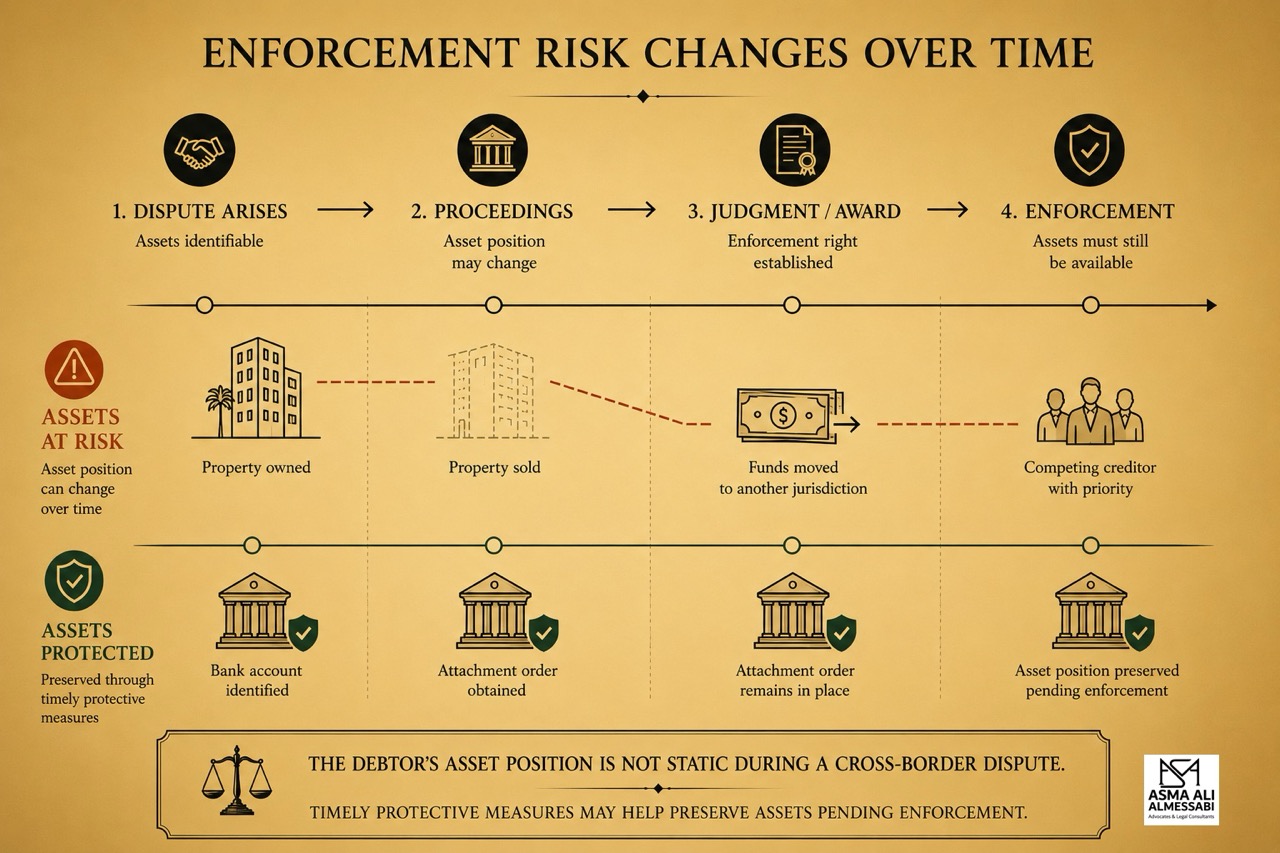
Asset Transfers, Corporate Groups and Attempts to Avoid Enforcement
Difficult enforcement cases frequently involve changes in the debtor’s asset position during or after a dispute.
The legal analysis requires precision. A transfer of property after a dispute has arisen is not automatically fraudulent or ineffective. Businesses continue to trade, finance their operations, dispose of assets and reorganise their affairs while litigation is pending. Corporate personality cannot simply be disregarded because a creditor suspects that value has moved elsewhere within a group.
Where transactions are alleged to have been undertaken to prejudice creditors, the transfers and surrounding circumstances require examination under the applicable legal framework. Available remedies will depend on the legal basis of the challenge, the parties involved, the nature and timing of the transaction and, where relevant, insolvency or other creditor-protection rules.
Asset tracing can nevertheless become important in establishing how the debtor’s position has changed. Transfers to related parties, changes in shareholdings, disposals of significant assets and movements of value within a corporate structure may warrant investigation, but none should be treated in isolation as proof of wrongdoing.
Beneficial ownership requires similar care. Identifying an individual as the ultimate beneficial owner of a company does not make the company’s assets that individual’s personal property, nor does it make the individual’s assets available automatically to satisfy a corporate debt.
A sophisticated recovery strategy therefore distinguishes three questions that are sometimes conflated: where value has moved, who legally owns the asset identified, and whether the creditor has a legal basis to execute against it.
The distinction protects the integrity of the enforcement strategy. Asset tracing is most useful when it produces legally actionable information rather than merely demonstrating commercial connections between the debtor and other persons.
Why Cross-Border Enforcement Strategies Fail
Many enforcement difficulties originate well before an application reaches a UAE court.
The underlying dispute-resolution clause may have been poorly drafted. Service in the foreign proceedings may be vulnerable to challenge. The judgment may not yet possess the required legal status. A creditor may commence proceedings under a domestic statutory route without first considering whether a treaty provides the appropriate framework.
Similar mistakes arise on the asset side. A claimant may spend considerable resources establishing enforceability before investigating whether the debtor owns meaningful assets. Another may assume that the wealth of a corporate group can be treated as the wealth of the judgment debtor. Delay may allow competing creditors or secured lenders to acquire rights over assets that initially appeared available.
Arbitration introduces its own potential difficulties. An uncertain arbitration agreement, procedural irregularity, an award extending beyond the tribunal’s mandate or a question concerning arbitrability can acquire importance at the enforcement stage even after lengthy proceedings have concluded.
Documentation can also become decisive. Judgments, evidence of their status, arbitration agreements, awards, translations, certifications and materials establishing service or procedural regularity may all carry significance depending on the route being pursued.
These are rarely problems created solely by the enforcement application itself. They are frequently the downstream consequences of decisions made during contract drafting, commencement of proceedings or conduct of the underlying dispute.
By the time recovery becomes urgent, some of those decisions may be difficult to reverse.
Planning for Enforcement Before a Dispute Arises
The strongest enforcement planning can begin while the commercial relationship is still functioning normally.
For significant international contracts, dispute-resolution provisions should be designed around the transaction rather than inserted as standard boilerplate. The governing law, chosen forum, arbitration seat where applicable, institutional rules, scope of the dispute-resolution agreement and likely location of counterparty assets can all affect the eventual effectiveness of the parties’ legal rights.
The choice between litigation and arbitration may carry particular enforcement consequences. Arbitration can provide access to the international framework of the New York Convention. Court litigation may be preferable for other reasons, including the nature of the dispute, remedies required, jurisdictional connections and applicable treaty relationships.
Neither should be selected in isolation from the commercial structure of the transaction.
Counterparty risk is equally important. A contractual promise has limited value if the entity giving it has insufficient assets to meet a substantial liability. Where a transaction relies economically upon the strength of a wider corporate group, guarantees, security arrangements or other forms of credit support may provide greater protection than relying on the eventual ability to obtain a judgment against an undercapitalised operating company.
The analysis should continue once a dispute arises. If UAE enforcement is reasonably foreseeable, the requirements of that future enforcement can be considered while the underlying proceedings are being conducted. Service, evidential records, the form of relief sought and asset intelligence may all become relevant.
This does not require every international contract to be drafted on the assumption that the relationship will fail. It requires the parties to recognise that dispute resolution and enforceability form part of the same allocation of commercial risk.
A contract that determines where a dispute will be heard but ignores whether the resulting decision can realistically be enforced addresses only part of that risk.
How ASMA Supports Cross-Border Enforcement and Asset Recovery
Cross-border enforcement frequently requires the coordination of dispute strategy, UAE procedure and the debtor’s asset position.
ASMA Ali Al Messabi Advocates & Legal Consultants advises businesses, investors and private clients on disputes with a UAE enforcement dimension, including matters involving foreign judgments, arbitral awards, international arbitration, multi-jurisdictional litigation and asset recovery.
The firm’s involvement may begin before enforcement proceedings are commenced, with an assessment of the foreign decision, the applicable treaty or convention, the appropriate jurisdictional route and the nature of the assets potentially available in the UAE. Where proceedings remain underway abroad, early UAE advice can also assist in identifying issues that may later affect enforcement, including service, documentation, protective measures and legal ownership of relevant assets.
More complex recovery matters may involve several entities, jurisdictions or categories of property. In such cases, the enforcement strategy must be developed around the particular judgment or award and the factual and legal position of the debtor rather than around a standard procedural template.
The objective is not merely to establish that a foreign decision is capable of enforcement. It is to determine the most effective legal route from the decision already obtained to the recovery that the client is seeking.

Enforcement Should Be Planned Around Recovery
A foreign judgment or arbitral award establishes an important legal position, but for a creditor it is rarely the final commercial objective. Effective enforcement in the UAE requires an understanding of the instrument being enforced, the framework through which it can be given effect and the property against which recovery can realistically be pursued. Foreign court judgments may engage the Civil Procedure Code, reciprocity and applicable treaty arrangements. Foreign arbitral awards benefit from the international framework of the New York Convention, while UAE-seated awards and matters involving the DIFC or ADGM require their respective legal regimes to be considered.
The differences are substantive. A route appropriate for one judgment or award may be unsuitable for another, even where both arise from similar commercial circumstances.
The asset position is equally important. A judgment against a company cannot ordinarily be executed indiscriminately against property belonging to its shareholders or affiliates. Valuable assets may be secured, owned by another entity or exposed to competing claims. Conversely, early identification of assets may inform protective measures and materially improve the prospects of eventual recovery.
These considerations extend beyond disputes that have already reached judgment. Governing-law clauses, jurisdiction agreements, arbitration provisions, guarantees, security and counterparty structure can influence the practical value of contractual rights years later. Decisions made when a transaction is negotiated may ultimately determine how effectively those rights can be enforced after the commercial relationship has deteriorated.
The strongest enforcement strategy therefore connects three elements from the outset: the underlying legal right, the jurisdiction in which that right can effectively be pursued and the assets from which the resulting obligation can ultimately be satisfied.
In cross-border disputes, obtaining the decision and recovering its value remain separate achievements. A successful enforcement strategy is what connects the two.
Frequently Asked Questions
Can a foreign court judgment be enforced in the UAE?
Potentially, yes. Where enforcement is pursued through the onshore UAE courts, foreign judgments may be enforceable under Federal Decree-Law No. 42 of 2022, subject to Article 222 and the other provisions relevant to the particular case. An applicable international treaty may provide a different enforcement framework.
Relevant considerations can include jurisdiction, reciprocity where applicable, proper participation of the parties in the original proceedings, the legal status of the foreign judgment, consistency with existing UAE judgments and UAE public order. The country of origin and any applicable treaty should therefore be established before the enforcement route is selected.
Does the UAE need to have an enforcement treaty with the country that issued the judgment?
Not necessarily. A treaty may provide an important basis for enforcement and prescribe its own requirements, but the absence of a treaty does not automatically mean that a foreign judgment cannot be enforced.
Where no applicable treaty governs the judgment, the domestic statutory framework may provide an alternative route. The position should be assessed by reference to the particular originating jurisdiction and judgment rather than through a general assumption about non-treaty countries.
What does reciprocity mean when enforcing a foreign judgment in the UAE?
Article 222 provides for foreign judgments and orders to be enforced in the UAE on the same conditions laid down by the law of the originating country for execution of UAE judgments and orders.
The treatment afforded to UAE judgments in that jurisdiction can therefore become relevant where the domestic statutory route applies. The manner in which reciprocity is established requires consideration of the particular jurisdiction and relevant UAE legal authority.
Can an English court judgment be enforced in the UAE?
An English judgment may potentially be enforced in the UAE, but it should not be regarded as automatically enforceable merely because it was issued by an English court.
The appropriate analysis depends on the nature and status of the judgment, the relevant UAE jurisdiction, applicable reciprocity considerations and the procedural route through which enforcement is sought. Where DIFC jurisdiction is relevant, the DIFC framework may also require consideration.
An English judgment should therefore be assessed individually before an enforcement strategy is selected.
Can a US or European court judgment be enforced in the UAE?
Potentially. There is, however, no single answer applicable to every US or European judgment.
The United States comprises multiple state and federal jurisdictions, while European states have their own legal systems and international treaty relationships. The originating court, applicable treaty arrangements, reciprocity where relevant and the requirements of the UAE enforcement framework must therefore be examined for the particular judgment.
How is a foreign arbitral award enforced in the UAE?
Foreign arbitral awards require consideration of the New York Convention, where applicable, together with the relevant UAE procedural framework.
The Convention provides an established international enforcement mechanism but allows recognition or enforcement to be refused on specified grounds. The award creditor must still pursue the appropriate procedure in the UAE and, after obtaining the necessary enforcement authority, identify assets against which execution can proceed.
Can a UAE court reconsider the merits of a foreign arbitral award?
Enforcement under the New York Convention is not intended to provide a rehearing of the underlying commercial dispute.
The Convention identifies specific grounds upon which recognition or enforcement may be refused. These concern matters such as the arbitration agreement, procedural fairness, the tribunal’s authority, arbitral procedure, status of the award, arbitrability and public policy rather than a general right to reconsider whether the tribunal reached the correct commercial conclusion.
What is the difference between a foreign arbitral award and a UAE-seated arbitral award?
A foreign arbitral award is made in an arbitration seated outside the UAE and may fall within the New York Convention framework when enforcement is sought in the UAE.
An award rendered in an onshore UAE-seated arbitration is governed principally by the UAE Arbitration Law. DIFC- and ADGM-seated awards are subject to their respective arbitration regimes.
The location of the arbitration seat is therefore legally significant and should not be confused with the physical location at which hearings happen to take place.
What role can the DIFC Courts play in enforcing foreign judgments and arbitral awards?
The DIFC Courts maintain their own recognition and enforcement framework and may be relevant in appropriate cases involving foreign judgments or arbitral awards.
Their role depends on the applicable jurisdictional basis and the circumstances of the particular matter. The DIFC should not be treated automatically as a conduit for every foreign decision intended ultimately to reach assets elsewhere in Dubai. The relationship between the DIFC Courts and Dubai Courts, together with the location of assets and any parallel proceedings, can require careful analysis.
What role can ADGM play in cross-border enforcement?
ADGM has its own courts, arbitration framework and civil and commercial legal regime. It may therefore be relevant where there is an appropriate ADGM jurisdictional connection, an ADGM-seated arbitration, an ADGM judgment or assets situated within the financial free zone.
Its role should be assessed independently from that of the onshore Abu Dhabi courts and from the DIFC framework.
Can assets belonging to a shareholder or related company be used to satisfy a judgment against a UAE company?
Not merely because the shareholder or company is related to the judgment debtor.
Separate legal personality means that assets belonging to a parent, subsidiary, sister company, shareholder or director do not ordinarily become assets of the debtor. Reaching property owned by another person requires an appropriate legal basis.
This distinction is particularly important when conducting asset tracing within complex corporate groups.
What happens if a debtor transfers assets while enforcement is being pursued?
The answer depends on the nature and timing of the transfer, the parties involved and the applicable legal framework.
Not every disposal during a dispute is improper. Where there is evidence that transactions have been undertaken in circumstances that prejudice creditors, however, the transfers and any available remedies may require separate investigation.
Early asset analysis and consideration of available protective measures can become particularly important where there is a genuine concern about the future availability of assets.
Can assets be frozen before a foreign judgment or award is finally enforced?
UAE law provides protective and precautionary measures in circumstances prescribed by the applicable legal framework, but their availability is not automatic.
The court will consider whether the requirements for the particular measure have been satisfied. In arbitration matters, tribunal powers, court powers, the seat of arbitration and the location of assets may also affect the analysis.
The availability of protective relief should therefore be assessed on the facts of the particular dispute rather than assumed from the existence of a claim or award.
How long does it take to enforce a foreign judgment or arbitral award in the UAE?
There is no reliable single timeframe applicable to every enforcement matter.
Article 222 contains a five-working-day period relating to the Execution Judge’s order on a foreign-judgment petition, but that should not be confused with the duration of the complete enforcement and recovery process. Documentation, objections, appeals, asset identification, attachment and subsequent execution measures may all affect the timetable.
The complexity of the debtor’s asset position can be as important to the overall duration as the initial enforcement application.
Should enforcement be considered when drafting the original commercial contract?
For substantial cross-border transactions, it should form part of the risk analysis.
The governing law, jurisdiction clause, arbitration agreement, seat of arbitration, counterparty structure, guarantees and security arrangements can all affect the practical enforceability of contractual rights. The likely location of the counterparty’s assets should also be considered.
A dispute-resolution clause determines where or how a dispute will be decided. A well-structured international contract should also consider whether the resulting judgment or award is likely to be effective where the counterparty’s assets are located.
Published by ASMA Ali Al Messabi Advocates & Legal Consultants
Legal Insights | Updated September 2026