

Data has become part of the operating infrastructure of almost every international business in the United Arab Emirates. Customer information passes through CRM platforms and payment systems; employee records are maintained on global HR platforms; marketing technologies collect and analyse behavioural information; cloud providers host business-critical systems; external advisers and specialist service providers receive personal data in the ordinary course of delivering their services; and UAE entities frequently exchange information with regional or global headquarters. As corporate operations have become more integrated, the legal questions surrounding data have correspondingly moved beyond the traditional boundaries of privacy compliance and into the wider fields of governance, technology procurement, risk management and commercial contracting.
The resulting exposure cannot be addressed through a privacy notice alone. A company conducting business in the UAE may collect personal information locally while storing it through an international cloud provider, administering it through systems accessible to an overseas parent company, sharing it with payroll, payment, marketing or professional-service providers and relying on technical support delivered from several jurisdictions. What appears commercially to be a single processing activity may therefore involve several legal entities, contractual relationships and international transfers, each of which must be considered within the regulatory framework applicable to the organisation concerned.
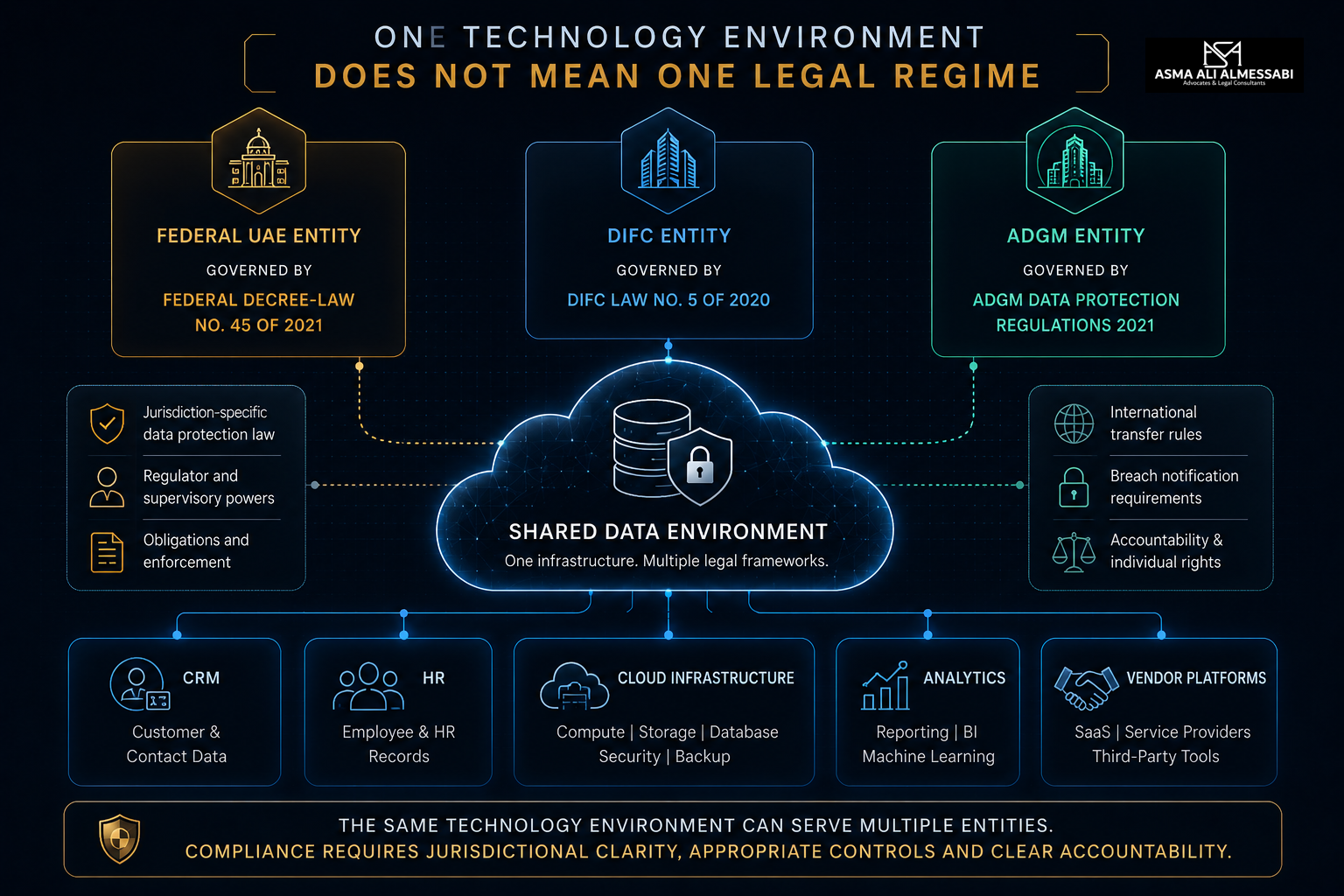
This is particularly significant in the UAE because there is no single data protection regime that can be applied indiscriminately across every corporate structure and business activity. Federal Decree-Law No. 45 of 2021 on the Protection of Personal Data provides the principal federal framework, while the Dubai International Financial Centre and Abu Dhabi Global Market maintain separate data protection regimes within their respective jurisdictions. Businesses operating in regulated sectors may also encounter additional requirements concerning information security, confidentiality, outsourcing, record keeping, localisation and regulatory notification, with the result that a multinational group using common technology and governance systems across its UAE operations may nevertheless need to accommodate materially different legal requirements at entity level.
The practical consequence is that data protection compliance cannot sensibly begin with the drafting of a privacy policy or the adoption of standard contractual clauses. It must begin with the organisation itself: the entities through which it conducts business, the information each entity processes, the purposes for which that information is used, the systems through which it passes, the third parties permitted to access it and the jurisdictions into which it is transferred. Only once that factual environment has been established is it possible to determine which legal regime applies, whether the processing has an appropriate legal basis, what information must be provided to individuals, what contractual safeguards are required and whether an international transfer can lawfully take place.
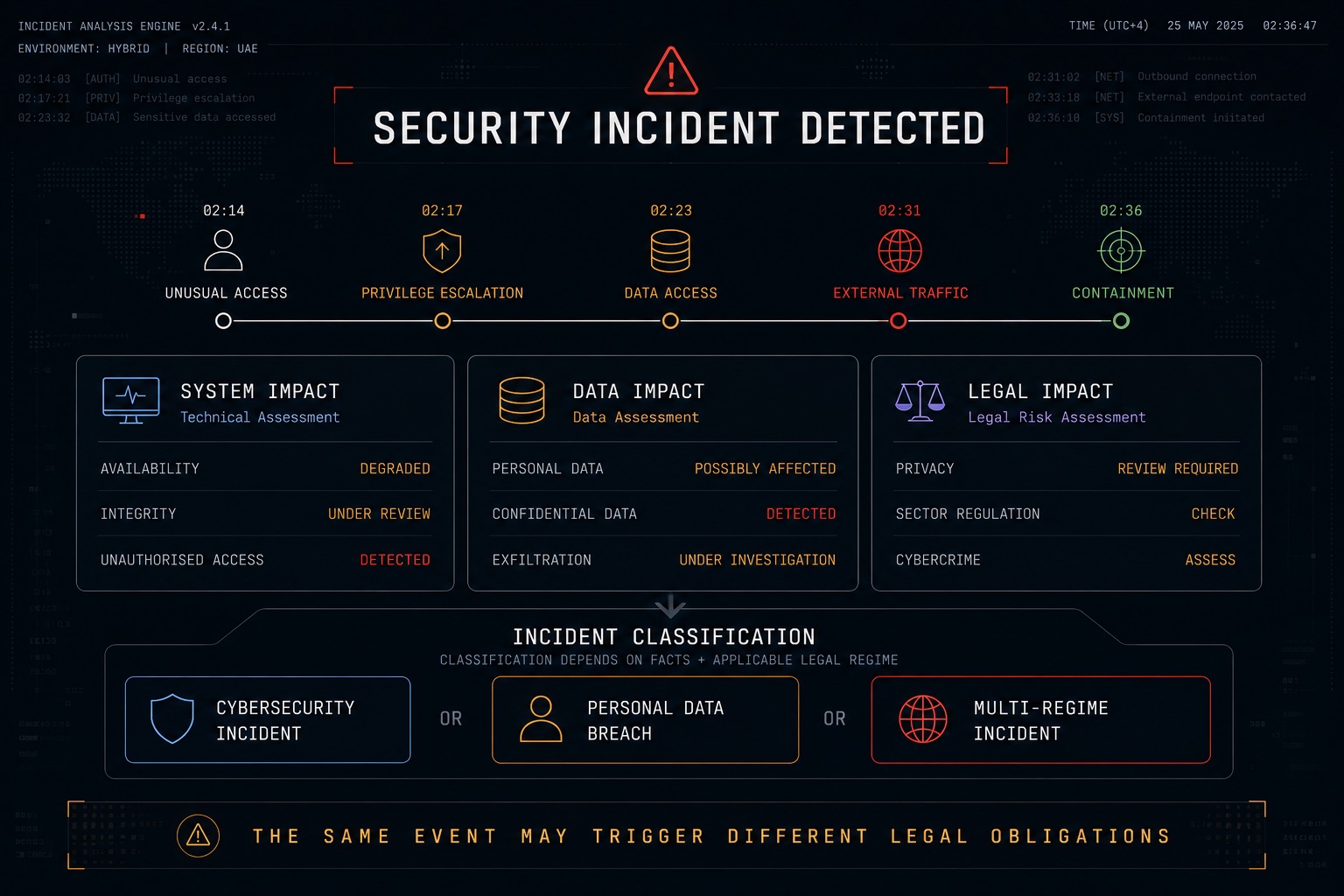
Cybersecurity introduces a related but distinct dimension. A weakness in information security may expose personal data, but it may equally affect commercially confidential information, operational systems or infrastructure without constituting a personal data breach. Conversely, personal information can be unlawfully disclosed without any sophisticated cyberattack having occurred. During a serious incident, those distinctions are rarely academic: they determine which regulatory regimes may have been engaged, which contractual notification obligations must be examined, whether affected individuals may need to be informed and how the organisation should preserve evidence while technical investigation and containment remain in progress. Effective governance therefore requires data protection, cybersecurity, commercial contracting and incident response to operate as connected disciplines rather than as separate compliance functions.
For international companies, the objective is consequently not to impose a single privacy model across every UAE operation, nor to create independent compliance structures that bear little relationship to the way the group actually conducts business. The more sustainable approach is to establish common governance wherever the legal frameworks permit it—particularly in data mapping, vendor management, information security, retention, training and incident response—while preserving the distinctions required by the federal, DIFC, ADGM and sector-specific regimes. In that sense, the central challenge of UAE data governance is one of harmonisation without assuming legal uniformity.
The UAE Data Protection Framework and the Importance of Regulatory Perimeter
Determining the applicable regulatory perimeter is the necessary starting point for any meaningful assessment of data protection compliance in the UAE. Federal Decree-Law No. 45 of 2021 establishes the principal federal regime governing personal data protection and addresses matters including processing controls, controller and processor responsibilities, the rights of data subjects, information security and transfers of personal data outside the State. Its application must nevertheless be considered by reference to its statutory scope and exclusions rather than on the assumption that the presence of a company in the UAE necessarily brings every processing activity within an identical federal framework.
That distinction becomes particularly important where a corporate group maintains operations in the UAE’s financial free zones. The DIFC regulates data protection through DIFC Law No. 5 of 2020 and its associated regulatory framework, while ADGM operates under the Data Protection Regulations 2021. These are substantive data protection regimes in their own right, with separate regulators and provisions governing lawful processing, accountability, individual rights, controller and processor obligations, data protection officers, personal data breaches and international transfers.
The differences are not merely institutional. They can affect the timing and structure of compliance decisions. In ADGM, for example, a controller must notify the Office of Data Protection of a qualifying personal data breach without undue delay and, where feasible, no later than 72 hours after becoming aware of it, unless the breach is unlikely to result in a risk to affected individuals. DIFC adopts a different formulation: where a personal data breach compromises a data subject’s confidentiality, security or privacy, the controller must notify the Commissioner of Data Protection as soon as practicable in the circumstances, while breaches likely to result in a high risk to the security or rights of affected individuals may also require communication to those individuals. A group-wide incident-response plan must therefore be capable of recognising these distinctions rather than assuming that a single notification threshold and deadline applies across every UAE entity.
The complexity becomes clearer when the legal structure is compared with the technological one. A multinational group may use a single CRM platform for its onshore and financial-free-zone entities, maintain employee records within one global HR system and allow regional management to access information generated by several subsidiaries through common reporting infrastructure. From an operational perspective, these arrangements may constitute an integrated corporate environment; from a data protection perspective, however, the identity of the entity controlling a particular processing activity, the regime applicable to that entity and the legal basis upon which information moves between participants remain matters requiring separate analysis. Corporate integration does not, by itself, collapse those distinctions.
A sophisticated compliance framework should therefore seek consistency at the level of governance without confusing consistency with legal uniformity. Information-security standards, incident-response procedures, vendor due diligence, data inventories and internal training can frequently be designed on a group-wide basis, particularly where the organisation wishes to apply a common standard that meets or exceeds the requirements imposed across its operations. Matters such as transparency documentation, lawful-processing analysis, international-transfer mechanisms, breach notification procedures and certain governance obligations may nevertheless require jurisdiction-specific treatment. The purpose of the exercise is not to create parallel compliance programmes unnecessarily, but to identify precisely where common governance remains appropriate and where the applicable legal regime requires a different approach.
The regulatory-perimeter exercise should also extend beyond general data protection legislation. Organisations operating in financial services, healthcare, telecommunications, virtual assets and other regulated industries may encounter additional requirements governing cybersecurity, outsourcing, confidentiality, localisation, record keeping or incident reporting. In such environments, identifying the relevant sector regulator can be as important as identifying the applicable privacy law, because a technology arrangement that appears acceptable under general data protection principles may still require additional contractual safeguards, regulatory approval or operational controls.
For this reason, an assessment framed simply as “UAE data protection compliance” can be too narrow. The appropriate question is which combination of data protection, sector-specific, contractual and cybersecurity requirements governs the organisation’s particular information environment.
| Issue | Federal UAE | DIFC | ADGM |
| Principal Framework | Federal Decree-Law No. 45 of 2021 | DIFC Law No. 5 of 2020 | Data Protection Regulations 2021 |
| Separate Regulator | Federal framework / competent authority | DIFC Commissioner of Data Protection | ADGM Office of Data Protection |
| DPO Requirement | Applies in specified higher-risk circumstances | Applies according to DIFC requirements | Applies according to ADGM requirements |
| DPIA / High-Risk Processing | Risk-based obligations under federal framework | Higher-risk accountability requirements | DPIA expressly required for processing likely to result in high risk |
| International Transfers | Adequacy and recognised safeguards / statutory grounds | DIFC transfer framework | Adequacy and safeguards including ADGM SCC mechanisms |
| Breach Notification | Federal breach framework and implementing requirements | Commissioner notified as soon as practicable where threshold met | Without undue delay and, where feasible, within 72 hours where threshold met |
| Sector Rules May Also Apply | Yes | Yes | Yes |
Mapping Personal Data Through the Business
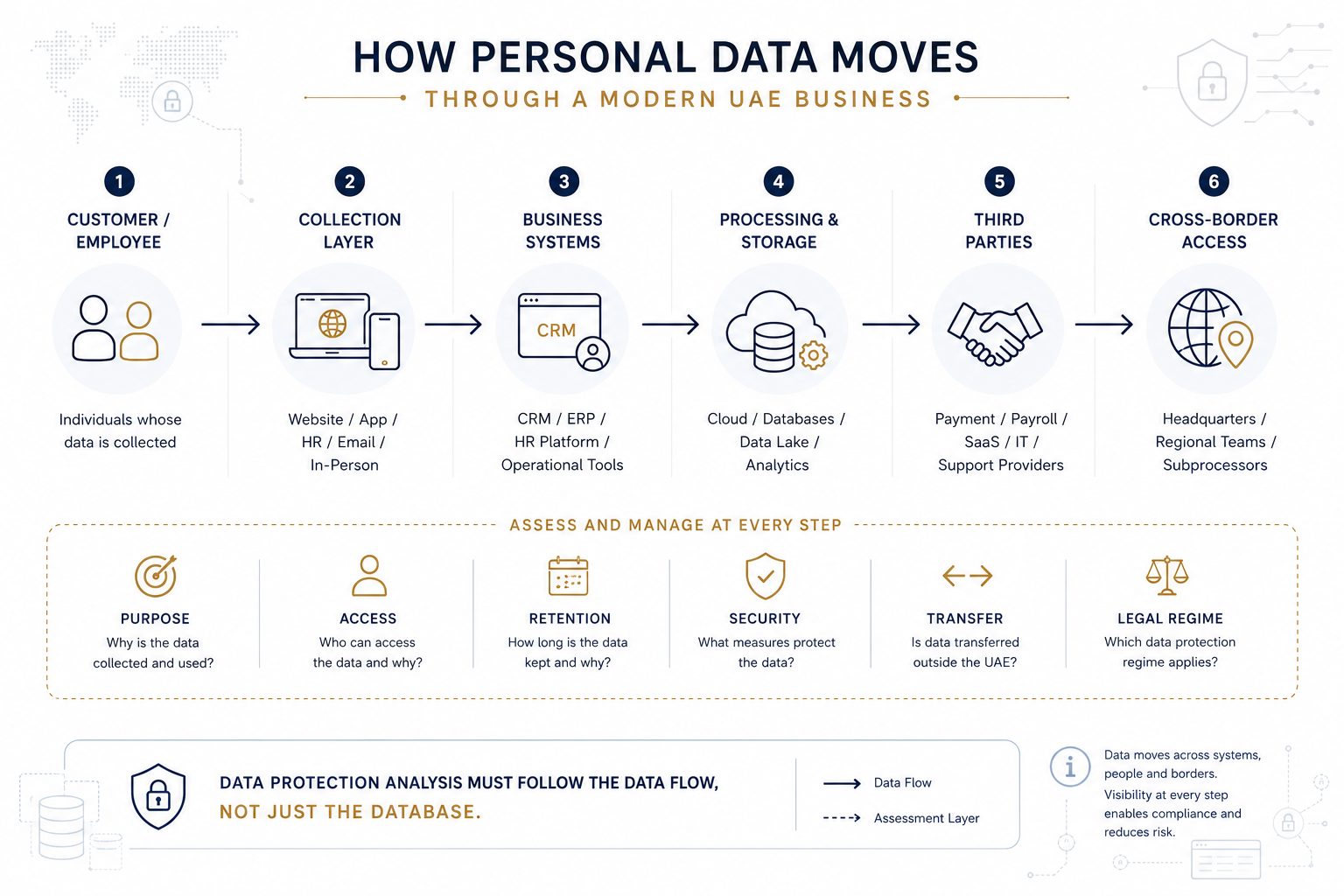
Once the regulatory perimeter has been established, the analysis should move from the organisation’s legal structure to its actual information environment. This is frequently where weaknesses become apparent, because businesses tend to understand data according to the applications through which employees interact with it rather than according to the complete chain of processing taking place behind those applications. A customer may submit information through a UAE-facing website, for example, without any indication from that interaction alone that the information is subsequently transmitted to an internationally hosted CRM, analysed through a separate analytics provider, made available to a regional sales team and backed up through infrastructure located elsewhere.
Personal data itself should also be understood more broadly than the categories that are immediately recognisable as confidential records. Names, identification documents, telephone numbers and email addresses are obvious examples, but an organisation’s data environment may also contain financial information, online identifiers, access records, customer communications, employment information, device data, location information, marketing profiles and other information capable of relating to an identified or identifiable individual. Certain information may become identifying only when combined with other datasets, while sensitive categories of personal information can warrant additional scrutiny because of the consequences that may follow from misuse or unauthorised disclosure.
A proper data-mapping exercise therefore traces information through the business rather than simply listing the databases that management knows to exist. It should establish the categories of information being processed, the entity responsible for the relevant activity, the purpose for which the information is required, the systems in which it is stored, the personnel permitted to access it, the external recipients to whom it is disclosed, the jurisdictions in which processing or access occurs and the period for which the information remains identifiable. Where processors or other service providers are involved, the analysis should extend sufficiently far into the supply chain to identify material subprocessors and additional locations of processing where these are relevant to the organisation’s obligations.
This exercise has legal significance because almost every subsequent compliance question depends upon the accuracy of the underlying factual picture. An organisation cannot reliably determine whether an international transfer is permitted if it does not know that the transfer is taking place; it cannot establish an appropriate retention period for information that has not been identified; it cannot assess whether a service provider has adequate contractual obligations if the provider’s role in the processing environment is unclear; and it cannot respond efficiently to an individual seeking access to personal information if relevant records are distributed across systems that have never been mapped. Data mapping is therefore not preliminary administrative work undertaken before the legal analysis begins; it is the factual foundation upon which that analysis depends.
The same exercise should distinguish between information that the organisation genuinely needs to retain and information that persists because no decision has ever been made to delete it. Modern cloud infrastructure makes indefinite storage technically easy, but the legal and security implications of unnecessary retention remain significant. Appropriate retention periods should reflect the purposes for which information is held together with applicable statutory, regulatory, contractual and evidential requirements, rather than being determined by storage capacity or organisational habit. A defensible retention framework will therefore distinguish among categories of records and establish a reasoned basis for retaining, deleting or anonymising them.
There is also a direct relationship between retention and cybersecurity exposure. The volume of information compromised during an incident can be materially greater where historic records have been retained without continuing justification. Data minimisation and retention governance should consequently be understood not only as privacy principles but also as elements of risk containment: reducing unnecessary holdings narrows the quantity of information potentially exposed when security controls fail.
Lawful Processing, Accountability and the Rights of Individuals
Once an organisation understands what information it processes and which legal framework applies, attention turns to the legal justification for that processing. Consent is often treated as the default mechanism for legitimising the use of personal data, particularly in consumer-facing environments, but this approach can obscure the more fundamental requirement to identify the purpose of the processing and determine the appropriate legal basis under the applicable regime.
The federal UAE framework permits processing without consent in a number of defined circumstances, subject to the conditions established by the legislation, while the DIFC and ADGM regimes similarly recognise several legal bases for processing. The correct analysis therefore depends upon why the organisation needs the information and the legal context in which that need arises. Processing required to perform contractual obligations, satisfy legal requirements, administer legitimate corporate functions or support another recognised legal basis may occupy a different position from processing that depends upon consent.
This distinction is particularly important where consent would be artificial or unstable. An employer, for example, should not assume that broadly worded employee consent resolves every issue associated with processing workforce information, particularly where the nature of the employment relationship may affect the circumstances in which consent is obtained. Equally, a business should not obtain generic customer consent for numerous unrelated purposes simply because doing so appears administratively convenient. The more defensible approach is to identify material processing activities, determine the legal basis supporting each of them and ensure that the organisation’s actual practices remain consistent with that analysis.
Transparency obligations should then reflect the same factual and legal structure. Privacy notices are not effective merely because they contain familiar data protection terminology; their value depends upon whether they accurately explain the processing carried out by the organisation. A notice imported from another jurisdiction or copied from a business with a different operating model may create an apparent layer of compliance while failing to describe the entities involved, purposes of processing, categories of recipients, international transfers or retention practices that actually characterise the business.
Individual rights create a further test of whether the organisation’s compliance framework functions operationally. Depending upon the applicable regime and circumstances, individuals may have rights concerning access to their information, correction, deletion, restriction or cessation of certain processing, objection, portability and aspects of automated processing or decision-making. Recognising those rights in a policy is relatively straightforward; responding to them across fragmented systems is considerably more demanding.
A request concerning a former employee may require information to be located across HR systems, payroll records, email archives, access logs and physical files, while customer information may be distributed among CRM, billing, support and marketing platforms. The organisation must be able to identify the request, verify the individual where appropriate, determine which rights apply, locate relevant information and assess any applicable limitations or exceptions within the procedural requirements of the governing regime. Data mapping, retention and access governance therefore become integral to the exercise of individual rights rather than separate compliance activities.
Higher-risk processing requires an additional level of analysis. The applicable UAE frameworks do not treat every processing activity as presenting the same degree of risk, and formal impact-assessment mechanisms can become particularly important where an organisation is introducing new technology, monitoring individuals, processing sensitive information on a significant scale or undertaking other activities capable of creating elevated risks to individual rights.
ADGM expressly requires controllers to conduct a Data Protection Impact Assessment before undertaking proposed processing likely to result in a high risk to the rights of individuals, with prior consultation with the Commissioner becoming relevant where the assessment indicates that high risk would remain in the absence of adequate mitigation. The DIFC framework similarly contains risk-based accountability mechanisms applicable to higher-risk processing. Under the federal framework, organisations should also assess higher-risk processing carefully in light of the legislation’s security, governance and Data Protection Officer requirements and any applicable implementing rules.
For international groups, impact assessment should be treated as a decision-making process rather than a document produced solely for compliance purposes. A meaningful assessment should identify the proposed processing, evaluate necessity and proportionality where relevant, examine the potential consequences for affected individuals and establish the measures required to mitigate those risks before the processing becomes operational.
This is particularly important where new AI tools, biometric systems, employee-monitoring technologies or large-scale analytics are involved, because the legal analysis may need to address not only the information being processed but also the scale, intrusiveness, predictability and technical architecture of the activity.
Accountability also requires clear organisational responsibility. The federal law provides for the appointment of a Data Protection Officer in specified higher-risk circumstances, including certain forms of processing involving technologies or volumes of data capable of creating elevated risk and systematic or comprehensive processing involving sensitive personal data. The precise appointment analysis must be conducted against the criteria applicable under the relevant framework rather than through a blanket assumption that every UAE business requires a DPO. DIFC and ADGM likewise contain their own DPO requirements.
Whether or not a mandatory appointment threshold is reached, responsibility cannot remain diffuse. A company in which privacy issues move informally among legal, compliance, HR and IT functions without defined ownership is likely to encounter difficulty when a data-subject request, significant vendor arrangement or security incident requires a prompt decision. Effective governance requires responsibility for assessment, implementation, escalation and monitoring to be sufficiently clear that the organisation can act when the legal framework is tested in practice.
Vendors, Cloud Services and Contractual Allocation of Data Risk
The migration of corporate infrastructure to external technology providers has made vendor governance one of the most significant points of intersection between data protection law and commercial contracting. An organisation may exercise careful control over information within its own systems while allowing substantial quantities of the same data to be processed by cloud providers, payroll companies, CRM platforms, payment services, marketing technologies, outsourced IT providers and other specialist vendors. The fact that processing has been outsourced does not remove the need to understand how the information will be handled or the legal consequences of the resulting relationship.
The analysis should begin before the contract is signed. The organisation should understand which categories of information the provider will receive, the purposes for which those data are required, whether the provider acts solely on the organisation’s instructions or also uses information independently, where processing and storage will occur, whether subprocessors participate in delivery of the service, what security measures apply and what happens to the information when the commercial relationship terminates. These questions are not merely procurement matters; they determine the structure of the data protection and transfer analysis that follows.
Once the parties’ roles have been established, the contractual terms should correspond with the substance of the processing arrangement and the requirements of the applicable regime. Depending upon the relationship, provisions may need to address documented processing instructions, confidentiality, technical and organisational security measures, subprocessing, assistance with individual rights, regulatory cooperation, incident notification, international transfers, audit or assurance rights and deletion or return of information following termination. The contractual framework should also provide sufficient visibility into material changes in the provider’s processing environment, particularly where new subprocessors or jurisdictions may affect the legal basis upon which the service was originally approved.
Cybersecurity obligations should form part of the same contractual analysis. A provider’s general commitment to maintain appropriate security may be insufficient where the customer’s regulatory or commercial obligations require more specific controls, assurance rights or incident-management procedures. Equally, an incident-notification clause that permits a provider to delay disclosure until its own investigation has been completed may place the customer in a position where it cannot satisfy regulatory or contractual deadlines that begin to run earlier.
The importance of these provisions becomes particularly apparent during a serious incident. A controller may need information from its processor to determine whether affected individuals or regulators must be notified; a regulated customer may itself be required to provide information to a supervisory authority; and a company may need prompt access to forensic findings in order to assess contractual claims, insurance coverage or litigation exposure. The effectiveness of the customer’s legal response may therefore depend upon rights negotiated long before any incident occurred.
Cloud infrastructure adds a further complication because the location of processing cannot always be reduced to the region selected when the account is configured. Primary hosting may occur in one jurisdiction while backups, technical support, security monitoring, disaster recovery or subprocessors involve others. A contract may identify a nominal hosting location without fully describing the jurisdictions from which information can be accessed in the ordinary delivery of the service.
For international companies, cloud diligence should consequently examine the architecture relevant to their particular use of the service rather than rely exclusively upon a provider’s general statements concerning data location. The objective is not to assume that all information must remain physically within the UAE, since the legal position depends upon the applicable regime and any sector-specific requirements, but to establish where processing actually occurs and whether the organisation has the legal and contractual framework required to support it.
Cross-Border Data Transfers in an International Business
Cross-border transfers deserve particular attention because they sit at the centre of the operating model of many international companies. A UAE subsidiary may report to a European or Asian headquarters, use global HR and finance systems, centralise customer support in another jurisdiction or depend upon technology providers whose infrastructure spans several countries. Even where the commercial activity is conducted entirely within the UAE, the supporting data environment may be inherently international.
The federal regime establishes a structured framework for transfers of personal data outside the UAE. Where the destination provides an adequate level of protection recognised within the statutory framework, transfer may take place on that basis. Where an adequate level of protection is not available, the legislation provides alternative routes under which transfers may still be permitted, including contractual or other safeguards capable of securing an appropriate level of protection, together with certain specified circumstances in which transfer may otherwise be lawful.
The distinction is important because cross-border compliance should not be reduced to the assumption that execution of a standard data-processing agreement automatically legitimises every transfer. The organisation must first determine the applicable transfer route and then ensure that the contractual and organisational safeguards correspond with that route.
DIFC and ADGM maintain their own transfer frameworks. ADGM, for example, recognises appropriate safeguards for transfers to jurisdictions that do not provide an adequate level of protection and has adopted its own Standard Contractual Clauses, together with an approved addendum mechanism for the European Commission’s SCCs. DIFC likewise regulates international transfers through its own framework. These mechanisms should not be treated as interchangeable merely because they perform comparable functions.
A meaningful transfer analysis therefore begins with the movement of the information rather than with the selection of a contractual template. The organisation should identify the exporting entity, the recipient, the destination jurisdiction, the categories of personal data involved, the purposes for which the information is transferred, the legal role of the recipient and any onward transfers through additional processors or group companies. Once those elements are understood, the organisation can determine which transfer rules apply and whether the destination or the safeguards surrounding the transfer satisfy the requirements of the relevant regime.
Intra-group transfers require the same degree of attention. Corporate ownership does not, by itself, provide a legal basis for unrestricted movement of personal information between affiliates. A parent company may have legitimate reasons to receive financial, HR, compliance or operational information from a UAE subsidiary, but the fact that the recipient belongs to the same group does not eliminate questions concerning purpose, access, transparency, security and international transfer.
This is particularly relevant where multinational groups have centralised data architecture. A group-wide HR platform may permit personnel at headquarters to access UAE employee information; a global CRM may make customer records available to sales teams in several markets; and consolidated reporting tools may extract information from local entities automatically. In such circumstances, the transfer does not necessarily occur because an employee actively sends a file abroad. It may be embedded in the architecture of the system itself.
International-transfer governance should therefore be built around data flows rather than individual acts of transmission. The organisation needs to understand not only where information is initially stored but also who can access it, where that access takes place and whether the service providers supporting the system introduce further jurisdictions into the processing chain.
The commercial importance of this analysis is considerable. If an organisation discovers only during a regulatory inquiry, transaction or cyber incident that its data architecture involves transfers that were never assessed, remediation may require changes to contracts, vendor arrangements, system configuration or internal access rights. Addressing the transfer structure when technology and outsourcing decisions are made is considerably more effective than attempting to reconstruct it after the organisation has become dependent upon the relevant systems.
Cybersecurity, Cybercrime and the Legal Character of an Incident
Data protection and cybersecurity are closely connected, but treating them as interchangeable can lead to incorrect conclusions during an incident. Cybersecurity concerns the protection of systems, networks and information against threats affecting confidentiality, integrity and availability, whereas data protection is concerned with the lawful and responsible processing of personal information and the rights and interests of the individuals to whom that information relates. The same event may engage both disciplines, but it does not necessarily do so.
The wider UAE legal environment also includes legislation directed specifically at conduct involving information technology and electronic systems. Federal Decree-Law No. 34 of 2021 concerning the fight against rumours and cybercrimes forms part of that wider framework and addresses criminal conduct involving electronic systems, data, privacy and other forms of online activity. Federal legislation concerning electronic transactions and trust services forms another component of the broader legal environment in which digital business operates.
These regimes perform different functions from data protection legislation. The personal data framework regulates the lawful processing and protection of information relating to individuals, whereas cybercrime legislation may become relevant to the unauthorised access, acquisition, alteration, disclosure or misuse of electronic information and systems. In a serious cyber incident, a company may therefore need to consider data protection obligations, sector-specific cybersecurity rules, contractual obligations and potential criminal-law implications concurrently.
A ransomware attack may severely disrupt a company’s operational infrastructure without compromising personal information, in which case the incident may have substantial cybersecurity, contractual and sector-regulatory consequences without necessarily producing the same data protection obligations as an event involving the exfiltration of customer records. Conversely, an employee who mistakenly discloses a file containing personal information to an unauthorised recipient may create a personal data breach without any external attacker having penetrated the organisation’s systems.
Serious incidents frequently involve less convenient distinctions. An attacker may obtain access to an environment containing personal and commercially confidential information, encrypt part of the infrastructure and claim to have exfiltrated data, while forensic investigators remain unable during the initial stages to establish precisely what was accessed or removed. Management may therefore need to consider regulatory and contractual obligations before the technical investigation has reached definitive conclusions.
The legal response must operate alongside the technical investigation rather than wait for it to finish. Counsel needs sufficient information to identify the potentially applicable regulatory frameworks, contractual notification provisions, insurance requirements and litigation risks while forensic teams work to contain the incident, establish the attack vector, determine the systems affected and preserve evidence. Those processes are interdependent: legal analysis requires technical facts, while the investigation itself may need to be structured with regard to regulatory, evidential and potential dispute considerations.
This is why incident-response capability should be established before it is required. A mature framework identifies who has authority to activate the response, how legal and technical teams will coordinate, which senior decision-makers must be informed, when external forensic specialists or advisers should be engaged and how communications with customers, regulators, insurers and other stakeholders will be controlled. The organisation should also understand in advance which contractual relationships impose notification or cooperation obligations, since these may differ materially from the requirements imposed directly by data protection legislation.
Data Breach Notification, Evidence and Contractual Exposure
The discovery of a security incident should trigger an immediate assessment of its legal character, but it should not produce indiscriminate notification. Whether regulators, individuals, customers or other parties must be informed depends upon the applicable legal regime, the nature of the information affected, the consequences of the incident and the notification thresholds and procedures relevant to the organisation.
The applicable UAE regimes should be examined separately. In ADGM, the 72-hour notification framework creates a relatively clear procedural reference point for qualifying breaches. DIFC requires notification to the Commissioner as soon as practicable where the relevant statutory threshold is met, with additional communication obligations where the breach is likely to result in a high risk to affected individuals. Under the federal framework, breach obligations must be assessed under the federal legislation together with the applicable implementing and regulatory requirements. A multinational incident-response plan should therefore contain a jurisdictional decision tree rather than a single UAE-wide deadline.
At the same time, the absence of complete forensic certainty should not be mistaken for an absence of legal obligation. Cyber investigations develop progressively, and regulatory or contractual notification periods may operate before every technical question has been resolved. The organisation must therefore be capable of making reasoned decisions on the basis of the information available at each stage, updating its assessment as the factual position becomes clearer and maintaining a contemporaneous record of the decisions taken and the reasons supporting them.
Contractual obligations can be particularly significant because they may operate independently of general data breach notification requirements. Technology agreements, outsourcing arrangements, customer contracts, insurance policies, financing documents and sector-specific commercial arrangements may require notice following a security incident, confidentiality breach, service interruption or loss of information even where the event does not satisfy the threshold for notification under the applicable data protection regime.
For service providers, this issue is especially important. A provider may not itself be responsible for determining whether affected individuals must be notified, but its customer may depend upon prompt information from the provider to make that determination. Contractual provisions should therefore require notification sufficiently early to allow the customer to satisfy its own obligations and should address the information, cooperation and continuing updates required as the investigation progresses.
Evidence preservation should be integrated into the response from the outset. System logs, access records, forensic images, communications and other technical information may later become relevant to regulatory inquiries, insurance claims, contractual disputes, employment proceedings or litigation against responsible parties. Remediation undertaken without coordination can unintentionally destroy evidence necessary to determine what occurred or to support the organisation’s subsequent legal position.
Internal communications require similar discipline. During the early stages of an incident, information is incomplete and conclusions can change rapidly as forensic evidence develops. Management needs sufficient information to make decisions, but preliminary hypotheses should not become embedded as factual conclusions through uncontrolled internal correspondence. A structured reporting process helps preserve the distinction between established facts, working assumptions and matters still under investigation.
A well-governed response therefore does more than contain the technical event. It creates a defensible record showing how the organisation identified the incident, assessed its consequences, determined its notification obligations, preserved evidence and adjusted its response as additional information became available.
Sector-Specific Data and Cybersecurity Obligations
General data protection law represents only one layer of the analysis for businesses operating in regulated sectors. The character of the organisation, the information it processes and the authority supervising its activities may introduce additional obligations that are more specific than the requirements imposed under general privacy legislation.
Financial institutions, for example, may be subject to regulatory expectations concerning outsourcing, operational resilience, cybersecurity, record keeping and the use of third-party technology. Regulated entities in DIFC and ADGM may also need to consider the requirements of the relevant financial services regulator alongside the applicable data protection regime. An outsourcing arrangement that is acceptable as a matter of privacy contracting may still be deficient if the regulated entity lacks required oversight, access, audit or termination rights.
Virtual-asset businesses present similar issues. A licensed virtual-asset service provider may process significant volumes of identification, transaction-monitoring and compliance information while also being subject to regulatory requirements concerning technology, cybersecurity, AML controls and operational governance. The legal analysis therefore cannot be confined to whether customer information is processed lawfully under the applicable data protection regime.
Healthcare organisations may face heightened considerations because of the sensitivity of patient and health information and the existence of additional rules affecting healthcare information and electronic health systems. Telecommunications providers and businesses operating digital communications infrastructure likewise occupy a more specialised regulatory environment in which privacy, cybersecurity and sector regulation can intersect.
The practical consequence is that vendor selection, cloud architecture and incident response should not be assessed solely by reference to the general UAE data protection framework. A regulated business should establish at the outset which supervisory requirements apply to its systems and information, whether restrictions exist concerning outsourcing or data location and what regulatory notifications may become necessary if a critical provider or system is compromised.
Employee, Customer and Digital-Platform Data
The principles governing corporate data protection become particularly important in areas where processing is extensive but often treated as routine. Employee information provides a clear example. Employers may hold identification documents, contact and financial information, health-related records, performance material, communications, access logs and other information generated throughout the employment relationship, while multinational groups frequently administer those records through systems accessible to HR, finance and management personnel outside the UAE.
The fact that employee processing occurs internally does not remove it from the organisation’s data governance framework. The employer must consider the purpose and legal basis for relevant processing, the information provided to employees, the personnel permitted to access particular categories of records, the periods for which those records are retained and any international transfers created by centralised HR or group-management systems. Monitoring technologies require additional care where they collect information concerning employee activity, communications, location or behaviour, since the necessity and proportionality of the processing may require closer examination.
Customer acquisition creates a different but equally complex environment. A relatively simple website may incorporate analytics tools, advertising technologies, cookies, pixels, CRM integrations and marketing automation services, each of which may process information for different purposes and through different infrastructure. An organisation should understand which technologies are active, what information they collect, which third parties receive that information and whether the transparency and consent mechanisms used on the website correspond with the applicable legal requirements.
International businesses should be particularly cautious about assuming that a mechanism designed for another jurisdiction automatically establishes UAE compliance. A cookie-management system configured around European requirements may form part of a global privacy architecture, but its presence does not replace the need to analyse the UAE regimes applicable to the relevant entity and processing activity. Conversely, a UAE-focused implementation may need to accommodate additional requirements where the same digital platform serves individuals in other jurisdictions.
Artificial intelligence is increasingly becoming part of the same data environment rather than a separate technological category. Employees may use general-purpose AI systems for document analysis, customer communications, recruitment, research or internal productivity, while businesses may incorporate AI functionality directly into customer-facing or operational systems. Where personal or confidential information is supplied to those tools, familiar data-governance questions reappear in a new technical context: what information is being processed, for what purpose, by which provider, under what contractual terms, in which jurisdictions and with what retention, security or secondary-use implications.
Where an AI deployment is capable of producing a high risk to individuals, the organisation should also consider whether a formal impact assessment is required under the applicable regime. This is particularly relevant where the technology involves profiling, systematic evaluation, large-scale sensitive data processing or other forms of processing capable of materially affecting individuals. Impact assessment in this context should occur before deployment, when the organisation still has an opportunity to alter the design, reduce the dataset, change the provider or introduce additional safeguards.
An AI policy that simply prohibits certain categories of information from being uploaded may be useful, but it is unlikely to be sufficient where AI systems become embedded in ordinary business processes. The organisation should understand which tools are approved, how providers handle submitted information, whether data can be used for purposes beyond delivery of the contracted service, which personnel can use the systems and whether higher-risk applications require additional legal or technical review. The novelty of the technology does not displace the underlying governance principles; it increases the importance of applying them consistently.
Data Protection and Cybersecurity in Corporate Transactions
Data governance can also become a material issue in acquisitions, investments and corporate restructuring. A purchaser acquiring a UAE business may inherit not only the target’s customer and employee datasets but also its historic processing practices, technology contracts, security weaknesses, unresolved incidents and regulatory exposure. Where the target depends heavily upon technology or processes significant volumes of personal data, these matters may affect valuation, transaction documentation and the post-completion integration strategy.
Legal due diligence should therefore examine more than the existence of privacy policies. The relevant questions may include which data protection regimes apply to the target, whether material processing activities have been appropriately documented, whether international transfers have been structured correctly, whether significant technology and processor contracts contain adequate protections, whether material incidents have occurred and whether any regulatory investigations, customer claims or remediation obligations remain outstanding.
Technical cybersecurity diligence may need to accompany the legal review where the target’s risk profile justifies it. Security governance, penetration-testing results, audit findings, access controls, incident history, critical vendor dependencies, insurance arrangements and remediation programmes can all affect the buyer’s assessment of the business. The absence of a publicly known breach does not establish that the target’s cybersecurity environment is robust, just as the occurrence of a historic incident does not necessarily mean that the underlying exposure has been resolved.
Findings should be translated into transaction consequences rather than left as abstract compliance observations. A material weakness may require remediation before completion, a specific indemnity, additional warranty protection, adjustment to valuation, retention or escrow arrangements, changes to transitional services or accelerated post-acquisition integration. In more serious circumstances, a buyer may need to reconsider whether particular data assets can be transferred or integrated in the manner originally contemplated.
Corporate transactions also illustrate why privacy governance should not be isolated from broader commercial law. Data may constitute an important commercial asset, but the ability to use that asset after completion depends upon the legal basis on which it was collected, the purposes communicated to individuals, contractual restrictions affecting its use and the regulatory framework governing any subsequent transfer or integration.
Building a Defensible Data Governance Framework
The objective of a mature data protection and cybersecurity programme is not the elimination of every conceivable risk. No organisation operating complex technology infrastructure can guarantee that an incident will never occur, nor can compliance be reduced to a checklist capable of anticipating every future processing activity. The more realistic objective is to establish a governance framework through which material risks are identified, assessed, documented and managed in a manner proportionate to the organisation’s activities and regulatory exposure.
That framework should begin with the relationship between legal entities, processing activities and technology. The organisation needs to know which regimes apply, what information is processed, where it moves and who is responsible for the relevant decisions. Lawful-processing analysis, transparency, retention, individual rights, impact assessments, vendor management and international-transfer mechanisms should then be built around that factual structure rather than developed as independent compliance exercises.
Procurement and technology governance should incorporate privacy and cybersecurity sufficiently early that legal requirements can influence the design of new arrangements. Introducing a cloud platform, employee-monitoring system, AI application or outsourced service can change the organisation’s data environment before any new privacy document is produced. Review at the point of procurement or implementation allows questions concerning data minimisation, access, international transfers, security, retention, impact assessment and contractual allocation of responsibility to be addressed while the organisation still has meaningful choices about how the arrangement will operate.
Governance must also accommodate change. Corporate groups acquire and dispose of businesses, replace vendors, migrate infrastructure, introduce new technology and expand into additional jurisdictions. Each development can alter data flows that were previously mapped and legal assumptions that were previously correct. A compliance programme should therefore provide mechanisms for material changes to be identified and assessed rather than treating the initial implementation exercise as a permanent description of the organisation.
Incident preparedness completes the framework because it tests whether governance can operate under pressure. When a significant event occurs, the company should already know which personnel have authority to act, which advisers and forensic specialists may need to be engaged, which regulators and contractual counterparties could become relevant and where the information necessary to make those decisions can be obtained. The effectiveness of the response will depend substantially upon work undertaken before the incident rather than upon the volume of policy documentation produced after it.
The strongest programmes are therefore those in which legal compliance corresponds with operational reality. Documentation remains important, but its purpose is to record and support a functioning governance system rather than substitute for one.
How ASMA Supports Data Protection and Cybersecurity Matters in the UAE
ASMA Ali Al Messabi Advocates & Legal Consultants advises businesses operating in the UAE on legal matters arising from the collection, use, protection and international transfer of personal information, including the interaction between data protection requirements, technology arrangements and wider commercial obligations.
For international organisations, the work may require an assessment of the regulatory framework applicable to different UAE entities and processing activities, particularly where operations extend across mainland UAE, DIFC, ADGM or regulated sectors. Advice can include privacy and data-governance structures, controller and processor arrangements, Data Protection Impact Assessments, cross-border transfers, technology and outsourcing agreements, contractual allocation of cybersecurity risk and the legal implications of new processing activities or technology deployments.
Data and cybersecurity incidents may require a broader response. In addition to determining the implications under the applicable data protection regime, an organisation may need to consider contractual notification requirements, regulatory obligations arising from its sector, insurance arrangements, employment issues, cybercrime considerations, potential claims and the preservation of evidence. Coordinating those issues with the technical investigation is important where legal decisions must be taken while the underlying facts continue to develop.
The same considerations can arise in corporate transactions, where data protection compliance, cybersecurity history, technology dependencies and unresolved incidents may form part of the legal and commercial risk being acquired. In those circumstances, the purpose of legal review is not merely to identify deficiencies but to determine how they should affect transaction structure, contractual protection, remediation and post-completion integration.
Data Compliance Must Follow the Data
The legal architecture of a corporate group is usually more orderly than the information environment through which that group operates. A UAE company may collect information from a customer or employee under one legal regime, process it through technology supplied by a provider in another jurisdiction, permit access by an overseas affiliate and depend upon additional processors that are largely invisible to the individual from whom the information originated. The commercial organisation may regard those arrangements as a single integrated system, but data protection law requires a more precise understanding of the entities, purposes, relationships and transfers involved.
This is why effective UAE data governance begins with the movement and use of information rather than with the production of compliance documents. Privacy notices, processing agreements, transfer mechanisms, impact assessments, retention policies and incident-response procedures remain essential components of the framework, but their legal value depends upon whether they accurately reflect the organisation’s actual operations. Documentation cannot compensate for a business that does not know where its information resides, who can access it or why it is being retained.
The same principle becomes more consequential when a cybersecurity incident occurs. An organisation that understands its systems, vendors, data flows and contractual relationships is better positioned to determine which information has been affected, which legal regimes have been engaged and which notifications or remedial measures may be required. Where those matters have never been mapped, the first stage of incident response can become an attempt to reconstruct the company’s own information environment at precisely the moment when management has the least time to do so.
For multinational groups, the UAE’s regulatory structure makes that governance exercise particularly important. Federal legislation, the separate DIFC and ADGM regimes and sector-specific requirements may coexist within the same wider business, while the technology supporting those entities remains highly integrated. The appropriate response is neither to disregard those legal distinctions nor to allow them to produce unnecessarily fragmented operations. It is to establish common governance where possible while preserving jurisdiction-specific treatment where the law requires it.
Data protection, cybersecurity and cross-border transfers should therefore be understood as connected elements of corporate risk rather than separate technical or compliance disciplines. Their effective management requires legal analysis to remain aligned with technology, contracts, operational processes and the continuing development of the business. For international companies operating in the UAE, the measure of a credible data governance programme is ultimately not how comprehensive it appears on paper, but whether it remains legally and operationally coherent when information moves across systems and borders—and whether it continues to function when those systems are tested by an incident.

Frequently Asked Questions
What is the principal data protection law in the UAE?
Federal Decree-Law No. 45 of 2021 on the Protection of Personal Data establishes the principal federal framework governing personal data protection in the UAE. Its application must nevertheless be considered in light of its scope and exclusions, the separate regimes operating within DIFC and ADGM and any sector-specific requirements applicable to the organisation or processing activity concerned.
Do DIFC and ADGM follow the federal UAE data protection regime?
No. DIFC and ADGM maintain their own data protection frameworks. DIFC operates under DIFC Law No. 5 of 2020 and its associated regulatory framework, while ADGM operates under the Data Protection Regulations 2021. An organisation with entities or relevant processing activities across more than one UAE jurisdiction should therefore establish the applicable regime for each part of its operations rather than assume that one framework governs the group as a whole.
Does a UAE company always need consent before processing personal data?
No. Consent is an important basis for certain processing activities, but the applicable UAE data protection frameworks recognise circumstances in which processing may be permitted on other legal grounds. The correct basis depends upon the applicable regime, the purpose for which information is processed and the circumstances surrounding the processing.
What is a Data Protection Impact Assessment?
A Data Protection Impact Assessment is a structured assessment of proposed processing that may create elevated risks to individuals. ADGM expressly requires controllers to carry out a DPIA before undertaking processing likely to result in a high risk to individual rights. Higher-risk processing under the federal and DIFC frameworks should likewise be assessed against the relevant legal and accountability requirements. DPIAs are particularly relevant to activities involving sensitive data, large-scale monitoring, profiling and certain AI or biometric technologies.
What is the difference between a data controller and a processor?
A controller generally determines the purposes and means of processing personal data, whereas a processor handles personal data on behalf of a controller within the relevant processing relationship. The classification should reflect how the arrangement operates in substance; describing a service provider as a processor in a contract will not necessarily resolve the legal position if the provider independently determines material purposes for which the information is used.
Can personal data be transferred outside the UAE?
Yes, where the requirements of the applicable legal framework are satisfied. The federal regime distinguishes between transfers to destinations providing an appropriate level of protection and transfers relying upon other recognised safeguards or statutory grounds. DIFC and ADGM operate separate international-transfer frameworks, and the appropriate mechanism should be identified according to the regime applicable to the exporting entity.
Does ADGM use Standard Contractual Clauses for international transfers?
ADGM recognises Standard Contractual Clauses as an appropriate safeguard for certain transfers to jurisdictions that do not provide an adequate level of protection and has adopted its own SCC framework. ADGM also recognises an approved addendum mechanism in conjunction with European Commission SCCs. These mechanisms should not automatically be assumed to satisfy transfer requirements under the federal or DIFC regimes.
Does using an international cloud provider create a cross-border data transfer?
It may. The analysis should consider not only where the provider identifies its primary hosting region but also where information can be accessed or otherwise processed through technical support, backup arrangements, disaster recovery, security functions and subprocessors. The legal consequences will depend upon the applicable data protection regime and any additional sector-specific requirements.
Does every UAE business need to appoint a Data Protection Officer?
No. The appointment analysis depends on the criteria established under the applicable regime and the organisation’s processing activities. The federal law requires a DPO in specified higher-risk circumstances, while DIFC and ADGM contain their own DPO requirements. Even where a formal appointment is not mandatory, responsibility for privacy governance should be clearly allocated.
Is there one UAE-wide deadline for notifying a personal data breach?
No. The applicable regime must be identified. In ADGM, qualifying breaches must be notified to the Office of Data Protection without undue delay and, where feasible, within 72 hours of awareness. DIFC uses an “as soon as practicable” standard for notification to the Commissioner where its statutory threshold is met. Federal requirements should be assessed under the federal legislation and applicable implementing framework.
Does every cybersecurity incident have to be reported as a data breach?
No. A cybersecurity incident and a personal data breach are not necessarily the same event. The reporting analysis depends upon the nature of the incident, the information affected, the applicable regulatory framework and the relevant notification threshold. Separate contractual, insurance, cybercrime or sector-specific obligations may nevertheless become relevant.
What UAE law is relevant to cybercrime?
Federal Decree-Law No. 34 of 2021 concerning the fight against rumours and cybercrimes forms part of the UAE’s wider legal framework governing conduct involving electronic systems, networks and data. Depending upon the circumstances of an incident, cybercrime issues may need to be considered alongside data protection, sector regulation, contractual obligations and potential civil claims.
Why are data breach provisions important in technology and outsourcing contracts?
A company may depend upon its service provider for the information required to satisfy its own regulatory, customer or insurance obligations following an incident. Contractual provisions should therefore address the timing and content of incident notification, continuing cooperation, access to relevant information, subprocessor involvement and other matters necessary for the customer to assess and respond to the event effectively.
How long should a UAE company retain personal data?
There is no single appropriate retention period for every category of personal information. Retention should be assessed according to the purpose for which the information is held together with applicable statutory, regulatory, contractual, evidential and legitimate business requirements. A documented retention framework should distinguish among categories of records rather than apply indefinite storage as a default.
Are employee records part of data protection compliance?
Yes. Employee information may contain extensive personal and, in some cases, sensitive information and should be incorporated into the organisation’s wider data governance framework. Employers should consider the legal basis and purpose of processing, transparency, access controls, retention, monitoring practices and international transfers, particularly where global HR systems or overseas group functions can access UAE workforce information.
Are cookies, analytics and online advertising technologies relevant to UAE data protection?
They can be where the technologies process information relating to identifiable individuals or otherwise fall within the scope of the applicable data protection framework. Businesses should understand which technologies operate through their digital platforms, the information they collect, the parties receiving that information and the purposes for which it is processed rather than relying exclusively upon a generic cookie or consent mechanism.
Can employees use public AI platforms with company or customer data?
Use of external AI services should be governed within the organisation’s broader data, confidentiality, security and technology framework. Before personal, confidential or commercially sensitive information is submitted, the company should understand how the provider processes that information, whether it is retained or used for additional purposes, where processing occurs and what contractual and security protections apply. Where the proposed use is likely to create a high risk to individuals, an impact assessment may also be required under the applicable regime.
Should data protection and cybersecurity form part of M&A due diligence?
They can be material areas of due diligence, particularly where the target is technology-dependent, processes significant volumes of personal data or operates in a regulated industry. Historic breaches, inadequate transfer arrangements, weak security controls, deficient technology contracts or unresolved regulatory exposure may affect valuation, transaction documentation, contractual protection and the post-acquisition integration strategy.
Is a privacy policy sufficient for UAE data protection compliance?
No. A privacy policy is one component of a wider governance framework and cannot, by itself, establish that an organisation’s processing activities comply with the applicable law. Effective governance requires the company to understand its data environment and address matters including lawful processing, transparency, individual rights, impact assessments, retention, vendor relationships, international transfers, information security, incident response and organisational accountability.