

A New Legal Framework for Doing Business in the UAE
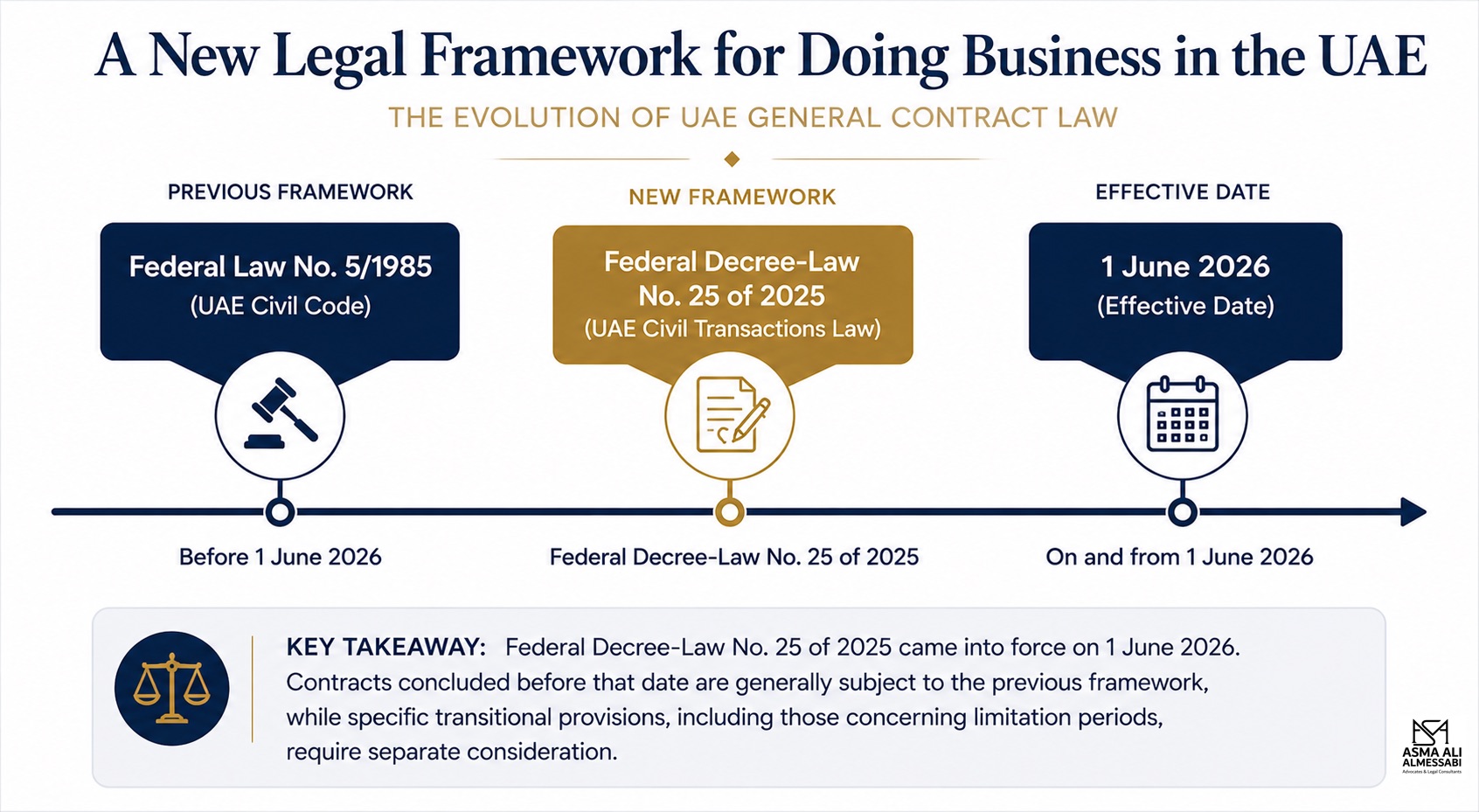
On 1 June 2026, one of the most significant changes to the UAE’s private law framework in four decades came into effect. Federal Decree-Law No. 25 of 2025 introduced a new Civil Transactions Law, replacing Federal Law No. 5 of 1985. The reform extends across a wide range of civil relationships, but its importance for businesses is particularly significant because the Civil Transactions Law provides many of the underlying legal principles governing how contracts are negotiated, formed, interpreted, performed and enforced in the UAE.
For international companies, the practical question is therefore not simply what changed in the legislation. It is what those changes mean for the contracts businesses negotiate and rely upon every day.
A multinational entering into a distribution arrangement with a UAE partner, a technology company negotiating a master services agreement, an investor establishing a joint venture, or a supplier entering into a long-term commercial relationship may all encounter aspects of the new framework. The implications can begin before the contract is even signed.
The new Civil Transactions Law now expressly regulates important aspects of pre-contractual negotiations, including good-faith conduct and disclosure obligations. It provides greater statutory recognition of framework agreements, modernises aspects of contract formation and interpretation, revises rules affecting agreed compensation and exceptional circumstances, and introduces changes across areas ranging from guarantees to contracts for works.
For businesses accustomed to treating their UAE contracts as documents that can simply be renewed or adapted from international templates, this creates an important reason to review both contract language and contracting procedures.
The reform does not mean that every existing agreement has suddenly become ineffective, nor does it mean that established principles of UAE contract law have disappeared. Significant elements of the previous framework remain familiar. What has changed is the level of statutory detail surrounding several stages of the contractual relationship.
For international businesses, that distinction matters. Contractual risk can arise during negotiations, through the information exchanged between the parties, through the authority of the individuals conducting those negotiations, through the structure of framework arrangements, and through the way contractual rights are exercised after execution. Companies operating in the UAE should therefore view the new Civil Transactions Law not simply as a legislative development, but as an opportunity to reconsider the entire lifecycle of their commercial contracts.
Which Commercial Contracts Are Affected by the New UAE Civil Transactions Law?
The new Civil Transactions Law forms part of the underlying legal framework applicable to a broad range of contractual relationships in onshore UAE, subject to any specialised legislation governing the particular transaction or sector. Its general principles may interact with more specific legislation governing companies, commercial transactions, employment, banking, real estate, consumer relationships and regulated activities. Companies should therefore avoid assuming that the Civil Transactions Law operates in isolation, the starting point is timing.
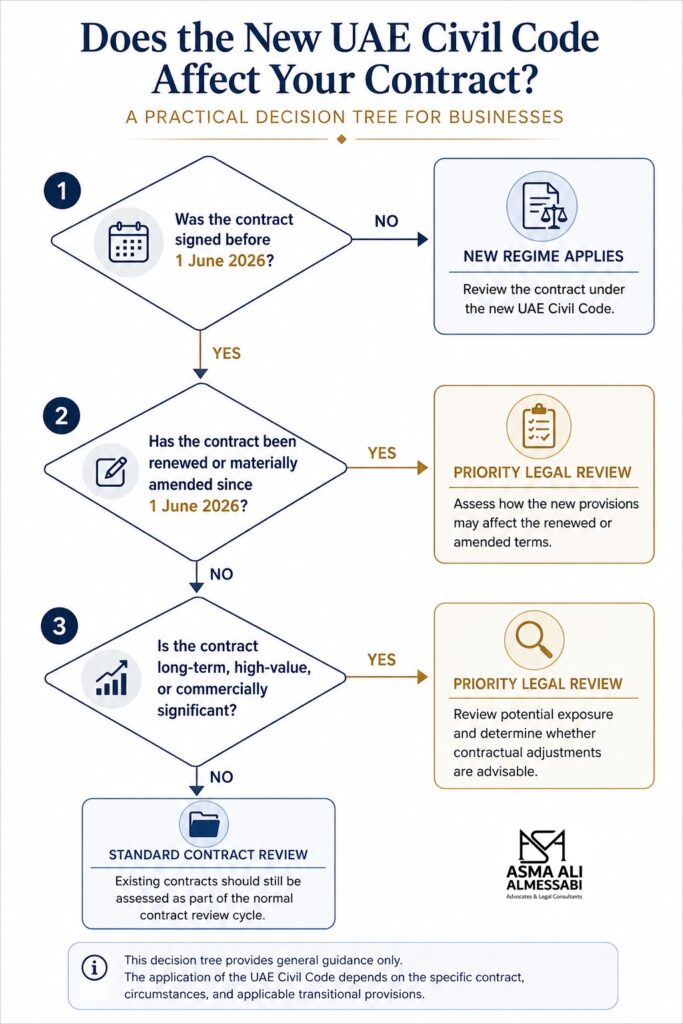
The new Civil Transactions Law came into force on 1 June 2026 and does not generally apply retrospectively to contracts concluded before that date. Agreements entered into before 1 June 2026 therefore remain governed by the legal framework applicable when they were concluded, while contracts concluded from that date fall within the new framework.
This distinction becomes more complex where an existing commercial relationship is subsequently renewed, materially amended, or generates new transactions after 1 June 2026. A master agreement entered into under the previous framework may, for example, continue generating purchase orders, statements of work, variations, or other contractual arrangements after the new law has taken effect. These circumstances should be assessed individually rather than assuming that the date of the original agreement determines the legal position for every subsequent transaction.
Limitation periods require separate analysis because the Decree-Law contains specific transitional provisions governing periods that had already begun but had not expired when the new law entered into force.
International companies should therefore resist two opposite assumptions. The first is that every agreement signed before 1 June 2026 must immediately be rewritten. The second is that legacy agreements can simply be ignored because they pre-date the new law. Neither approach provides an adequate contract-management strategy. Businesses should instead identify agreements according to their commercial importance, governing law, date, duration, renewal mechanisms and likelihood of amendment.
The priority should be contracts that remain operational for several years, generate significant financial exposure, contain automatic renewal provisions, involve recurring transactions, or are likely to be amended following 1 June 2026. That exercise can reveal something more important than whether a particular clause technically requires amendment. It can identify whether the company’s contracting architecture still reflects the legal environment in which it now operates.
Pre-Contractual Negotiations Under the New UAE Civil Transactions Law
Perhaps one of the most commercially significant developments concerns the negotiation stage. Businesses often think of contractual liability as something that begins once signatures appear on the final agreement. Commercial reality is different. Major transactions may involve months of meetings, emails, presentations, due diligence, draft agreements, term sheets, letters of intent, financial projections and representations before definitive documents are executed. Under the new Civil Transactions Law, this period deserves considerably greater attention.
Articles 121 and 122 significantly strengthen the statutory framework governing pre-contractual conduct. Negotiations must be initiated, conducted and terminated in good faith, while the new framework also addresses the disclosure of material information relevant to the proposed transaction. Confidential information exchanged during negotiations must likewise be considered carefully within the applicable legal framework.
This does not mean that entering negotiations obliges a company to conclude the transaction. Businesses remain free to negotiate, reject terms and ultimately decide that an agreement is not commercially attractive. The distinction lies in how that freedom is exercised.
A party entering negotiations without a genuine intention to progress them, deliberately creating misleading expectations, failing to address disclosure obligations applicable in the circumstances, or improperly using confidential information obtained during negotiations may face legal consequences even where the proposed transaction is never completed. For international companies, this increases the importance of internal negotiation discipline.
Consider an acquisition or strategic joint venture. The parties may exchange financial information, customer data, forecasts, regulatory information and details of pending commercial issues. Senior executives may make statements regarding future investment, exclusivity or expected performance while lawyers continue negotiating the definitive documents.
If the transaction later collapses, the history of those negotiations may become important. Emails that were once considered informal commercial discussions, presentations, draft agreements, information disclosed or withheld, and the circumstances surrounding withdrawal from negotiations may all require examination. Companies should therefore review how negotiations are conducted rather than focusing exclusively on the final contract.
Non-disclosure agreements should be used appropriately. Letters of intent should clearly identify which provisions are binding and which remain subject to definitive agreement. Employees participating in negotiations should understand the limits of their authority. Material representations should be documented carefully, and commercially sensitive information received from counterparties should be controlled.
The legal department should not necessarily be introduced only when the commercial team believes the transaction is ready for signature. For strategically important UAE transactions, legal risk management may need to begin considerably earlier.
Contract Formation, Authority and Digital Communications
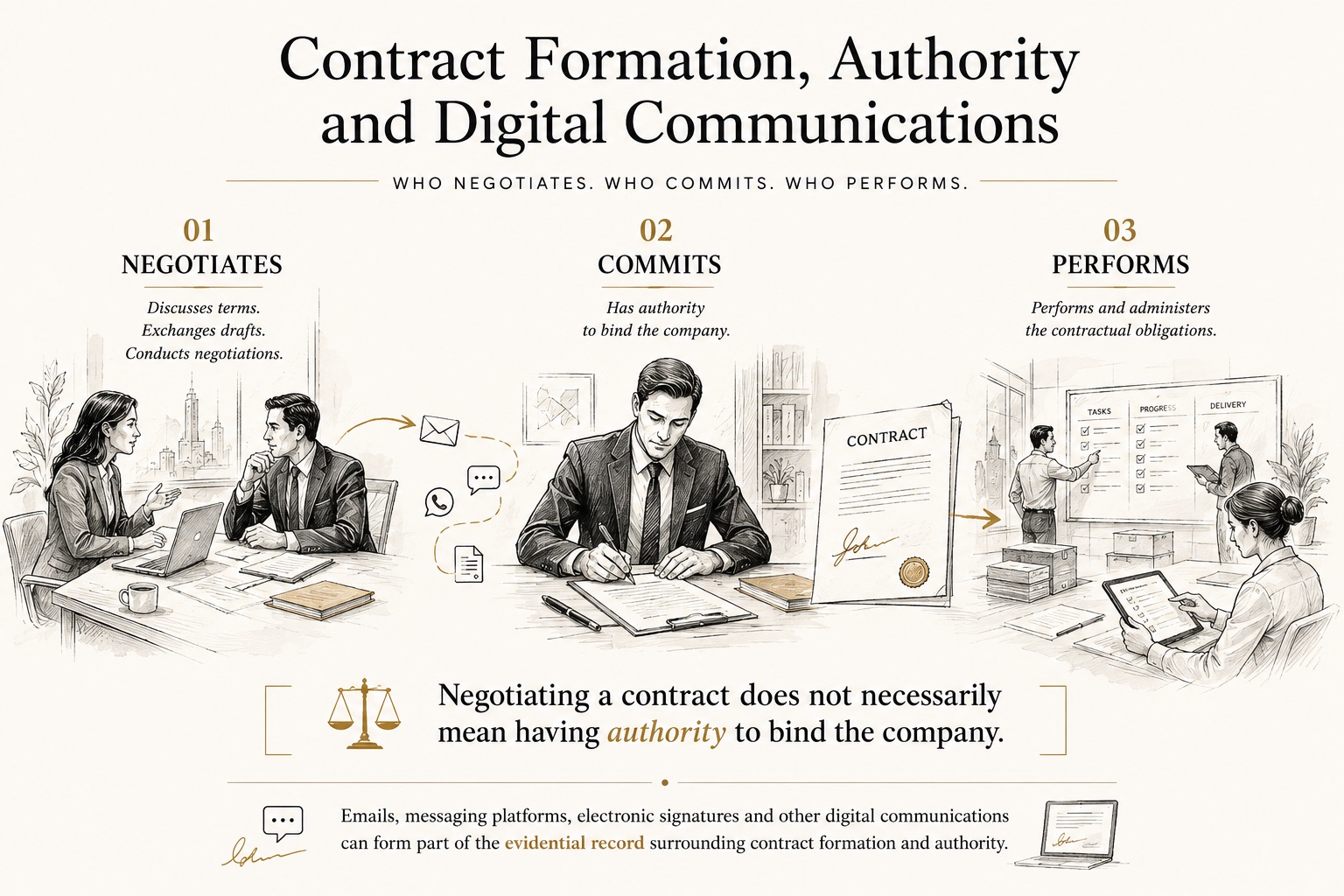
Modern commercial agreements are rarely negotiated around a single physical table. Offers are exchanged by email, amendments are discussed through video calls, approvals may pass through several jurisdictions, and electronic signatures are increasingly routine.
The new Civil Transactions Law accommodates modern methods of contracting, while electronic transactions remain subject to the UAE’s separate legislation governing electronic transactions and trust services. For businesses, however, one of the larger practical issues is authority.
International groups frequently operate through complex delegation structures. A UAE subsidiary may have a general manager, authorised signatories, regional executives, procurement officers and employees authorised to negotiate contracts but not necessarily to execute them. The distinction between negotiating authority and contracting authority should therefore be explicit.
Companies should review who is authorised to negotiate, who may make binding commercial commitments, who may approve deviations from standard terms, who may execute contracts, whether applicable powers of attorney remain valid and appropriate, and whether internal approval procedures correspond with the authority presented externally.
This becomes particularly important where counterparties interact repeatedly with the same senior employee and may perceive that individual as possessing substantial authority. Digital contracting should therefore be accompanied by robust corporate controls. The fact that an agreement can be concluded quickly does not eliminate the need to establish who had authority to conclude it.
Contract Interpretation: Drafting Still Matters
International companies sometimes assume that sufficiently detailed drafting can eliminate interpretative uncertainty. No contract can achieve that completely. Commercial relationships evolve, circumstances change, and disputes often concern situations the parties did not specifically anticipate when the agreement was signed.
The new Civil Transactions Law provides a more structured framework for contractual interpretation, including circumstances in which wording is clear and situations where interpretation becomes necessary.
Precision therefore remains the first line of defence, a well-drafted agreement should clearly identify the parties’ obligations, payment mechanisms, performance standards, approval procedures, liability allocation, termination rights and dispute resolution process. Contractual language does not, however, exist in a vacuum. Where interpretation is required, the broader circumstances of the transaction, the parties’ intentions and the nature of their commercial relationship can become relevant under the applicable legal framework; this creates particular risk for international companies that rely heavily on global templates.
A contract originally drafted for English, Singaporean or US law may contain concepts developed within those legal systems. Simply replacing the governing-law clause with “UAE law” does not necessarily make the document appropriate for an onshore UAE relationship. Definitions, remedies, termination mechanisms, liability clauses and boilerplate provisions should be reviewed within the legal system that will actually govern the agreement. The objective is not to make contracts longer. It is to make them more precise. A twenty-page agreement that clearly allocates commercial risk may be considerably more effective than a sixty-page international template containing provisions that do not operate as the parties assume under UAE law.
Framework Agreements Under Article 138 of the New UAE Civil Transactions Law
Many modern businesses do not negotiate a completely new contract for every transaction. Instead, they establish a master framework governing the commercial relationship and subsequently issue purchase orders, statements of work, project schedules, work orders, or individual transaction documents.
Article 138 of the new Civil Transactions Law expressly recognises framework agreements, providing greater statutory clarity for commercial relationships in which principal terms are established in advance and subsequently applied to individual contracts or transactions.
This is particularly relevant for international businesses operating recurring commercial relationships in the UAE. Technology providers may use master services agreements followed by individual statements of work. Manufacturers may establish distribution frameworks covering multiple products. Procurement departments may enter supply frameworks under which individual orders are issued throughout the year, while professional services firms may establish umbrella agreements governing multiple engagements. The existence of a framework does not remove the need for precision.
Companies should ensure that the hierarchy between documents is clear. If a purchase order conflicts with the master agreement, which prevails? Can a statement of work modify liability provisions? Which terms apply when a local subsidiary issues an order under a group-level agreement? When does an individual transaction become binding? How are prices adjusted? Can individual orders continue after termination of the framework? These questions are often responsible for disputes that appear to concern performance but actually originate in poor contract architecture.
The express recognition of framework agreements provides businesses with another reason to review how their master agreements and downstream transactional documents interact.
Force Majeure and Hardship Under UAE Contract Law
Commercial contracts are designed at a particular moment in time. The world rarely remains the same throughout their duration. Supply chains can be interrupted. Shipping routes may become unavailable. Commodity prices can move sharply. Regulatory requirements may change. Political events can affect markets, and unexpected economic circumstances may transform the cost of performance. These issues are especially important in the UAE, where businesses frequently participate in international supply, logistics, construction, energy and investment relationships.
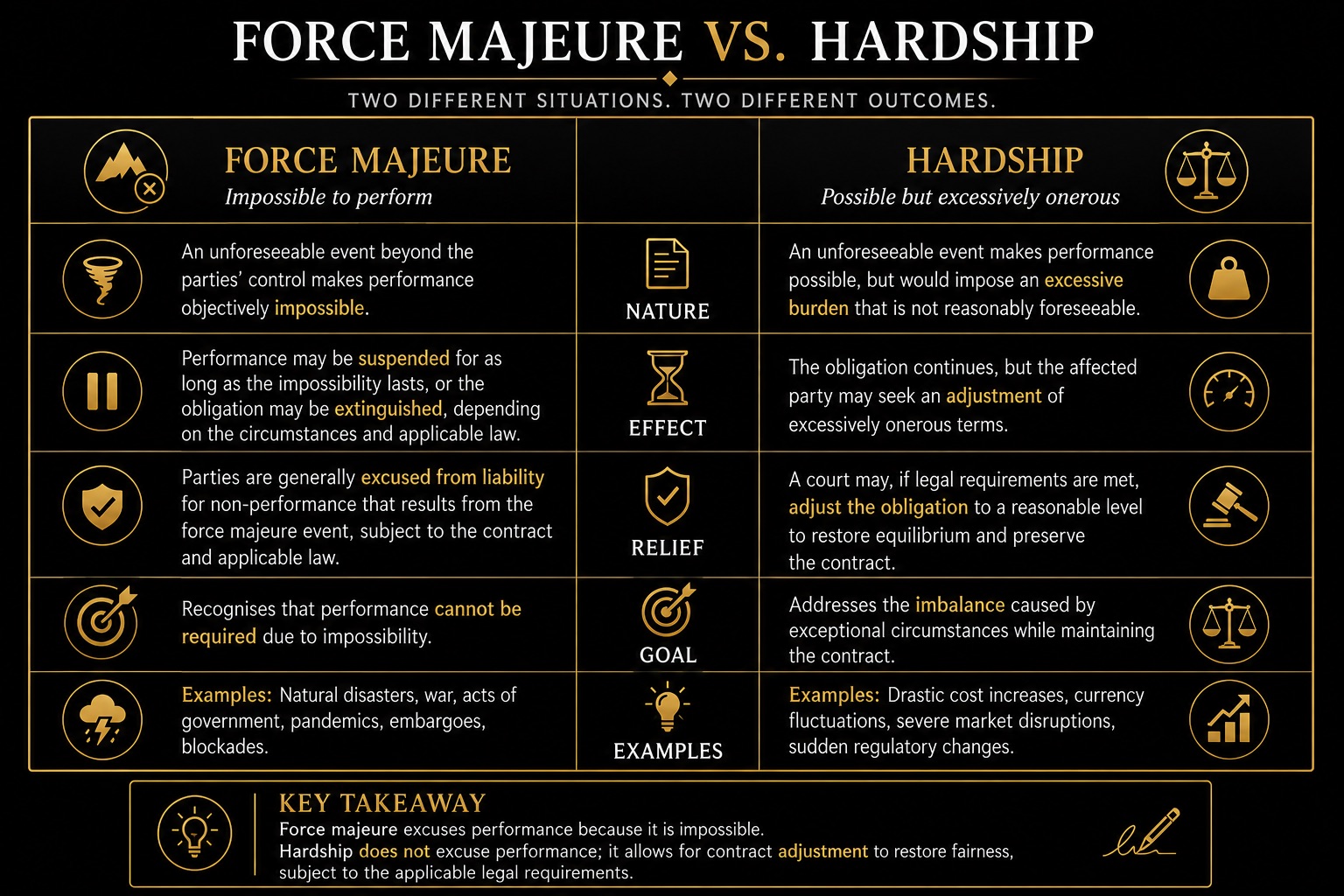
The new Civil Transactions Law retains the important distinction between circumstances that make contractual performance impossible and circumstances that make performance exceptionally burdensome.
Force majeure generally concerns circumstances in which performance becomes impossible under the applicable legal requirements. Exceptional general circumstances address a different situation: performance remains possible, but qualifying extraordinary and unforeseeable circumstances make the obligation excessively onerous.
Where the statutory requirements for exceptional general circumstances are satisfied, the court may intervene to restore contractual balance in accordance with the remedies provided by the law. The existence of increased costs, reduced profitability, or commercial difficulty should not therefore be assumed, by itself, to establish entitlement to judicial relief. For commercial parties, generic force majeure clauses therefore deserve scrutiny. A clause copied from another jurisdiction may not reflect the legal framework applicable to the UAE contract.
Businesses should consider how their agreements address triggering events, causation, notification requirements, mitigation, temporary versus permanent disruption, price escalation, supply-chain alternatives, suspension, renegotiation, termination, and allocation of costs during the affected period. The practical objective is not to predict every possible crisis. It is to establish a process for responding when circumstances change.
Long-term supply, infrastructure, construction, distribution and service agreements deserve particular attention because relatively small changes in cost or availability can become substantial over several years. Recent geopolitical and economic disruption has demonstrated that contract resilience should no longer be treated as an abstract drafting exercise. It has become an operational issue.
Liability, Damages and Contractual Risk Allocation
One of the principal functions of a commercial contract is to allocate risk before something goes wrong; companies negotiate liability caps, indemnities, exclusions, warranties, liquidated damages and insurance requirements precisely because they want greater certainty regarding the financial consequences of breach. The new Civil Transactions Law should prompt businesses to reconsider whether those mechanisms operate as intended.
A particularly important area concerns pre-agreed compensation, commonly described in international commercial contracts as liquidated damages. Article 340 of the new Civil Transactions Law preserves the parties’ ability to determine compensation in advance while maintaining judicial supervision over the amount ultimately recoverable. Depending upon the circumstances and evidence concerning the loss suffered, the court may adjust agreed compensation in accordance with the statutory framework. Businesses should therefore avoid treating a liquidated damages figure as automatically determinative merely because it appears in the contract.
This matters well beyond construction contracts. Agreed compensation mechanisms may appear in distribution agreements, technology implementation contracts, logistics arrangements, service agreements, outsourcing contracts and other relationships where parties want greater certainty regarding the financial consequences of delay or non-performance. Companies should avoid inserting arbitrary figures simply because they appeared in a previous contract. The commercial rationale for agreed compensation should instead be considered and documented when the agreement is negotiated.
The same discipline should extend to the wider liability regime, a contract review should examine whether exclusions, indemnities and liability caps operate coherently rather than as isolated clauses. For example, an agreement may contain a general liability cap but separate indemnities that appear unlimited. Another may exclude consequential loss without clearly addressing the categories of loss that matter most to the particular transaction. Risk allocation should reflect the commercial relationship. A standard clause library can be useful, but it should not substitute for transaction-specific analysis.
Termination Should Be Designed Before the Relationship Deteriorates
Termination provisions are often negotiated at the end of the drafting process, despite the ability to leave a commercial relationship being potentially as important as the ability to enter one. Businesses should understand both their contractual termination rights and the mandatory legal framework that may affect those rights. The contract should distinguish clearly between different exit scenarios. Termination for material breach is different from termination following insolvency. Termination after prolonged force majeure is different from termination for convenience. Expiration is different from early termination. Each may require different notice, cure and procedural mechanisms.
The consequences of termination also deserve attention. Businesses should establish what payments become immediately due, who owns work completed before termination, what happens to confidential information, whether licences terminate automatically, whether customer data must be returned, whether outstanding purchase orders survive, which warranties and indemnities continue, and how ongoing disputes will be handled. Poorly drafted termination clauses frequently move uncertainty from the commercial relationship into the dispute that follows it. Companies reviewing their UAE contracts in 2026 should therefore examine the entire termination architecture rather than searching for a single termination provision.
Limitation Periods Can Change Litigation Strategy
Contract management does not end when a dispute emerges. Businesses also need to understand how long claims remain actionable. The new Civil Transactions Law introduces changes affecting limitation periods across different categories of claims, and its transitional provisions make this particularly relevant to matters that arose before 1 June 2026 but were not already time-barred.
This is an area where generalisation can be dangerous. Different causes of action and contractual relationships may be subject to different periods, while specialised legislation may also apply.
Companies should not assume that a claim arising under a contract concluded before 1 June 2026 necessarily retains the limitation period that would previously have applied. The Decree-Law contains specific transitional rules governing limitation periods that were already running when the new law entered into force, making the timing of existing and potential claims an important part of the 2026 legal review.
International businesses should therefore avoid assuming that a limitation period used in another jurisdiction applies to UAE claims or that the period applicable under the previous Civil Code necessarily remains unchanged.For significant disputes, potential claims should be identified early. The relevant contract, applicable legislation, date on which the claim arose and any interruption or suspension issues should be reviewed before commercial negotiations consume valuable time. A strong claim can still become a weak recovery strategy if limitation is considered too late.
Cross-Border Contracts Require More Than a UAE Template
International companies rarely operate through purely domestic relationships. A UAE subsidiary may contract with a European supplier, an Asian manufacturer, a US technology company or a regional distributor covering several GCC markets, this creates another layer of contractual analysis. The parties must determine which law governs the agreement, which courts or arbitral tribunal will resolve disputes, and how any resulting judgment or award may ultimately be enforced.
These questions should not be treated as interchangeable. Governing law determines the substantive legal framework applicable to the contract. Jurisdiction determines where disputes are heard. Arbitration clauses establish a private dispute-resolution mechanism whose seat, institutional rules and procedural architecture may have substantial consequences. Enforcement determines whether the successful party can actually recover against assets. For international contracts involving the UAE, these decisions should be made deliberately, An English-language agreement does not need English law merely because the drafting originated in London. Similarly, choosing UAE law does not automatically require litigation before a particular UAE court. Depending on the transaction, parties may consider onshore UAE courts, arbitration, DIFC-related arrangements or other appropriate dispute-resolution mechanisms.
The correct structure depends on the transaction, counterparties, assets, regulatory context and enforcement strategy and the new Civil Transactions Law makes this analysis more important because businesses should understand whether their contract falls within the new onshore framework before assuming its provisions apply.
Which UAE Commercial Agreements Should Companies Review in 2026?
A company with hundreds or thousands of contracts cannot realistically renegotiate every agreement simultaneously, nor should it. A risk-based review is more effective.
Distribution and Agency Agreements
These agreements frequently create long-term commercial dependence and may involve exclusivity, territory, minimum purchases, marketing obligations, intellectual property rights and termination restrictions. Companies should review authority, performance standards, renewal mechanisms, termination rights, compensation provisions and the interaction with any specific UAE legislation governing the relationship.
Supply and Procurement Agreements
Long-term supply contracts deserve particular attention to price adjustment, delivery obligations, hardship, force majeure, alternative sourcing, quality requirements, inspection, notice procedures and termination. International supply chains make these provisions commercially significant.
Master Services and Framework Agreements
Businesses should review the relationship between the master agreement and subsequent purchase orders or statements of work. Priority clauses, formation mechanisms and amendment procedures should be unambiguous.
Joint Venture and Shareholder Agreements
These agreements should be examined not only as contracts but within the wider UAE corporate framework. Governance, reserved matters, funding obligations, transfer restrictions, deadlock, exit rights and dispute resolution require careful alignment.
Technology, SaaS and Licensing Agreements
Digital businesses should review service levels, implementation obligations, data responsibilities, intellectual property ownership, licensing scope, confidentiality, limitation of liability, termination assistance and the consequences of service disruption.
Guarantees
The new Civil Transactions Law reorganises aspects of the legal framework governing guarantees. Businesses using parent guarantees, personal guarantees or other security arrangements should ensure that their documents reflect the current legal regime rather than relying automatically on legacy templates.
Construction and Project Agreements
Construction and project agreements warrant a dedicated review because the new Civil Transactions Law substantially reorganises the legal framework governing muqawala, or contracts for works, under Articles 812 to 839. These provisions address matters affecting project delivery, including defective performance, termination, contractor and employer rights, unforeseen circumstances, and other aspects of contracts for works. Developers, contractors, consultants, investors and companies involved in major construction or engineering projects should therefore undertake a specialised review of their agreements rather than relying solely on a general commercial-contract assessment.
The priority should ultimately follow exposure. A low-value agreement used occasionally may not justify immediate attention, while a master agreement governing tens of millions of dirhams of annual business clearly warrants greater scrutiny.
A Practical 2026 Contract Review Matrix
| Contract Area | Potential Risk | What Should Be Reviewed |
| Pre-contract negotiations | Liability before signature | Negotiation procedures, disclosure, confidentiality and LOIs |
| Authority | Commitments made by inappropriate personnel | Delegations, powers of attorney and signing policies |
| Contract formation | Uncertainty over when obligations become binding | Offer, acceptance and electronic contracting procedures |
| Framework agreements | Conflicting master and downstream terms | Document hierarchy, SOWs, purchase orders and amendments |
| Interpretation | Ambiguous or imported terminology | Definitions, obligations and UAE-law compatibility |
| Force majeure | Clause does not address actual disruption | Events, notices, mitigation, suspension and termination |
| Hardship | Performance becomes exceptionally onerous | Price adjustment and renegotiation mechanisms |
| Agreed compensation | Contractual figure may be subject to judicial supervision | Commercial basis, drafting and supporting documentation |
| Liability | Inconsistent risk allocation | Caps, exclusions, indemnities and insurance |
| Termination | Exit creates further disputes | Notice, cure periods, consequences and surviving obligations |
| Limitation | Claims pursued too late | Applicable periods and transitional rules |
| Dispute resolution | Judgment or award difficult to enforce | Governing law, jurisdiction, arbitration and asset location |
The purpose of this review is not to make every contract more complicated. It is to identify where contractual language and business processes no longer match the company’s actual legal exposure.
Four Situations International Companies Should Consider
Scenario 1: Negotiations Collapse After Months of Due Diligence
An international company spends several months negotiating a strategic UAE partnership. Sensitive commercial information is exchanged, senior executives make representations regarding the proposed transaction, and the parties progress through several advanced drafts. The transaction ultimately does not proceed.
The legal analysis should not begin and end with the fact that no definitive agreement was signed. The parties’ conduct during negotiations, disclosure of relevant information, treatment of confidential material and circumstances surrounding withdrawal may all require examination under the new framework.
Scenario 2: A Legacy Master Agreement Generates New Transactions
A company entered into a master supply agreement before 1 June 2026. After the new law came into force, the parties continue issuing substantial purchase orders and later amend pricing and performance obligations. It would be unsafe simply to assume that every aspect of the relationship is governed exclusively by the legal position existing when the original master agreement was signed. The structure of the agreement, nature of subsequent transactions and amendments should be reviewed individually.
Scenario 3: A Regional Executive Makes a Commercial Commitment
A senior regional executive negotiates a substantial agreement and communicates acceptance to the counterparty electronically. Internally, however, the executive’s formal signing authority is limited. The resulting dispute may involve more than the wording of the final document. The company’s delegation framework, communications, representations of authority and contracting procedures may become relevant.
Scenario 4: A Long-Term Contract Becomes Commercially Onerous
A supplier enters a multi-year agreement at fixed prices. An exceptional and unforeseeable general event later causes input costs to increase dramatically. Performance remains possible but becomes substantially more burdensome. The legal analysis therefore differs from a straightforward force majeure situation in which performance has become impossible. The contract’s price-adjustment, hardship, renegotiation and termination mechanisms should be considered alongside the applicable statutory framework.
These examples illustrate why the new Civil Transactions Law should not be approached solely as a drafting issue. It is also a matter of commercial behaviour, internal governance and contract administration.
What Legal, Procurement and Management Teams Should Do Now
For large organisations, implementing the new legal framework should be a coordinated exercise, the legal department should identify high-value UAE-law contracts, review templates, reconsider standard clauses and establish guidance for significant negotiations.
Procurement teams should understand that purchase orders, framework agreements, supplier communications and variations can create contractual consequences. Standard procurement documentation should therefore be aligned with the organisation’s master contractual framework. Sales and business-development teams should receive guidance on negotiation conduct, confidentiality, representations and authority. Statements made during advanced commercial discussions should not be treated as legally irrelevant simply because the final agreement remains unsigned. Senior management should ensure that delegation and signing authorities are clear, current and consistent with how the organisation actually conducts business. Finance teams should also be involved where contracts contain guarantees, agreed damages, price-adjustment mechanisms or substantial contingent liabilities.
The most effective response is not a mass rewriting exercise. It is a controlled contract-governance programme. Companies should identify their most important relationships, determine where the new legislation materially affects risk, and update both documents and internal procedures accordingly.
How ASMA Supports International Commercial Contracting
International commercial contracts should reflect more than the immediate transaction. They should account for how the relationship will operate, how risk will be allocated, how decisions will be documented, how unexpected circumstances will be managed, and what happens if the relationship eventually breaks down.
ASMA Ali Al Messabi Advocates & Legal Consultants advises UAE and international businesses on the negotiation, drafting, review and restructuring of commercial agreements across a range of sectors and cross-border relationships.
Our work may include commercial and corporate agreements, shareholder and joint venture arrangements, distribution and supply contracts, technology and licensing agreements, contractual risk allocation, corporate governance, regulatory considerations and dispute-resolution provisions.
Following the introduction of the new Civil Transactions Law, businesses with significant UAE contractual exposure should consider whether their existing templates, negotiation procedures and high-value agreements remain aligned with the current legal framework.
The objective should not simply be compliance. It should be contractual resilience.
Commercial Contracting in the UAE Has Entered a New Phase
The UAE’s new Civil Transactions Law should not be understood merely as the replacement of one statute with another. For businesses, its significance lies in the way it addresses the commercial relationship from its earliest stages. Negotiations, disclosure, authority, contract architecture, performance and changing circumstances can all affect the legal and commercial position. How a company manages these issues before a dispute arises may ultimately prove more important than the remedies available after one begins. International companies should therefore resist the temptation to respond by simply adding new clauses to existing templates.
A more effective approach is to examine how contracts move through the organisation from negotiation and approval to signature, performance, amendment, renewal and termination. For businesses with substantial UAE operations, this creates an opportunity to modernise contract governance at the same time as the legal framework itself is being modernised.
The strongest commercial contracts are not necessarily the longest. They are the agreements that clearly reflect the transaction, allocate risk deliberately, anticipate change, and provide both parties with a workable framework when circumstances do not develop exactly as expected. In 2026, that standard has become increasingly important for international companies doing business under UAE law.

Frequently Asked Questions
When did the new UAE Civil Transactions Law come into force?
Federal Decree-Law No. 25 of 2025 came into force on 1 June 2026 and replaced the previous Civil Transactions Law established under Federal Law No. 5 of 1985. The reform represents the most substantial recodification of the UAE’s civil law framework in decades.
Do companies need to rewrite every UAE contract signed before 1 June 2026?
No. Contracts concluded before 1 June 2026 do not generally become subject to the new law simply because the legislation has entered into force. However, renewals, substantial amendments and new transactions concluded after that date may require individual analysis. The Decree-Law also contains specific transitional provisions concerning limitation periods.
A risk-based review is therefore more appropriate than automatically replacing every existing agreement.
Can a company be liable during contract negotiations even if no agreement is signed?
Potentially, yes. Articles 121 and 122 establish an important statutory framework around pre-contractual conduct, including good-faith negotiations and disclosure. The fact that negotiations do not result in a final contract does not necessarily mean that the parties’ conduct during those negotiations has no legal consequences. This makes careful management of advanced negotiations, due diligence, confidential information and letters of intent particularly important.
Are electronic contracts recognised under the new UAE contractual framework?
The new Civil Transactions Law accommodates modern methods of contracting, while electronic transactions are also governed by separate UAE legislation concerning electronic transactions and trust services.Businesses should distinguish between the technical ability to execute an agreement electronically and the legal authority of the individual entering into it. Internal signing authorities, delegations and powers of attorney should remain clear.
Can UAE courts modify agreed liquidated damages under Article 340?
Yes. The new Civil Transactions Law continues to permit parties to agree compensation in advance, but the contractual figure should not be regarded as automatically determinative in every case. Article 340 maintains judicial supervision over agreed compensation, and the amount recoverable may be adjusted in accordance with the statutory requirements and evidence concerning the loss suffered. International companies should therefore review both the drafting and commercial rationale of liquidated damages provisions rather than automatically carrying forward figures contained in legacy contract templates.
What is the difference between force majeure and exceptional circumstances?
The concepts address different levels of contractual disruption. Force majeure generally concerns circumstances in which performance becomes impossible under the applicable legal requirements Exceptional general circumstances concern a different situation in which performance remains possible but qualifying extraordinary and unforeseeable circumstances make the obligation excessively onerous. Where the statutory requirements are satisfied, the remedies available may differ. Increased costs or reduced profitability alone should not automatically be assumed to satisfy those requirements.
Should international companies continue using their global contract templates in the UAE?
Global templates can provide a useful starting point, but they should not simply be transplanted into UAE transactions. Clauses developed for English, US or other legal systems may rely on concepts or remedies that do not operate identically under UAE law. High-value agreements should therefore be reviewed for compatibility with the applicable UAE legal framework, particularly where the agreement is governed by onshore UAE law.
Which contracts should businesses review first?
Companies should prioritise contracts according to financial, operational and legal exposure. Long-term supply agreements, distribution arrangements, joint ventures, shareholder agreements, master services agreements, technology contracts, guarantees, construction agreements and other strategically important relationships generally deserve priority. The review should consider not only the contract itself but also the negotiation, approval, amendment, renewal and termination procedures surrounding it.
Does the new Civil Transactions Law apply in DIFC and ADGM?
Not necessarily. The applicable legal framework depends on the jurisdiction in which the relationship operates, the nature of the transaction, the governing law agreed between the parties, and any mandatory or sector-specific legislation that applies.
The Dubai International Financial Centre (DIFC) and Abu Dhabi Global Market (ADGM) require particular attention because they are financial free zones with their own civil and commercial legal frameworks. A commercial agreement involving a DIFC entity or activities within the DIFC may therefore be governed by DIFC law rather than automatically falling under the federal Civil Transactions Law. DIFC also has its own contract legislation and court system.
ADGM similarly operates under a distinct legal framework based substantially on English common law together with ADGM legislation and regulations. Contracts connected with ADGM entities, activities or transactions may therefore require analysis under the ADGM framework rather than the federal Civil Transactions Law.
Other UAE free zones should not automatically be treated in the same way. Incorporation in a non-financial free zone does not by itself create a separate civil and commercial legal system comparable to DIFC or ADGM. Commercial agreements involving companies established in other UAE free zones may therefore remain subject to the federal UAE legal framework, alongside applicable free-zone regulations and any specialised legislation governing the particular activity.
International companies should consequently establish whether a contract falls within the federal UAE framework, DIFC law, ADGM law, or another specialised regulatory regime before assessing how the new Civil Transactions Law affects the agreement.
Published by ASMA Ali Al Messabi Advocates & Legal Consultants
Legal Insights | Updated August 2026